


If you’re a founder or HR lead at a growing startup or MSME, you’ve probably had this thought:
“We’ll fix the HR paperwork once we scale.”
But here’s the hard truth: Compliance doesn’t wait for you to be ready.
You could be 7 people or 70 — one mishire, one complaint, or one angry exit is all it takes to put your business at legal risk. And not the abstract kind. We’re talking fines, operational halts, investor scrutiny, and a damaged reputation you can’t bounce back from.
Still, most founders push HR policies to the bottom of their to-do list. Why?
Because legal compliance feels slow, expensive, and “not urgent”. Until it becomes the only thing that matters.
This article will walk you through 5 critical HR legal policies that Indian MSMEs and startups often delay and the very real cost of that delay.
We’ll go beyond the legalese into the messy, human, operational reality of what happens when these policies don’t exist and how to fix it without hiring an army of lawyers.
Table of Contents
Toggle1. Employee Contracts— Your First Line of Defense
Why it’s delayed:
Startups often treat hiring casually. A few excited chats over WhatsApp. An email with salary details. Maybe a generic offer letter grabbed from Google. That’s it.
Formal contracts? Too stiff. Too corporate. “We’re building something cool, not filing for IPO,” right?
But here’s where it breaks down.
Why that’s risky:
Without a proper employment contract:
- You can’t enforce notice periods.
- You can’t protect confidential data or IP.
- You can’t prevent them from joining a competitor the next day.
- You may even be unable to prove the person ever worked for you — legally.
Real-life mess:
A startup in Hyderabad onboarded a brilliant tech lead through a simple email offer. Three months in, he walked out with key client data and code access — and joined a direct competitor.
They wanted to sue. But their lawyer said:
“There’s no signed contract. No confidentiality clause. No legal footing.”
They lost time, money, trust — and eventually, the client.
What you should do instead:
- Always issue a detailed, role-specific contract before Day 1.
- Include these must-have clauses:
- Confidentiality
- Intellectual Property (IP) Ownership
- Notice Period
- Non-solicitation (no poaching team or clients)
- Performance and termination terms
- Avoid free online templates. They often miss industry-specific clauses and won’t hold up in court.
Legal context:
Contracts in India are governed by the Indian Contract Act, 1872. For them to be enforceable:
- There must be mutual consent
- It should be signed by both parties
- And it must clearly define rights and responsibilities
Without a valid, signed employment contract, most legal disputes around termination, IP, or notice periods become difficult to defend in court.
Why this matters for CEO & MSME founders:
This is the foundation of HR legal compliance for MSMEs in India. If you only fix one thing this quarter, fix this.
2. POSH Policy — The Policy You Hope You’ll Never Need (But Legally Must Have)
Why it’s often ignored:
“We’re a close-knit team. Nothing like that would ever happen here.”
This is the most common (and dangerous) belief among small companies. The idea that POSH compliance is for bigger teams or toxic cultures — not your friendly startup.
But harassment doesn’t care how friendly your vibe is.
What actually happens:
A casual joke lands wrong. A manager oversteps a boundary. An intern doesn’t know who to report to. And suddenly, you’re in the middle of a formal complaint — with no Internal Complaints Committee (ICC), no documented policy, and no training record.
That’s not just bad optics. It’s a legal violation.
True story:
A Mumbai digital agency brushed off POSH training. Then a harassment complaint landed. With no ICC in place, the complainant went public. The result? Public backlash, lost clients, and a compliance fine they didn’t see coming.
What the law says:
The POSH Act, 2013 kicks in once you hit 10 or more employees — even if some are part-time or consultants. You’re required to:
- Form an ICC (with at least one external member).
- Publish and communicate your POSH policy.
- Conduct annual training — and keep records.
Why it matters:
This isn’t just about legal protection. It’s about creating psychological safety at work. And for investors or enterprise clients, it’s one of the first things they’ll ask about during due diligence.
3. Termination & Exit: No More “Bro, It’s Not Working Out” Conversations
Why it’s overlooked:
Firing someone feels personal. Awkward. You tell yourself, “Let’s just keep it informal.” One email or a short call — done.
But when the employee challenges the exit, things unravel fast.
What can go wrong:
- No documented proof of poor performance.
- Delayed full & final (FnF) settlement.
- Social media drama. Labour office complaints. Legal notices.
Actual case:
A Bengaluru SaaS company laid off two underperformers over email — no formal warning, no process. One escalated the matter. The labor department got involved. The company paid penalties, and word spread on LinkedIn. Future hiring took a hit.
What to fix:
- Build a paper trail: performance reviews, warnings, improvement plans.
- Create a basic exit checklist:
- Laptop/data handover
- Revoke software access
- Issue reliving letters on time
- Document everything
- Follow notice periods and calculate dues transparently.
Relevant law:
The Industrial Disputes Act, 1947 governs fair dismissal, especially if the employee’s role falls under “workman” criteria. But even for others, wrongful termination can lead to lawsuits or settlement payouts.
Why founders should care:
Exit is when your employer brand is most vulnerable. Get this wrong, and even happy ex-employees won’t recommend you.
4. Leave and Attendance: Freedom Needs a Framework
Why it’s left loose:
You want to be the “cool” founder. “No leave tracking, no micromanaging — we trust the team.”
Great in theory. But without structure, flexibility becomes confusion.
Where it goes wrong:
- Two key people vanish during a product release.
- Disputes over how many days are actually left.
- Payroll mismatches and tax slip-ups.
Case in point:
A Noida-based D2C brand had no formal leave policy. In December, during their peak season, three operational staff took long leave — back-to-back. There was no backup. Orders got delayed, ratings tanked, and the Flipkart algorithm punished them.
Better approach:
- Define leave types: sick, casual, earned, and optional holidays.
- Decide on carry-forward, encashment, and notice period for planned leave.
- Sync with an attendance or payroll system (even a basic Google Sheet works).
Legal angle:
The Shops and Establishments Act (varies by state) mandates minimum leave entitlements. Ignoring this can lead to fines during inspections or labor disputes.
Why it’s strategic:
Formal leave policies aren’t about control — they’re about making chaos predictable, especially as your team grows.
5. PF, ESIC & Gratuity: Small Teams Still Have Big Legal Duties
Why MSMEs delay it:
“Statutory benefits? We’ll do that after we hit 50+ employees.”
But the law says otherwise.
- PF becomes mandatory once you have 20 or more employees.
- ESIC kicks in at just 10 employees, depending on salary limits.
- Gratuity is applicable after 5 years of continuous service — but you must be registered if you expect team members to stay long-term.
What happens if you ignore it:
- Employees file backdated claims after leaving.
- Surprise inspections from EPFO or ESIC.
- Arrears, penalties, and interest payments that hit your cash flow hard.
One example:
An Ahmedabad MSME deferred PF registration to save money. Then an employee quit, discovered the missing PF, and filed a complaint. EPFO slapped the company with ₹6 lakh in dues and interest. It strained their finances and reputation.
Do this instead:
- Register for EPF, ESIC, and Gratuity when you cross headcount thresholds.
- Calculate contributions in the employee’s CTC from Day 1.
- Mention all benefits in the offer letter or onboarding doc — clarity builds trust.
Legal support:
- EPF Act, 1952
- ESI Act, 1948
- Gratuity Act, 1972
Why it matters:
These aren’t just compliance checkboxes — they’re how you show employees they’re not disposable. That’s how startups retain talent in a poaching-heavy market.
MSME HR Compliance Quick Checklist
✅ Signed employee contracts
✅ POSH policy + ICC setup
✅ Exit protocols documented
✅ Leave policy synced with payroll
✅ Statutory benefits (PF, ESIC, Gratuity) registered
Compliance isn’t Just Legal — It’s Strategic
Gaps in HR compliance don’t just trigger fines. They impact how people see and trust your company. A poorly handled exit can result in a scathing Glassdoor review. A missing POSH policy can raise red flags during a funding round. Investors and senior hires notice when your HR foundations are shaky — and they may walk away. In today’s startup ecosystem, your ability to attract capital and talent depends on whether your house is in order behind the scenes.
What’s at Stake: Reputation, Retention & Risk
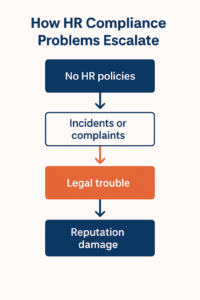
Here’s what founders often underestimate:
- Bad exits = Bad Glassdoor reviews.
One poorly handled termination can spiral into a public rant that hurts future hiring.
- Missing POSH policy = Funding red flag.
During diligence, investors do ask about internal complaints, ICC formation, and training records. If you fumble this, they walk.
- No contracts = Broken trust with senior hires.
High-value candidates (especially CXOs) notice when your basics aren’t in place. And they’ll pass.
Compliance is your reputation insurance. And the cost of getting it wrong isn’t just legal — it’s cultural and financial.
Fixing it later is how you fall behind
HR legal compliance for MSMEs in India isn’t just for big companies. It’s for anyone who wants to build a lasting business.
Many MSME founders often overlook HR compliance. It feels complicated, expensive, or like something to “figure out later.” But later often means after a problem — and by then, it’s already costing you.
Without clear MSME HR policies, things go wrong fast. Contracts are unclear. Exits get messy. Teams lose trust. Investors ask hard questions. Growth becomes stressful instead of exciting.
However, when you focus on employment compliance in India from the outset, everything changes.
You hire better. You avoid legal panic. You build trust — with your team, your clients, and your future investors.
You don’t need a fancy legal team or a 50-page manual. Just the right basics, done well.
Start now. Start small. But don’t wait. Because ignoring HR legal policies for startups doesn’t save you time — it creates risk. And fixing it later? That’s how businesses fall behind.
Want zero-stress compliance for your MSME?
We’ll help you set up HR policies that protect your team and your business.
HR Legal Experts can help.

Corporate Stalwarts is a trusted recruitment firm with 20+ years of expertise in executive search and leadership hiring.
We’ve placed 10,000+ candidates across 600+ companies in FMCG, Manufacturing, IT, Pharma, and more. Our 1M+ candidate pool and 48-hour turnaround enable fast, high-quality hiring solutions.
We help businesses build high-performance teams with precision, speed, and industry expertise.