



Why leadership hiring and lateral hiring are often confused
The confusion usually begins with intent.
Both leadership hiring and lateral hiring involve experienced professionals. Both may target senior titles. Both can involve similar compensation ranges. From the outside, the process can look similar.
The difference lies in what the organisation is actually trying to solve.
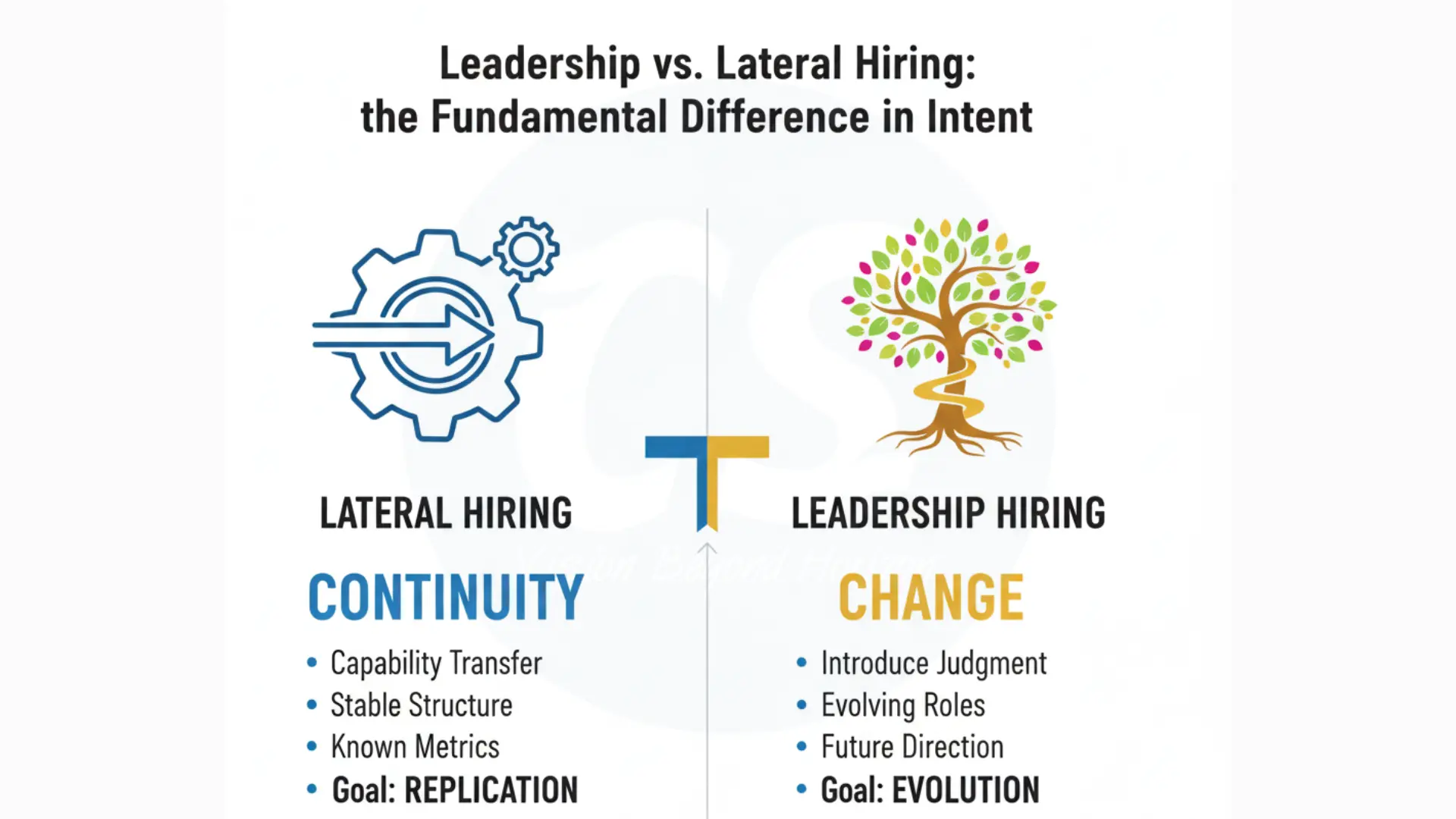
Lateral hiring is typically driven by continuity. Leadership hiring is driven by change.
When this distinction is missed, companies often use the right talent pool with the wrong hiring logic. The result is not immediate failure, but slow misalignment that becomes visible over time.
What lateral hiring is designed to do
Lateral hiring, at its core, is about capability transfer.
You are hiring someone to bring a defined skill set into an existing structure. The role is usually clear. Success metrics are known. The organisation expects the individual to integrate quickly and operate within established systems.
In this model, experience in a similar role matters deeply. Familiarity with industry norms helps. Speed to productivity is valued.
Lateral hiring works well when the business is stable, and the role already exists in a recognisable form. It is effective for strengthening teams, filling gaps, or scaling execution within a known direction.
Problems arise when lateral hiring is stretched beyond this purpose.
When organisations expect lateral hires to reshape strategy, recalibrate culture, or navigate ambiguity without redefining the role, the model begins to strain.
What leadership hiring is fundamentally different
Leadership hiring is not senior lateral hiring.
The objective is not just to bring in experience but to introduce judgment, direction, and decision-making capacity suited to where the organisation is going next.
In leadership hiring, the role itself is often still forming. The business may be entering a new phase, managing complexity it has not faced before, or rethinking how decisions are made at the top.
Here, experience alone is not enough.
What matters more is how leaders operate when clarity is incomplete. How do they make trade-offs? How do they influence without relying on existing authority? How do they align teams during transition?
This is why leadership hiring is closely linked to executive search but not identical to it. Executive search focuses on identifying senior talent. Leadership hiring focuses on suitability for context.
The distinction is subtle, but it determines outcomes.
Where companies go wrong in practice
Most leadership hiring challenges do not come from choosing the wrong person. They come from choosing the wrong hiring model.
When leadership roles are filled through lateral hiring, expectations often remain unspoken. The organisation assumes the leader will “figure it out.” The leader assumes the role is more defined than it actually is.

The mismatch shows up gradually.
This is why clarity between leadership hiring and lateral hiring matters long before a search begins.
How founders and CHROs should think about the difference
For founders, the question often surfaces during growth.
As the organisation scales, informal roles begin to formalise. Leadership expectations rise. The instinct is to hire someone who has “done this before.”
The real question is whether the organisation needs replication or evolution.
For CHROs, the challenge often appears during transition.
Mergers, restructuring, or leadership turnover create roles that look familiar on paper but behave very differently in reality. The decision is not about seniority but about readiness for ambiguity.
In both cases, clarity on the hiring model prevents downstream friction.
How leadership hiring partners approach this distinction
Leadership hiring partners operate differently from teams focused on lateral recruitment.
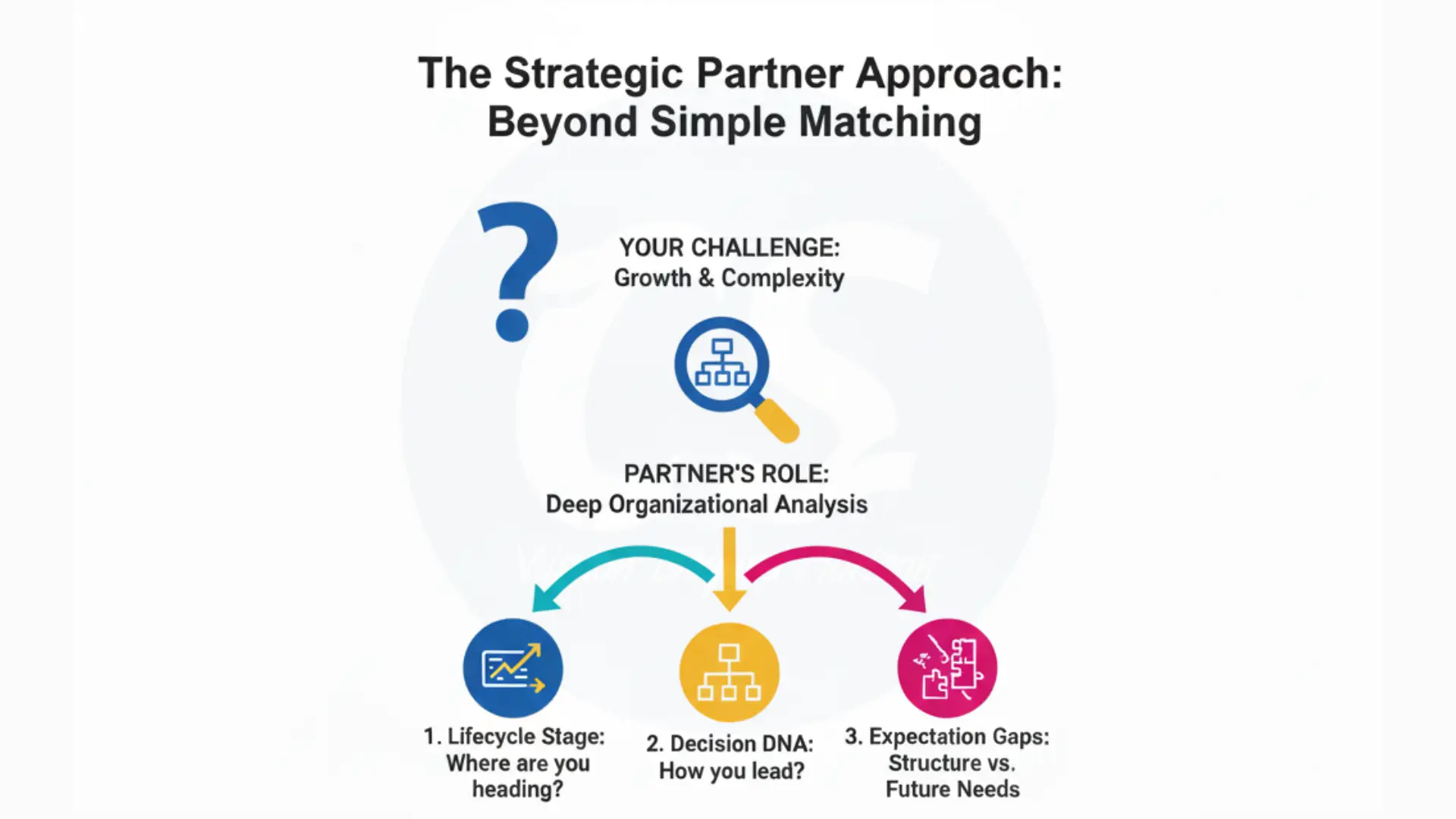
They spend time understanding where the organisation is in its lifecycle. They examine how leadership decisions are currently made. They look at where expectations are shifting faster than structure.
This allows them to guide whether a leadership hiring approach is required or whether lateral hiring will suffice.
At Corporate Stalwarts, this distinction shapes how we approach leadership hiring and executive search across India and global mandates. Our work focuses on aligning leadership capability with organisational context, not just matching profiles to roles.
This approach is particularly relevant for organisations navigating growth across markets such as Mumbai, Delhi NCR, and other leadership hubs in India, where scale and complexity often go hand in hand.
Choosing the right model before choosing a partner
The most important decision is not which firm to work with. It is the hiring model your situation requires.
In 2026, growing companies that invest time in making this distinction between leadership hiring and lateral hiring early are far more likely to build leadership teams that hold under pressure.
Before you engage any hiring partner, be clear about whether you need leadership hiring or lateral hiring. The outcome depends on it.


Corporate Stalwarts is a trusted recruitment firm with 20+ years of expertise in executive search and leadership hiring.
We’ve placed 10,000+ candidates across 600+ companies in FMCG, Manufacturing, IT, Pharma, and more. Our 1M+ candidate pool and 48-hour turnaround enable fast, high-quality hiring solutions.
We help businesses build high-performance teams with precision, speed, and industry expertise.