

What are RPO services, and how do they differ from staffing?
RPO services (recruitment process outsourcing) means giving part or all of your hiring work to an external partner. They work as an extension of your HR team. This is very different from staffing agencies that just fill individual jobs.
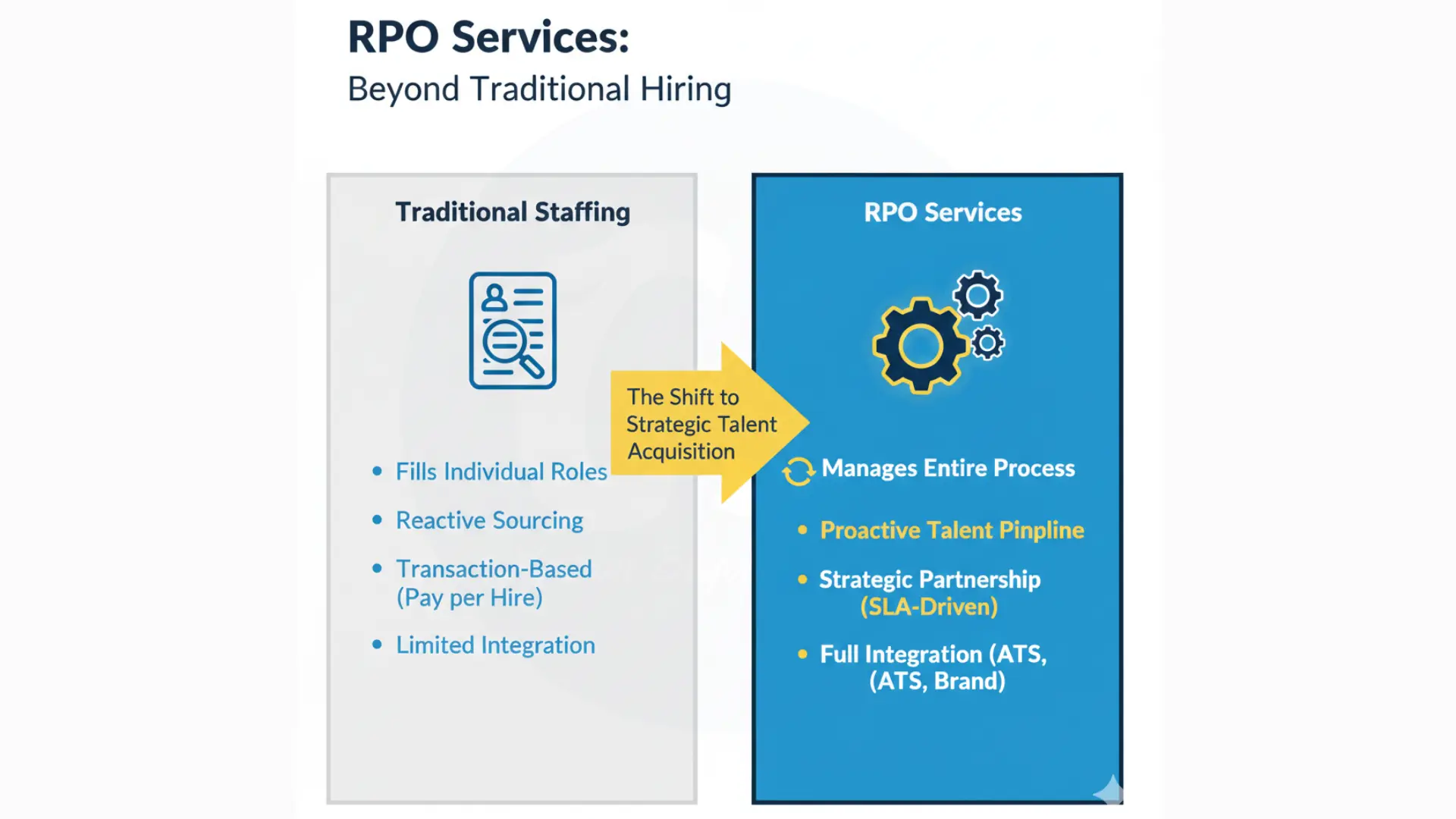
RPO providers manage your entire talent acquisition process. They handle workforce planning, employer branding, finding candidates, screening them, interviews, offers, and onboarding. Staffing agencies work on single roles. RPO partners integrate into your organisation, use your systems, and represent your employer brand.
The key difference is ownership:
Staffing agencies: Fill one role at a time. Work on commission. Source from their database. Represent multiple clients at once.
RPO providers: Own your recruitment process. Work on defined targets (SLAs). Build talent pools specific to your needs. Represent only your brand when talking to candidates.
Executive search: Handle senior leadership through retained contracts. These take months of engaging passive candidates.
RPO services: Manage volume hiring, specialised hiring, and everything from entry-level to mid-senior positions.
According to Corporate Stalwarts’ data, companies using RPO transform recruitment. It changes from reactive firefighting to proactive pipeline building. Talent becomes available before you need it, not after.
How do RPO services work in practice?
Recruitment process outsourcing operates through clear phases. SLA-driven execution and continuous improvement based on hiring metrics keep things working.
Phase 1: Discovery and process design (Weeks 1-4)
The RPO partner runs a complete needs assessment:
- Current hiring volumes by role, level, and location
- Time-to-fill and cost-per-hire benchmarks
- Quality of hire and retention metrics
- Pain points in your existing process
- Technology stack and ATS integration needs
- Hiring manager satisfaction levels
Based on this, they design workflows aligned to your goals. These might include reducing time-to-fill by 40%, improving quality of hire by 25%, cutting cost-per-hire by 30%, or building proactive pipelines for critical roles.
Phase 2: Team deployment and integration (Weeks 5-8)
RPO providers deploy dedicated recruiters. These people become extensions of your HR function:
- On-site presence in your Bangalore, Hyderabad, or Mumbai offices (for larger deals)
- Remote or hybrid teams for smaller volumes
- Access to your ATS, HRIS, and communication platforms
- Training on your employer’s value proposition, culture, and hiring standards
- Direct relationships with hiring managers
Unlike staffing agencies working from external databases, RPO recruiters work within your systems. They attend your team meetings and represent your brand exclusively.
Phase 3: Execution and optimisation (Ongoing)
Daily work includes:
- Proactive sourcing from job boards, LinkedIn, employee referrals, campus hiring, and passive candidate networks
- Resume screening using AI tools plus human judgment
- Initial phone screens and technical assessments
- Interview coordination with hiring managers across time zones
- Offer negotiation and closing
- Background verification and onboarding support
Weekly and monthly reporting:
- Pipeline health by role and stage
- Time-to-fill trending
- Source effectiveness (which channels deliver the best candidates)
- Offer acceptance and decline reasons
- Hiring manager feedback scores
According to Corporate Stalwarts’ RPO clients, this data-driven approach finds bottlenecks that internal teams miss. Examples: interviews scheduled but repeatedly cancelled, compensation misalignment, or job descriptions attracting the wrong candidates.
Phase 4: Continuous improvement
Every quarter, RPO partners analyse performance against targets. They recommend improvements:
- Adjusting salary bands based on market changes
- Refining job descriptions that underperform
- Expanding sourcing channels for hard-to-fill roles
- Automating repetitive tasks
- Enhancing candidate experience touchpoints

RPO services vs other hiring models: What’s the difference?
Understanding when to use each model matters more than knowing what each model does.
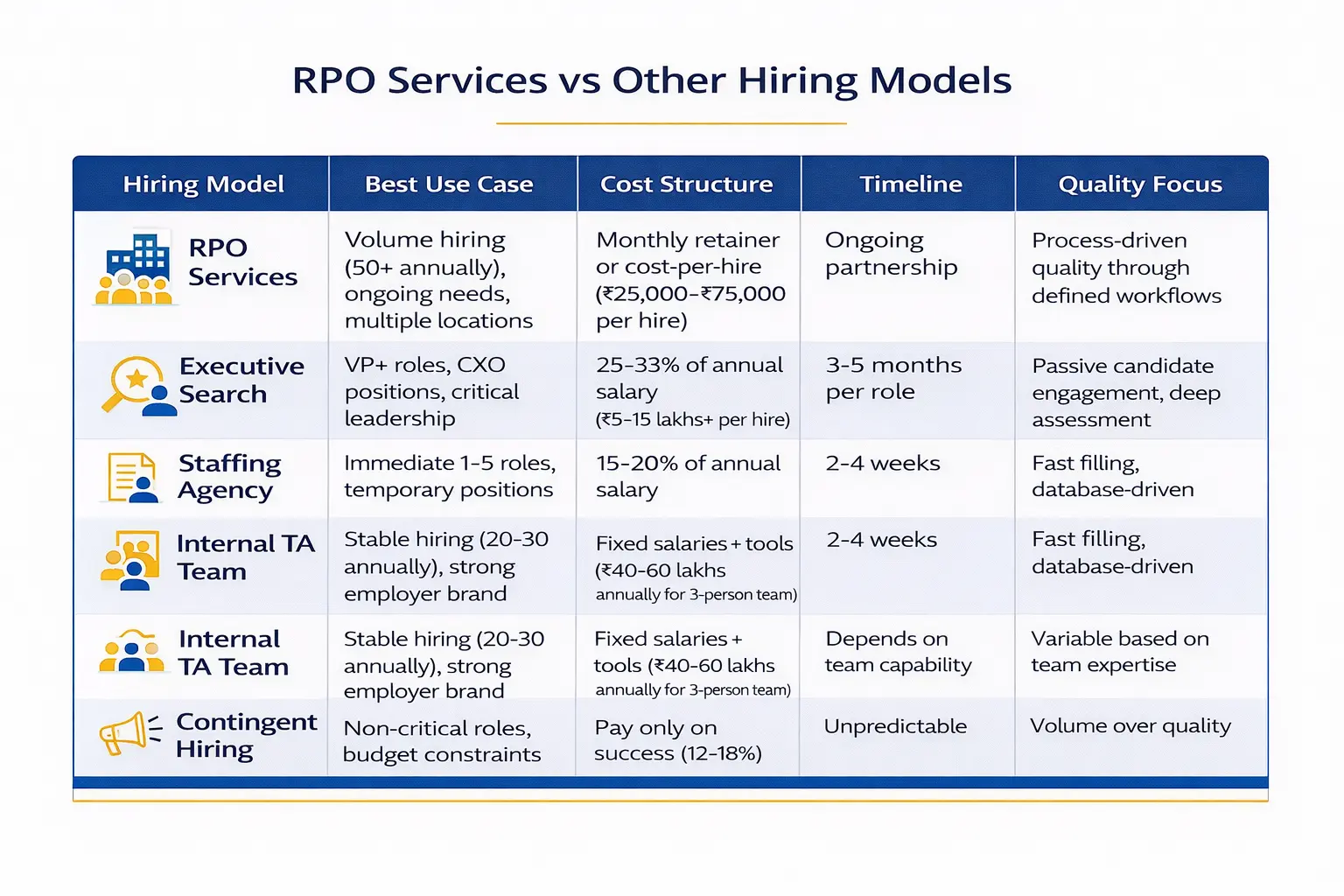
When to choose RPO over alternatives:
- Hiring volumes exceed 50 annually
- Need predictable recruitment costs
- Quality cannot be compromised for speed
- Internal team is overwhelmed or non-existent
- Expansion across multiple cities
- Specialised talent requires dedicated sourcing
When NOT to choose RPO:
- Hiring fewer than 20 people annually (fixed RPO costs don’t justify)
- All roles are senior leadership (executive search works better)
- The company lacks hiring clarity (RPO needs defined processes to manage)
- Organisation unwilling to integrate an external partner into its systems
Benefits of RPO services for growing companies
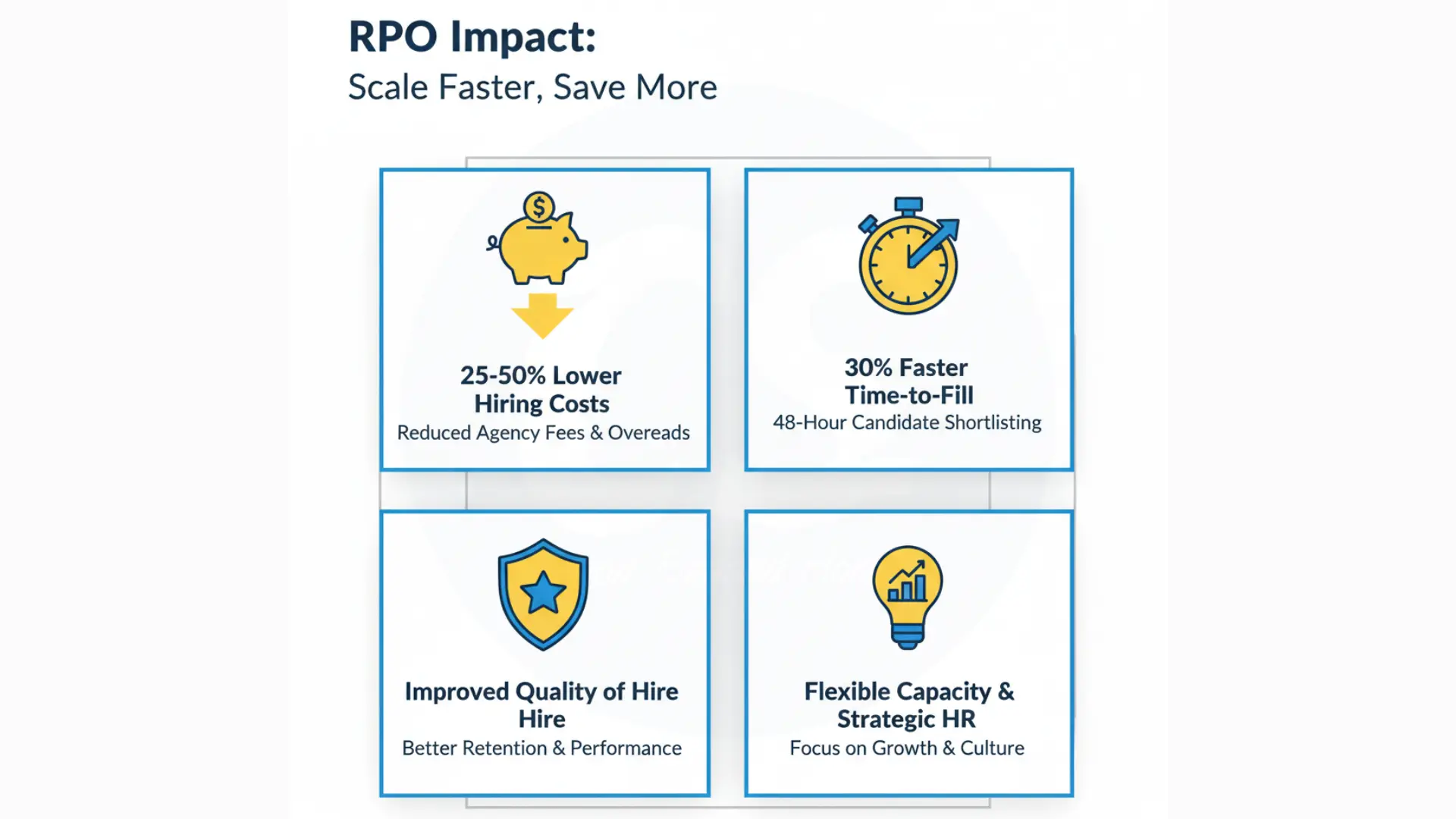
Recruitment process outsourcing delivers measurable improvements across speed, cost, quality, and strategic capability.
Faster time-to-hire
Corporate Stalwarts’ RPO clients experience 48-hour candidate shortlisting for standard roles through proactive talent pipelines. When positions open, pre-screened candidates already exist. As a result, this cuts time-to-fill dramatically.
Over 33% of global job placements now process through RPO platforms, reducing hiring cycles by 30%. The reason: dedicated sourcing runs continuously, not just when roles open.
Significant cost reduction
RPO typically reduces overall recruitment costs 30-50%. Here’s how:
Eliminating agency fees: Savings of 15-25% on placement fees for roles previously filled through contingent agencies
Economies of scale: RPO providers spread technology costs, job board subscriptions, and sourcing tools across multiple clients
Reduced administrative burden: No need to maintain full-time recruiters during slow hiring periods
Lower attrition costs: Better quality of hire reduces replacement hiring
Improved quality of hire
Structured processes, technical assessment capabilities, and data-driven screening improve candidate quality. Organizations report better cultural fits and higher performance from RPO hires compared to reactive hiring.
Methods that improve quality:
- Competency-based screening frameworks
- Structured interviews reduce bias
- Cultural fit assessment beyond resume screening
- Reference checking and background verification
Scalability and flexibility
Hiring capacity scales with business needs rather than remaining fixed. For example, a Bangalore startup hiring 10 people monthly can scale to 50 monthly during expansion. They don’t need to build permanent TA infrastructure.
This matters especially when companies expand to multiple cities. Hiring surges that internal teams cannot handle without quality compromise become manageable.
Access to advanced recruitment technology
RPO providers deploy AI-driven sourcing, applicant tracking systems, candidate relationship management, and analytics dashboards. These would cost individual companies ₹25-50 lakhs annually to license and maintain.
Strategic focus for HR teams
When recruitment moves to RPO partners, internal HR can focus on retention instead. They work on employee development, culture building, and workforce planning. They stop spending 60% of time on tactical hiring coordination.
When NOT to use RPO services: Honest limitations
RPO services solve specific problems. Understanding when they don’t fit saves time and money.
Your hiring is fewer than 20 people annually
Fixed RPO costs (even in cost-per-hire models) don’t justify for low volumes. A 3-person internal TA team or contingent recruiters work better.
Alternative: Use contingent hiring for specific roles, executive search for leadership, and internal referrals for cultural fits.
All your hiring is senior leadership (VP+)
RPO optimises for volume and process. Leadership hiring requires months-long passive candidate engagement, board-level discretion, and succession planning expertise.
Alternative: Partner with executive search firms specialising in CXO and VP-level mandates.
Your organisation lacks hiring clarity
RPO manages defined processes. If job descriptions change weekly, hiring managers contradict each other, or company culture remains undefined, RPO cannot optimise chaos.
Fix first: Establish clear job requirements, decision-making authority, and cultural values before engaging RPO.
You need 100% control over every hiring decision
RPO requires trust that external recruiters will represent your brand, screen candidates appropriately, and make recommendations. If you must personally review every resume and control every touchpoint, internal hiring suits you better.
Budget constraints prevent 6-12 month commitments
Most RPO agreements require minimum engagement periods to justify the integration effort and process setup. Month-to-month flexibility isn’t typical. Therefore, organisations need budget commitment for at least 6-12 months.
Alternative: Project RPO for defined hiring surges or contingent hiring with no commitment.
You’re hiring globally across 10+ countries with different regulations
RPO works best within defined geographies. Multi-country hiring with varying labour laws, languages, and compliance requirements requires specialised global recruitment solutions beyond standard RPO.
How to choose the right RPO partner in India
Selecting an RPO provider determines success. The wrong choice creates more problems than it solves.
Industry experience and sector expertise
Does the provider understand your industry’s talent market? A fintech’s engineering hiring differs from manufacturing’s operations hiring. Look for proven track records in your sector.
Questions to ask:
How many clients are in our industry?
Case studies showing similar hiring profiles?
Understanding of our competitive landscape for talent?
Technology capabilities and integrations
Can they integrate with your existing ATS, HRIS, and communication platforms? Do they use AI for sourcing and screening? What analytics and reporting do they provide?
Corporate Stalwarts’ RPO technology includes AI-driven candidate matching, automated screening workflows, and real-time hiring dashboards showing pipeline health across all roles and locations.
Presence in cities where you hire
Multi-location hiring requires local market expertise. A provider with recruiters in Bangalore, Hyderabad, Pune, Mumbai, and Delhi understands city-specific salary benchmarks, talent availability, and competitive dynamics.
Scalability and flexibility
Can they handle 20 hires this month, 50 next month, and 10 the month after without degrading quality? Look for proven ability to scale recruitment capacity quickly.
Cultural fit and communication
RPO recruiters represent your employer brand. Their communication style, professionalism, and cultural understanding must align with yours. Interview the actual recruiters who will work on your account.
Transparent pricing and SLA commitments
Beware of providers unwilling to commit to time-to-fill, quality of hire, or cost-per-hire metrics. Strong RPO partners operate on defined SLAs with consequences for missing targets.
References and client retention
Ask for references from current clients in similar industries and growth stages. 95% client retention indicates long-term partnership success, not just initial wins.
Work with Corporate Stalwarts for leadership hiring

Corporate Stalwarts is a trusted recruitment firm with 20+ years of expertise in executive search and leadership hiring.
We’ve placed 10,000+ candidates across 600+ companies in FMCG, Manufacturing, IT, Pharma, and more. Our 1M+ candidate pool and 48-hour turnaround enable fast, high-quality hiring solutions.
We help businesses build high-performance teams with precision, speed, and industry expertise.