

When do PF and ESI registration become mandatory?
This is one of the most common questions about employment law compliance India.
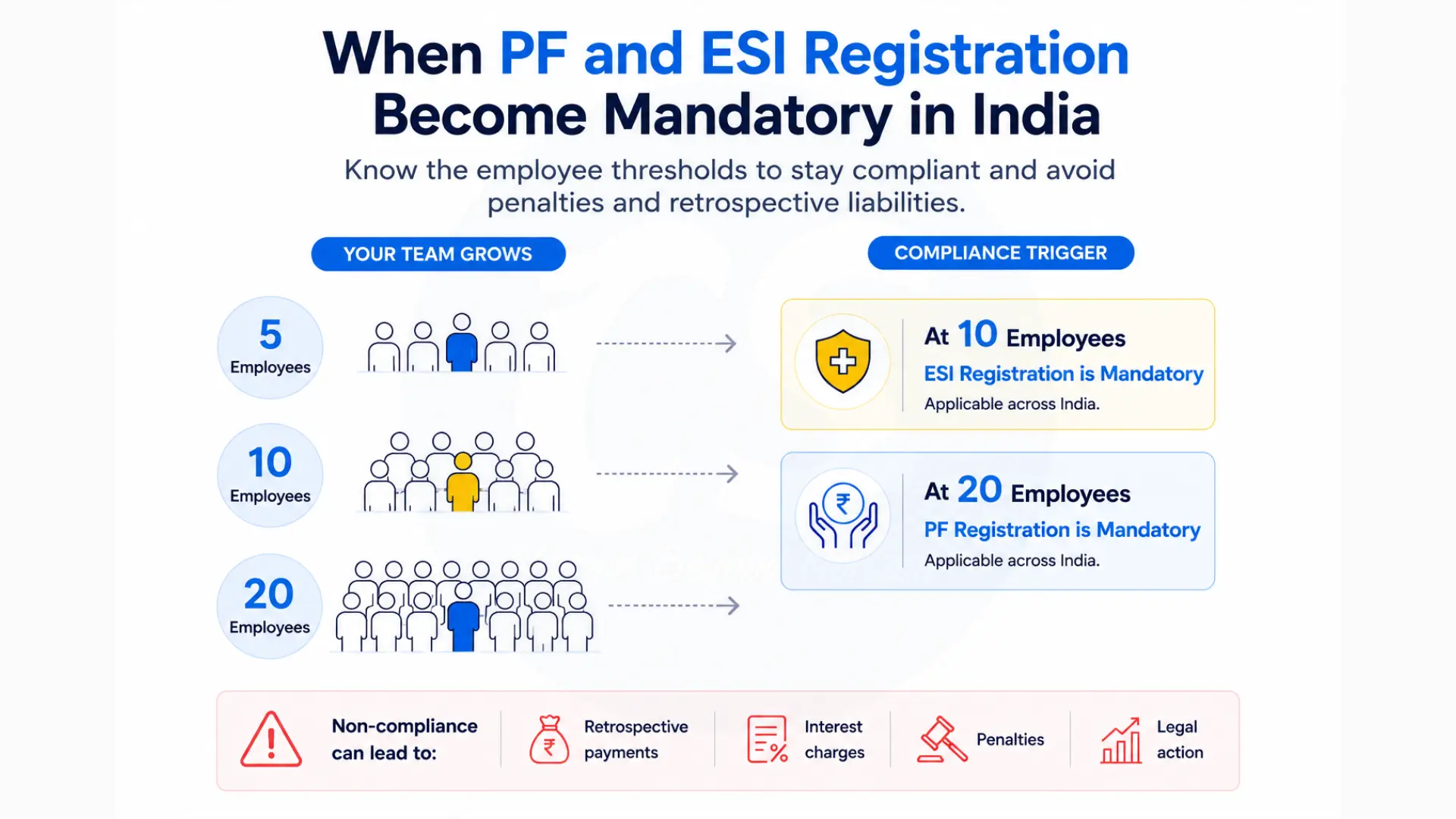
PF (Provident Fund) registration becomes mandatory once you have 20 or more employees. This threshold applies across most industries and states. Registration must be completed within specific timelines from the moment you cross the threshold, not when it’s convenient for you.
ESI (Employee State Insurance) registration typically applies to 10 or more employees, though this varies by state. Some states have higher thresholds and others lower. The registration triggers are based on headcount in the previous 12 months.
What does delayed PF ESI compliance costs
Companies often delay thinking, “We’ll register when we’re bigger.” This creates problems:
- Retrospective payments for all employees from the date you crossed the threshold
- Interest charges on delayed contributions (12% for PF)
- Penalties that start immediately and compound
- Potential criminal liability for wilful evasion
The cost of delayed PF ESI compliance far exceeds the cost of timely registration and ongoing filing.
If you’re approaching that threshold, understand HR compliance for startups in India before you cross it.
Common HR compliance gaps that get companies caught
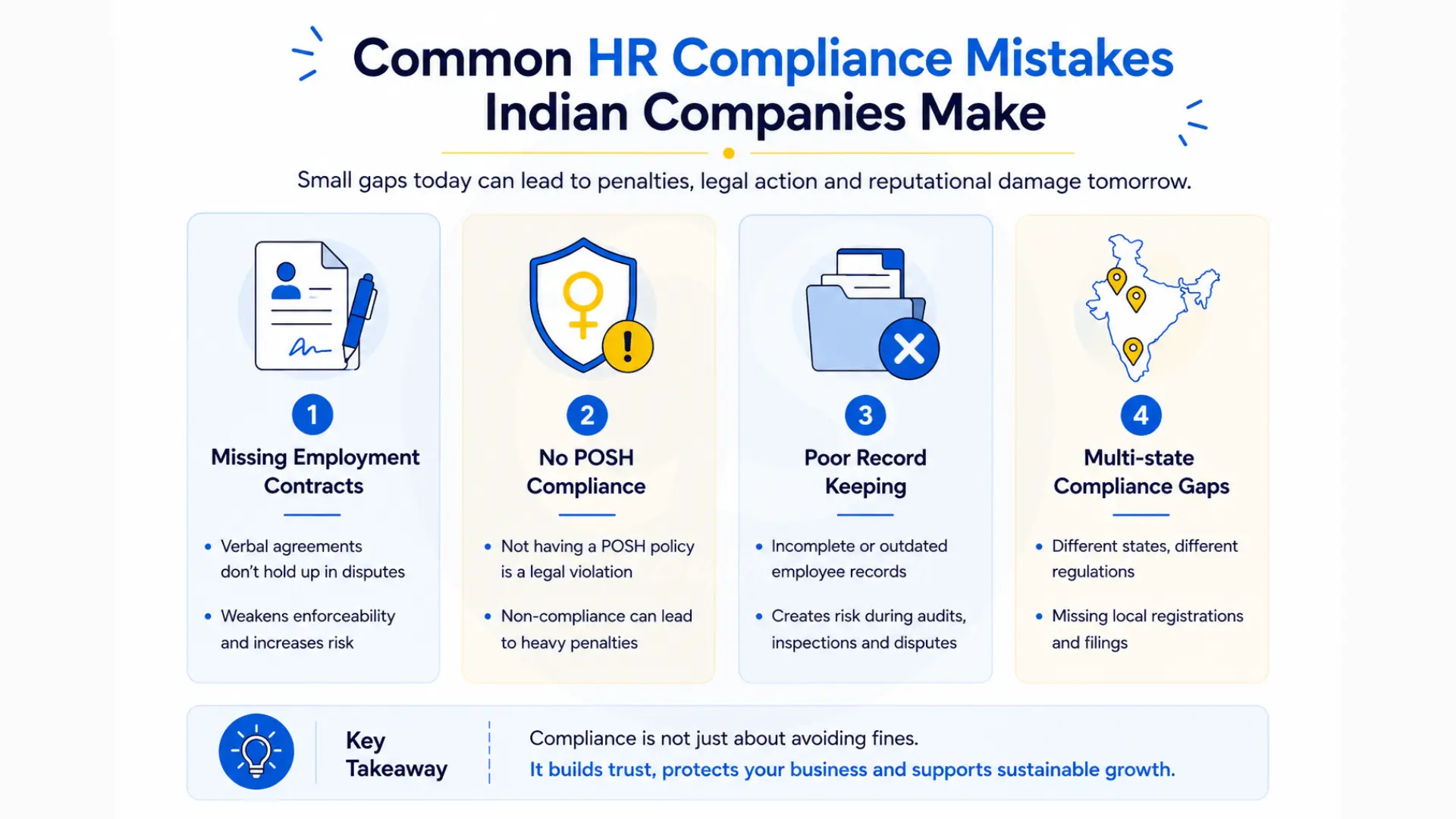
Missing employment contracts
Many companies hire on verbal agreements or casual offer letters. Under the Industrial Relations Code, written employment contracts are mandatory. Without them:
- You have no legal standing to enforce notice periods
- Termination disputes become impossible to defend
- Salary structures lack legal documentation
- Non-compete clauses are unenforceable
Written contracts aren’t optional. They’re legally required and protect both you and your employees.
No POSH compliance despite it being mandatory
The POSH Act applies to all organisations regardless of size. You need:
- Written prevention policy
- Internal Complaints Committee with an external member
- Annual training for everyone
- Quarterly reporting, even if there are no complaints
Courts recently penalised an organisation for failing to provide proper documentation to a complainant. Missing POSH compliance carries serious fines plus reputation damage.
Poor record-keeping that fails audits
“We have Excel sheets” doesn’t count as statutory compliance HR. The law requires specific formats for:
- Attendance registers
- Wage records with prescribed details
- Leave tracking with accruals
- Proper appointment documentation
Paper systems are becoming non-compliant as digitalisation increases. You need proper systems with audit trails.
Multi-state operations without state-specific compliance
If you have offices in multiple cities, each location needs:
- Separate Shops & Establishments registration
- Different minimum wage adherence
- State-specific professional tax filings
Companies often register in their headquarters state and assume that covers everything. It doesn’t. Each state triggers separate obligations under labour law compliance India requirements.
For a detailed breakdown, read about the most common HR compliance mistakes Indian companies make.
How to create HR policies India companies need
Creating proper HR policies India requires more than downloading templates. Policies need to reflect actual labour law requirements whilst fitting your operational reality.

Essential policies every company needs
Employment contracts: Clear terms covering role, compensation, working hours, leave entitlements, notice periods, and termination conditions compliant with the Industrial Relations Code.
Leave policy: Annual leave, sick leave, casual leave, and special leave entitlements. Must meet or exceed statutory minimums whilst being clear about accrual, carry-forward, and encashment rules.
POSH policy: Prevention of sexual harassment policy with clearly defined Internal Complaints Committee, reporting mechanisms, investigation processes, and protection against retaliation.
Grievance redressal policy: Clear process for employees to raise concerns, defined timelines for response, escalation paths, and protection against victimisation.
Working hours and overtime policy: Compliance with maximum working hours, rest periods, overtime calculation, and compensation as per the Occupational Safety Code.
Common policy mistakes
Copying templates without customisation: Generic policies from the internet often don’t match your industry, state laws, or operational reality. They create legal exposure rather than protection.
Not updating policies when laws change: Labour law amendments happen frequently. Policies need regular review and updates to remain compliant.
Creating policies without implementation plans: Writing a policy doesn’t create compliance. You need training, communication, and enforcement mechanisms.
How to build a proper compliance structure
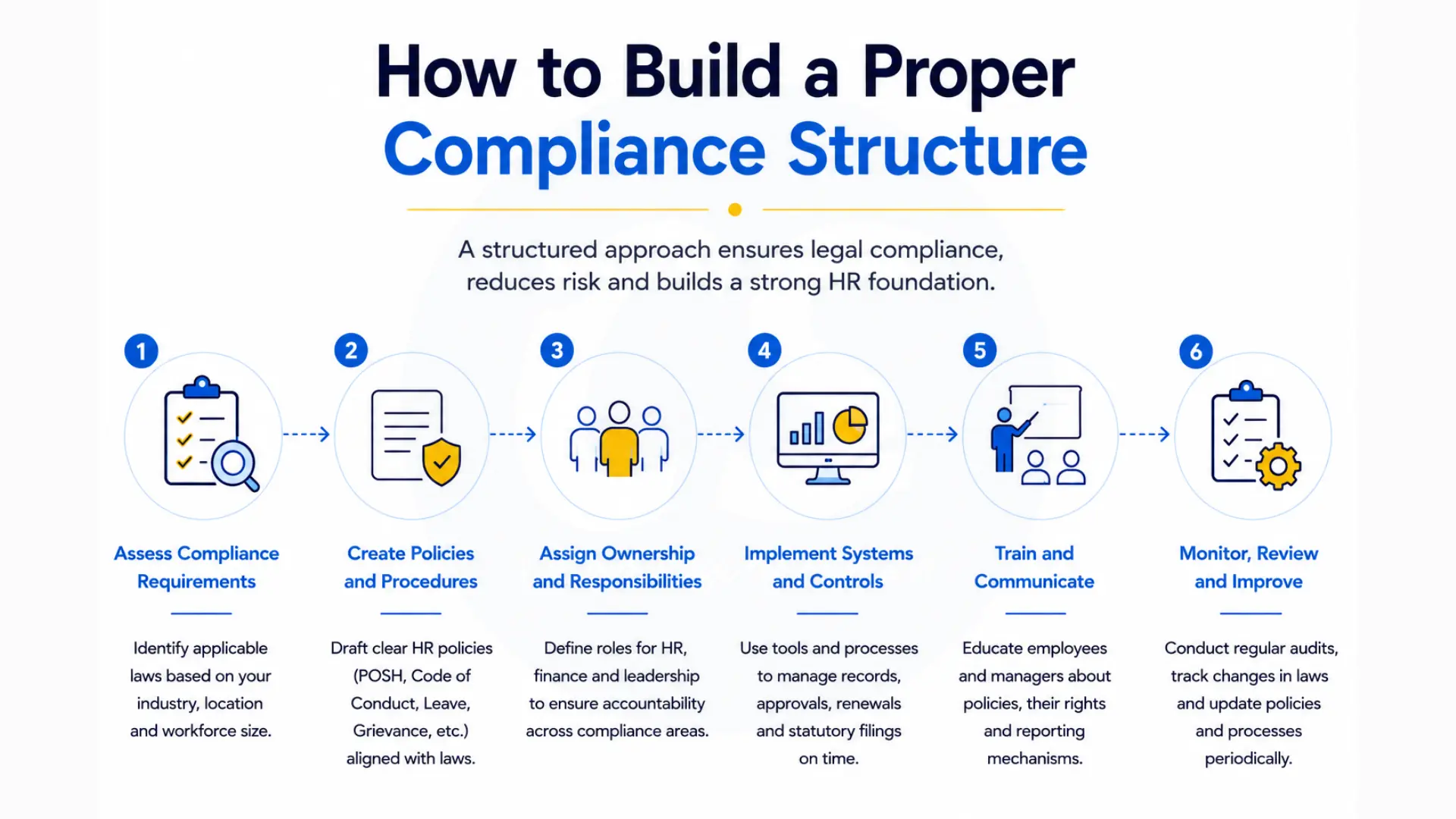
Start with a compliance audit
Before fixing anything, understand where you stand. A proper statutory compliance HR audit reviews:
- Registration status: Are you registered for everything required? Are registrations current?
- Policy gaps: Which mandatory policies are missing or outdated?
- Documentation: Do you have proper contracts, appointment letters, and exit records?
- Filing status: Are monthly returns current? Any delayed filings pending?
- Record standards: Are registers maintained in the right formats?
Professional audits identify risks worth far more than the audit cost itself.
Create a compliance calendar
- Labour law compliance India is ongoing, not one-time. Build a calendar tracking:
- Monthly deadlines: PF filing, ESI payment, professional tax, wage register updates.
- Quarterly obligations: POSH returns, welfare fund contributions (state-specific).
- Annual requirements: Yearly returns under various acts, bonus payments, contract renewals.
- Digital tools automate reminders and track filing status, reducing missed deadlines.
Document everything systematically
The enforcement system is evidence-based. If it’s not documented, it didn’t happen:
- Every policy decision needs written documentation
- All employee communications about leaves, warnings, terminations must be in writing
- Attendance, wages, deductions need audit trails
- Safety meetings, training sessions, and grievance resolutions require proper records
Read HR legal services FAQs businesses most commonly ask us.
How Corporate Stalwarts handles HR legal compliance
Corporate Stalwarts provides HR Policy & Advisory Solutions for growing companies across India. We handle everything from initial setup to ongoing advisory and statutory filings.
What we deliver
Compliance audit: Comprehensive review of your current status across all applicable laws.
Registrations: PF, ESI, Shops & Establishments, and Professional Tax across all your locations.
Policies and documentation: Employment contracts, leave policies, POSH policies, and employee handbooks compliant with current laws.
Monthly filings: All recurring compliance obligations managed end-to-end.
Updates and advisory: Proactive alerts on law changes with clear guidance on required actions.
Dispute support: Representation for labour enquiries, employee complaints, and inspector visits.
Our approach to HR compliance India
We build compliant HR systems that scale with your business:
- Multi-state coverage: Single point of contact for compliance across Bangalore, Mumbai, Delhi, Pune, Hyderabad, and tier-2 cities.
- Industry knowledge: Different requirements for IT, manufacturing, FMCG, pharma, and logistics based on decades of experience.
- Fixed monthly costs: Predictable pricing without surprise bills. Still weighing the cost? Read our HR advisory and intervention ROI breakdown.
- Integration with hiring: Our lateral hiring, RPO services, and virtual hiring include compliance management so new hires are compliant from day one.
“We were growing across four cities and had no idea we were missing major registrations. Corporate Stalwarts ran an audit, fixed everything within 90 days, and now handle all our monthly work. We haven’t worried about compliance since.” — Founder, Series A EdTech Company, Bangalore.
Ready to get compliant? Let’s talk.


Corporate Stalwarts is a trusted recruitment firm with 20+ years of expertise in executive search and leadership hiring.
We’ve placed 10,000+ candidates across 600+ companies in FMCG, Manufacturing, IT, Pharma, and more. Our 1M+ candidate pool and 48-hour turnaround enable fast, high-quality hiring solutions.
We help businesses build high-performance teams with precision, speed, and industry expertise.