


Loading...

The Cost of a Wrong CTO Hire Goes Far Beyond the Salary

Most CEOs know a bad hire is expensive.  What they underestimate is how far that cost travels when the hire is a CTO.  It does not stay in the technology...
The Cost of a Wrong CTO Hire Goes Far Beyond the Salary

Most CEOs know a bad hire is expensive. 

What they underestimate is how far that cost travels when the hire is a CTO. 

It does not stay in the technology department. It moves into your product timelines, your engineering team, your vendor relationships, and eventually your board conversations. By the time it is visible enough to act on, you have already paid six to eight months of a cost that nobody put on the invoice. 

The cost of a wrong CTO hire in India is not just a recruitment problem. It is a business continuity problem. According to SHRM research, a failed senior hire costs up to five times their annual salary when you account for lost productivity, team attrition, and the replacement search. For a CTO, who sits between ₹1.5 and ₹4 crore before the second search begins. 

This article breaks down where that cost comes from and what a hiring process built to prevent it looks like. 

Why a wrong CTO hire different from other senior mis-hires 

A wrong CFO creates a governance problem. A wrong CHRO creates a people problem. A wrong CTO creates all of the above, simultaneously, because the role touches technology delivery, team culture, product direction, and external partnerships at the same time. 

The CTO sets the technical direction for a team that will carry it out long after they are gone. They make decisions that take years to undo. They need the trust of the board and the respect of the engineers from day one. 

When that combination breaks, it does not break in one place. It breaks everywhere at once. 
hidden-cost-of-wrog-CTO-hire

How to calculate the cost of a wrong CTO hire 

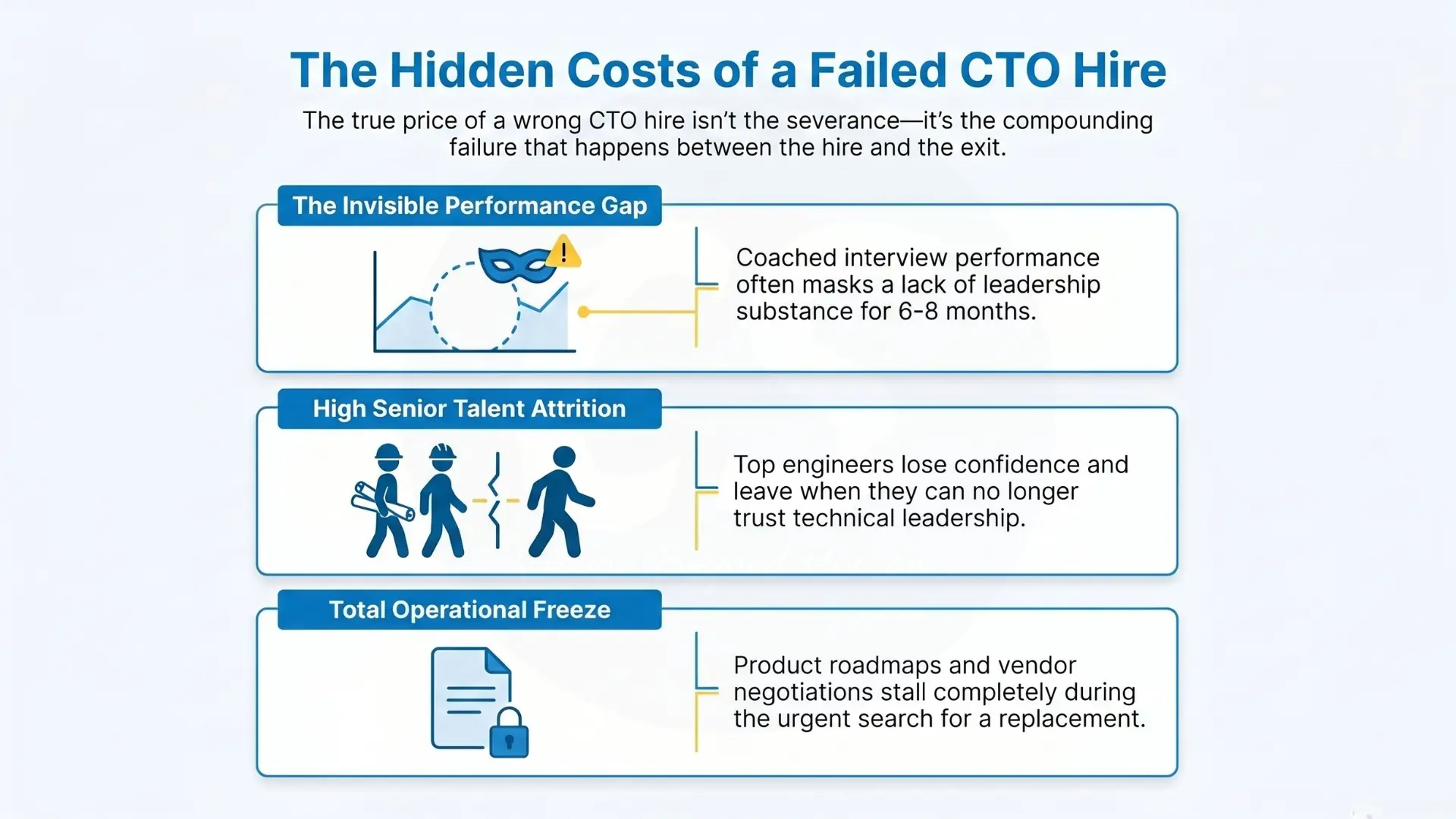
The recruitment fee is the smallest number in this calculation. The real cost builds in three stages. 

Stage 1: The performance gap that nobody names 

A new CTO joins. The first few months look fine. Everyone gives a new leader room. By month five, delivery is slipping. The engineering team is working around the problem rather than through leadership. The CEO is asking questions that are not getting real answers. 

In the worst cases, it comes out later that the candidate was coached specifically for the interview process. They cleared four or five rounds with the MD, CEO, and a technical panel. Nobody caught it. The interview was not designed to catch coached performance. It was designed to catch prepared communication. Those are not the same thing. 

Six to eight months pass before anyone acts. By then, the team has already adjusted around the gap, and the damage is done. 

Stage 2: The engineers who leave quietly 

When a CTO is not performing, the engineering team knows before leadership does. They stop bringing hard problems forward. They start looking for roles where leadership is stronger. The best ones leave first. 

They rarely mention the CTO in their exit interviews. The cost of losing two or three senior engineers in the months after a failed CTO hire does not appear in any report. It still gets paid. 

Stage 3: The freeze while you search again 

Once the decision is made to let the CTO go, everything stops. Product decisions. Vendor negotiations. Roadmap conversations. Nothing gets owned until a new head of technology is in place. 

Every week of that gap is a cost that shows up as a delay, not as a line item. Then the search starts again, now urgent, now with a harder story to explain to every candidate you speak to. 

We have seen this pattern in FMCG companies across Delhi NCR and Gurgaon, building digital and supply chain teams; in pharma and medical device companies in Pune and Bangalore, scaling their technology functions; and in manufacturing and engineering businesses across Noida and Chandigarh, investing in automation leadership. The industry changes. The cost pattern does not. 

Running a CTO search right now? Talk to our team before the offer goes out.

AI-screening banner

Why most CTO searches are set up to fail before they start 

The interview process is usually not the problem. The problem is what happens before the first round. 

Reference checks go only to contacts that the candidate prepared in advance. Behavioural assessment, if it happens at all, is a form, not a conversation. The role is presented to the candidate at its best, so they join with expectations that do not match the reality they walk into. 

Large search firms are not careless. They are under volume pressure. A recruiter handling twelve mandates at once cannot run deep references on every search. The incentive is to close, not to verify. And when a hire fails, no one person at that firm is accountable by name. 

That gap is precisely why CXO hires fail in India more often than companies expect and why it keeps happening to companies that have already been through it once. 

How Corporate Stalwarts approaches a CTO search 
How-corporate-stalwarts-approaches-CTO-and-CXO-search

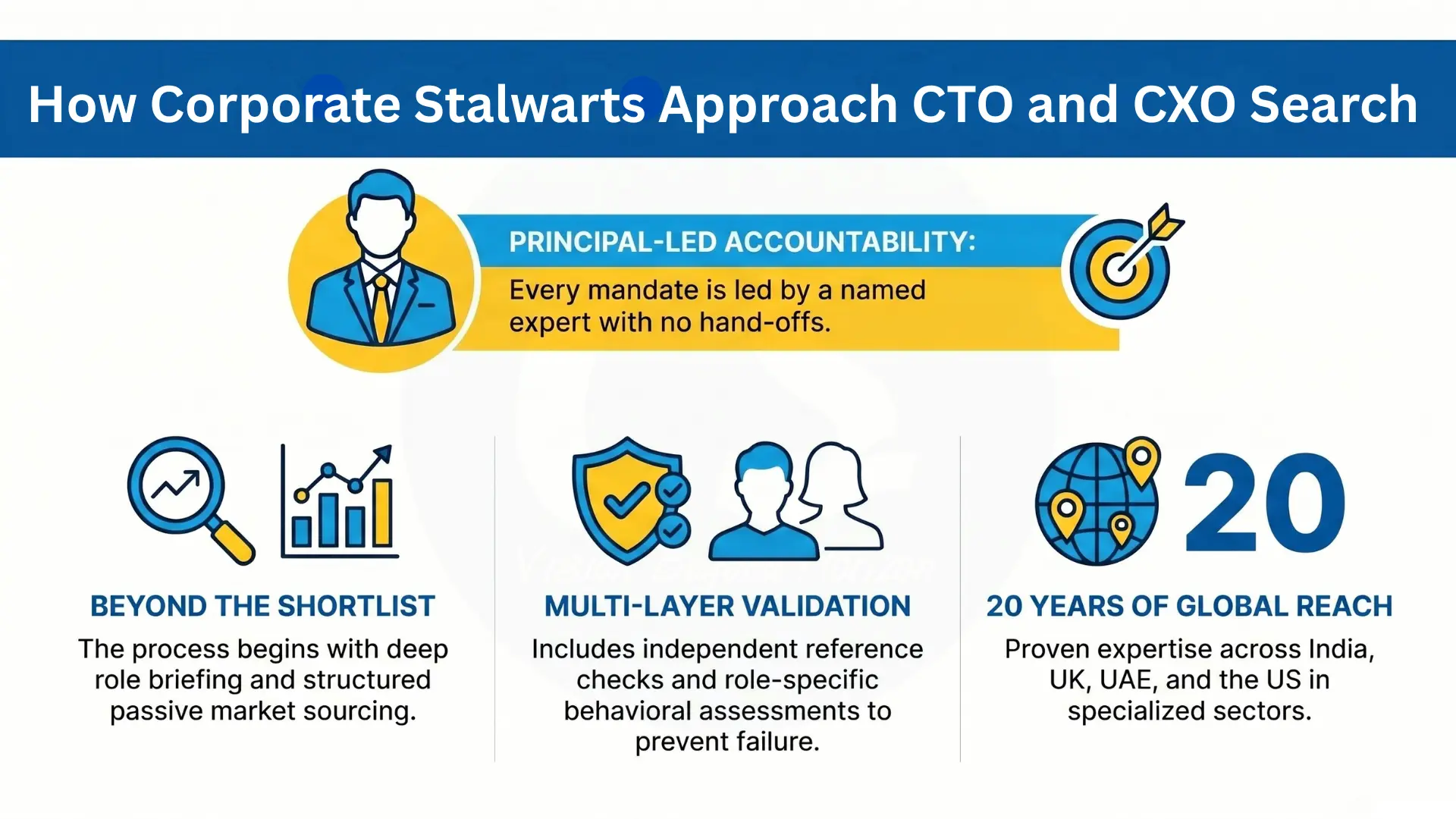
Corporate Stalwarts is a premium executive search firm and leadership hiring partner with over 20 years of experience across India. We have placed senior leaders for companies in Delhi, Gurgaon, Noida, Chandigarh, Bangalore, Pune, and Mumbai and have supported leadership mandates for organisations building teams in the UK, UAE, and the US. 

We work across FMCG, IT, pharma, building materials and paint, manufacturing, and GCC setups. At the CXO level, across all of these, we follow the same process. 

Every search begins with a proper brief. Not a job description. A real conversation about what this role demands, what the environment is actually like, and what has gone wrong in the past. That brief goes to the candidate too, accurately, because a hire who joins with wrong expectations is already on the path to failure. 

References go outside the candidate’s own list. We reach out to former peers, indirect reports, and people who worked through a difficult period with this person. The patterns that matter do not come from the references the candidate selected. 

Behavioural assessment is part of every senior search we run. Not a checkbox. A genuine read on how this person functions under pressure and in collaboration. For IT and GCC leadership roles, especially, this step is the difference between a hire that holds and one that unravels in month six. 

Every mandate at Corporate Stalwarts is led by a principal who is accountable by name. We do not hand it off. When you call six months later, the same person picks up. 

For companies that need to fill multiple functions alongside a CXO search, we combine our leadership hiring process with lateral hiring or a retained search model, depending on what the organisation actually needs. 

Question to ask any search firm before you engage 

Who is accountable by name if this hire does not work out in twelve months? 

Not the firm. A person. 

If they cannot answer that clearly, the process they are describing does not have real accountability built into it. Most organisations learn this after absorbing the cost of a wrong hire once. It does not have to work that way. 

If you are running a CTO or CXO search, speak to our team before your next hire. Request a call back, and we will walk you through exactly how we approach it.  
AI-screening banner


Frequently Asked Questions

Beyond the recruitment fee, the cost includes the productivity lost during the performance gap, the engineers who leave during the uncertainty, the delays to delivery while the organisation waits for new leadership, and the full cost of running the search again. SHRM research puts the total at three to five times the CTO's annual salary. 

A search with genuine reference checks and behavioural assessment takes five to eight weeks from brief to shortlist. A firm completing it in under two weeks is searching a database, not running a search. That time is a risk reduction investment, not a delay. 

In a retained search, one firm works exclusively on your mandate from the start. The process is deeper, the sourcing goes beyond the active market, and the accountability is clearer. Contingency models split focus across multiple firms and cannot support the same depth of process. 

No. The same failure pattern appears across FMCG, pharma, building materials and paint, manufacturing, and GCC setups. Any organisation making a significant technology leadership hire faces the same risk from a wrong decision. 

Yes. We run executive search mandates across Gurgaon, Noida, Bangalore, Pune, and Mumbai. We have also supported international placements in the UAE, UK, and USA. Location is not a constraint. 

Share this article

Related Articles

Browse the latest career advices

Why background verification at CXO level is not optional
How much do you know about the last CXO you hired?  Background verification for executive hiring in India confirms employment dates, checks a degree, and runs a criminal record search....
Why Workplace Disruption in India is a Leadership Hiring Problem First
Every conversation about workplace disruption in India eventually arrives at the same place.   Technology, AI adoption, reskilling, and the future of work are critical topics. Yet, a fundamental question goes...
26/03/2026
How to hire the right sales head in FMCG India
Hiring a Sales Head looks like one of the more familiar decisions an FMCG company makes.  The role exists in every organisation. The title is recognisable. The market has no shortage of...
My recruitment agency is sending CVs but none of them are right. Now what?
You are reading this because the CVs are not right, and your recruitment agency does not seem to understand why.  You have given feedback. The profiles keep coming. And somewhere...