
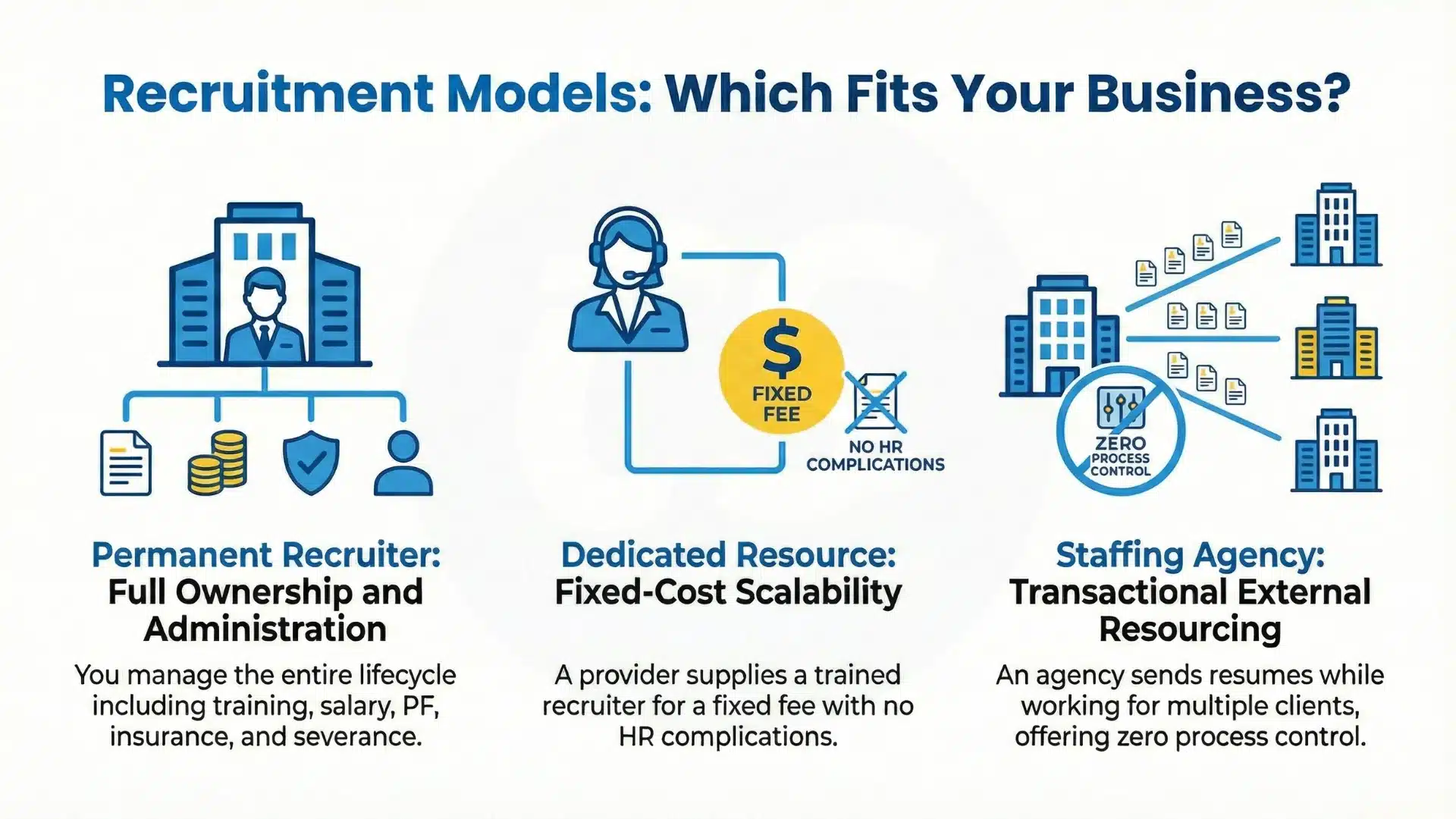
Every article explaining the hiring model gives you the same useless comparison table: “RPO is scalable, staffing is flexible, and permanent hiring gives you control.” Great. But which one actually works when you’re hiring 35 people over 8 months for a new Bangalore office that might or might not become permanent?
RPO providers want year-long commitments and manage your entire process. Permanent recruiters take months to hire and create severance headaches when projects end. Staffing agencies juggle ten clients while sending you resumes that don’t match your culture. None of these models fit when your hiring timeline is unclear, your volume fluctuates monthly, and your project might scale up or shut down.
That’s the gap the Dedicated Resource Model fills. You get dedicated recruiters who work only for you, but you’re not locked into permanent employment or long-term contracts.
This article tells you exactly when this makes sense and when it wastes your money.
Table of Contents
ToggleWhat is Dedicated Resource Model?
Think of it like this: You need a car for 6 months. Buying doesn’t make sense. Daily rentals are expensive and inconsistent. A monthly lease gives you the same car, dedicated to you, for as long as you need it.
Dedicated Resource Model works the same way with hiring professionals.
You get recruiters who:
- Work exclusively on your open positions
- Use your ATS and hiring tools
- Learn your company culture and values
- Attend your team meetings
- Report to your hiring managers
- Work your office hours
The difference from permanent employees: A recruitment firm employs them. You pay a monthly fee. When your project ends, you stop paying. No notice periods, no severance, no long-term commitment.
When does DRM model make sense for you?
Use this checklist to know if Dedicated Resource Model fits your situation:
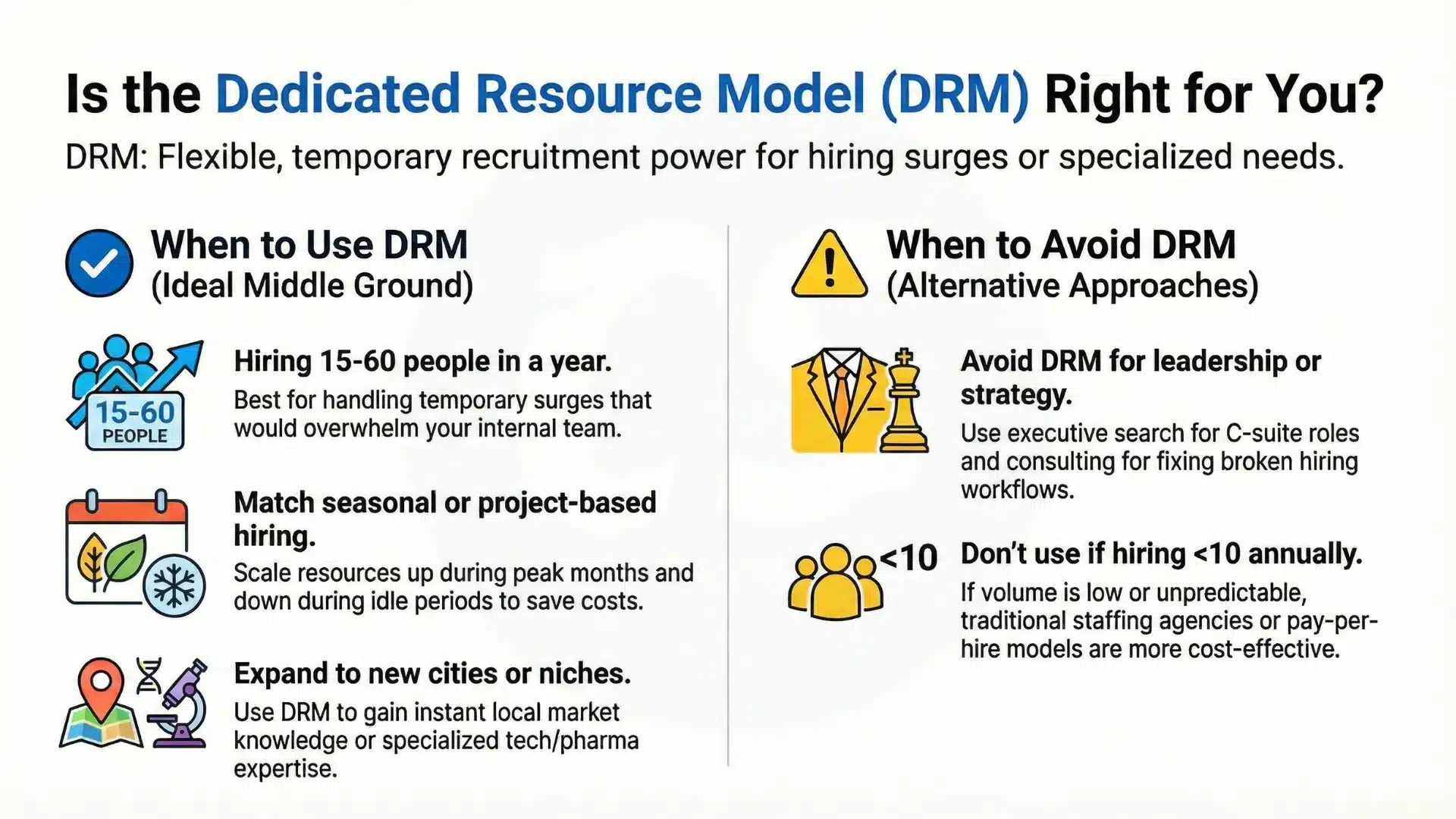
You’re hiring 15-60 people over the next 6-12 months
Your current team cannot handle this volume. Hiring would suffer, or your regular work would stop. You need help, but only temporarily.
Real example: A Bangalore SaaS company raised Series B. They need to hire 45 engineers in 9 months. However, after that, hiring drops to 8-10 per quarter. Two dedicated recruiters handled the surge. When it’s done, resources scale down.
Your hiring is seasonal or project-based
Some months you hire 20 people. Other months, zero. Permanent recruiters sit idle during slow periods. You waste your salary on unutilised capacity.
Real example: An ed-tech platform hires 80+ people before academic sessions (Jan-March, June-August). For the rest of the year, minimal hiring. Dedicated resources work only during peak months.
You’re expanding to new cities
Your Mumbai office works well. Now you’re opening in Pune and Bangalore. You need recruiters who understand local talent markets, salary expectations, and hiring competition in each city.
Real example: A logistics company expands from Delhi to Hyderabad and Pune. Dedicated recruiters in each city source locally while reporting to the central HR team.
You need specialized hiring expertise temporarily
You’re hiring roles your team doesn’t understand well. Tech startups hiring their first sales team. Manufacturing firms hiring tech talent. Pharma companies are hiring for GCC operations.
Real example: A pharma firm sets up a GCC in Hyderabad. They need recruiters who understand both pharma compliance and tech talent markets. Dedicated resources bring this expertise for 12 months while the team gets built.
You want to test before committing
You’re unsure whether to build an internal recruitment team or use RPO services. Dedicated resources let you test for 6 months. Then decide hire them permanently, continue as-is, or move to a different model.
When DRM model doesn’t work
Being honest saves you time and money. Don’t use Dedicated Resource Model if:
You hire fewer than 10 people per year
Monthly fees for dedicated resources won’t be justified. Use regular staffing agencies that charge only when they successfully fill a role.
You need help with hiring strategy, not execution
Dedicated resources execute hiring. They don’t build your recruitment process, fix broken workflows, or create hiring strategies. If you lack clear job descriptions, defined interview processes, or hiring criteria, you need talent acquisition consulting first.
All your hiring is senior leadership
VP and C-level roles need different expertise. Passive candidate search, months-long engagement, succession planning. Use executive search services designed for leadership hiring.
Your hiring needs are completely unpredictable
One month you hire 30 people. Next three months, zero hires. Then suddenly 25 hires. Fixed monthly costs don’t work here. Pay-per-hire models suit better.
You want someone else to manage the entire process
Dedicated resources work under your management. You define requirements, approve candidates, and make hiring decisions. If you want complete hands-off recruitment, consider RPO services instead.
How does Dedicated Resource Model work?
Step 1: Tell us what you need
How many people do you plan to hire? Over what timeline? What types of roles (tech, sales, operations)? What experience level do your resources need?
We match recruiters from our team based on your requirements. You interview them before they start.
Step 2: Resources integrate into your team (2 weeks)
They learn about your company culture, products, and hiring standards. Get access to your ATS, LinkedIn Recruiter, and communication tools. Understand what “good fit” means for your organisation.
Unlike external agencies, they become part of your hiring team.
Step 3: They start hiring
Daily work includes:
- Sourcing candidates from job boards, LinkedIn, and employee referrals
- Screening resumes against your requirements
- Conducting initial phone screens
- Coordinating interviews with hiring managers
- Managing candidate communication
- Tracking pipeline and sharing weekly updates
They work during your office hours. Attend your team meetings. Report to your managers.
Step 4: You track performance monthly
Number of hires completed, time-to-fill for each role, candidate quality, and hiring manager feedback. If performance drops, we replace resources quickly.
What does DRM cost?
Pricing depends on three factors:
- Resource experience: Junior recruiters (1-3 years’ experience) cost less than senior recruiters (7+ years) or specialised recruiters (tech, pharma, leadership).
- How many resources do you need: One recruiter costs more per person than three recruiters. Volume brings better rates.
- How long do you commit: a 3-month pilot costs more monthly than a 12-month engagement. Longer commitment = lower monthly rate.
Cost comparison that matters:
Permanent recruiter costs ₹7-10 lakhs annually (salary + benefits + overhead). Additionally, add recruitment costs to hire them, training time, and severance risk.
Dedicated resource costs a monthly fee with no hiring cost, no benefits, and no severance. As a result, it scales down all the time. For 6–12-month projects, dedicated resources typically cost 30-40% less than hiring permanent recruiters.

Common concerns clients have
“What if the recruiter doesn’t understand our culture?”
We invest heavily in onboarding. Resources spend 2 weeks learning about your culture, values, and what makes candidates successful at your company. During this time, they shadow your team, attend orientation sessions, and review past successful hires.
If cultural fit remains an issue after the first month, we replace the resource.
“Can we hire them permanently later?”
Yes. Many companies convert dedicated resources to permanent employees after 6-12 months. Consequently, your agreement will specify conversion terms clearly upfront.
“What happens if they leave mid-project?”
We replace them within 5-7 days at no additional cost. This is a key advantage over permanent employees, where replacement takes 2-3 months.
“How do we know they’re actually working full-time for us?”
Weekly pipeline reports, daily candidate submissions, and visible activity in your ATS. Since you manage their work directly, you see exactly what they’re doing.
If you’re not satisfied with productivity, we will address it immediately.
“Do we need to provide laptops and software?”
This gets decided upfront. Some clients provide equipment; others prefer us to handle it. Meanwhile, for your ATS and company-specific tools, you provide access. For general tools like LinkedIn Recruiter, we can include them in our fee, or you can provide them.
Transform your hiring with Corporate Stalwarts’ Dedicated Resource Model
Corporate Stalwarts provides experienced recruiters who integrate into your team and deliver results without permanent employment overhead.
What we bring:
- Recruiters with 3-10 years’ experience matched to your industry
- Full integration into your hiring process and tools
- Flexibility to scale monthly based on your needs
- Quick replacement if performance doesn’t meet standards
- Presence across Bangalore, Mumbai, Pune, Hyderabad, and Delhi
We’ve helped companies hire everyone from 15-person startup teams to 200+ person GCC buildouts. Whether you’re testing recruitment models, managing seasonal hiring, or scaling temporarily, dedicated resources give you capacity exactly when you need it.
Ready to discuss your hiring needs?
Frequently Asked Questions
Contract recruiters work independently, use their own methods, and often juggle multiple clients. In contrast, dedicated resources integrate fully into your team, work exclusively for you, use your systems, and follow your processes. Consequently, they feel like permanent employees without employment overhead.
Yes. We deploy dedicated recruiters to any city where you're hiring. They can work remotely, from your office, or from co-working spaces based on what works best for your setup.
You can scale up (add more resources) or scale down (reduce resources) monthly. Typically, we just need 2-3 weeks' notice for scaling up to match and onboarding additional people. Scaling down happens immediately.
They work your business hours. If you need weekend or evening availability for candidate calls, we can arrange that based on your requirements.
Any role your company hires for: engineering, sales, marketing, operations, support, finance, or HR. They can handle junior to mid-senior levels effectively. For VP+ leadership roles, executive search works better.
Dedicated resources work under your management. You define requirements, approve candidates, and make hiring decisions. Therefore, resources execute sourcing and screening, but quality control stays with you.

Corporate Stalwarts is a trusted recruitment firm with 20+ years of expertise in executive search and leadership hiring.
We’ve placed 10,000+ candidates across 600+ companies in FMCG, Manufacturing, IT, Pharma, and more. Our 1M+ candidate pool and 48-hour turnaround enable fast, high-quality hiring solutions.
We help businesses build high-performance teams with precision, speed, and industry expertise.