

What a posting reaches vs what a direct search finds
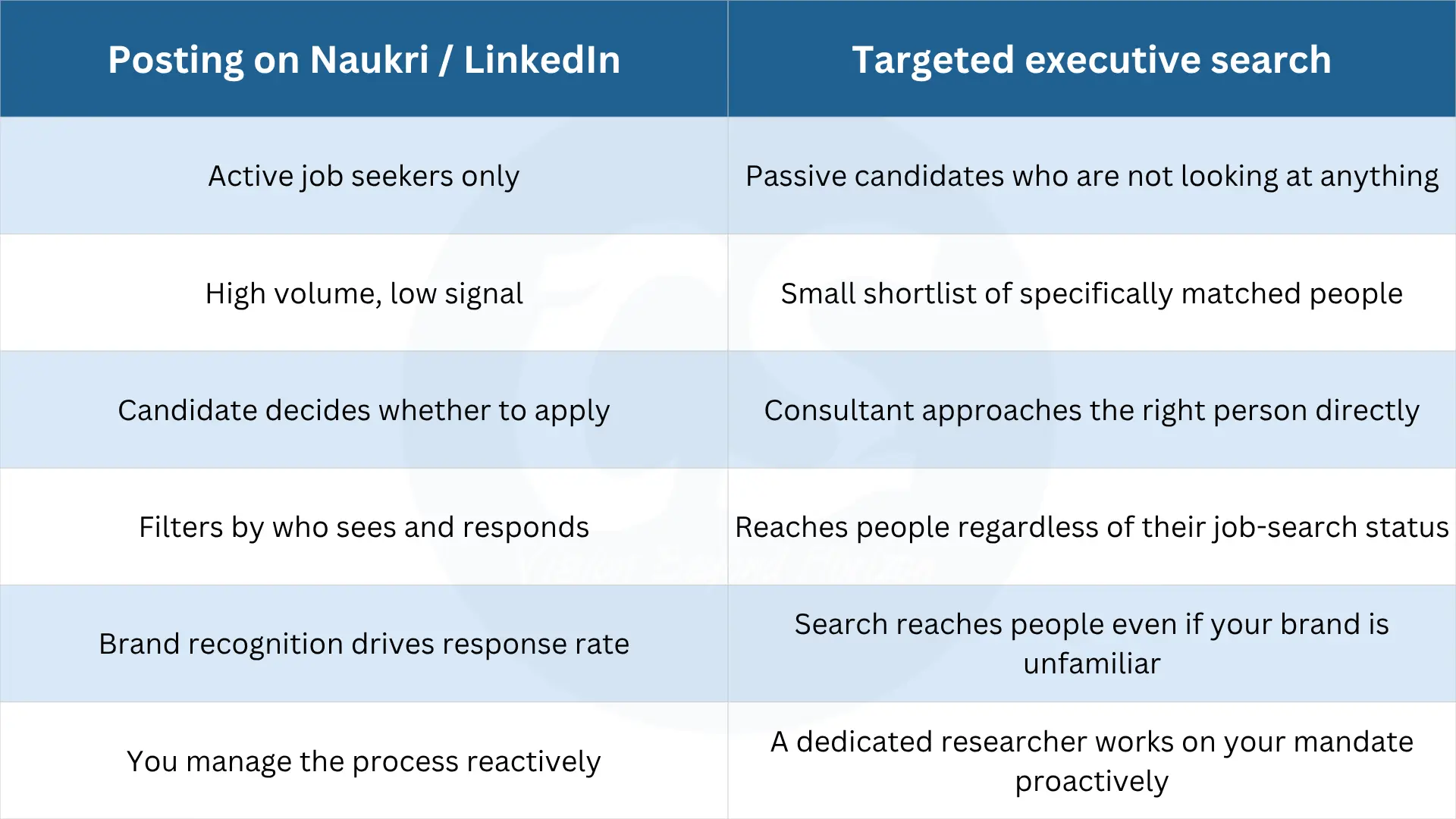
What the person you want is doing instead
The senior leader who fits your role is almost certainly running a team right now, delivering against targets, and managing the kind of complexity that makes them exactly who you need. They’re not browsing job boards. On occasion, they’ll have a conversation over dinner at an industry event or take a call from someone they’ve known for ten years who says something worth listening to. That’s their version of being open to a move.
What this means in practice is that reaching them requires a personalised approach through a trusted channel, not a broadcast. The opportunity needs a frame that is specific to them, credible enough to take seriously, and delivered by someone whose judgment they respect. A job post cannot do any of those three things. Neither can a cold InMail from a recruiter they’ve never heard of.
What we’ve found over years of running these searches is that the quality of the first conversation matters more than almost anything else. If the initial approach is generic, the candidate disengages immediately and rarely comes back. If it’s specific, if it speaks to their career trajectory, their sector knowledge, and the genuine opportunity in the role, they engage even if they weren’t looking at all.
How companies that consistently hire strong senior leaders do it
Across the searches we’ve run in India and internationally, the companies that consistently fill VP and CXO roles with people who perform and stay have one thing in common: they don’t rely on the market coming to them. They go into the market deliberately.
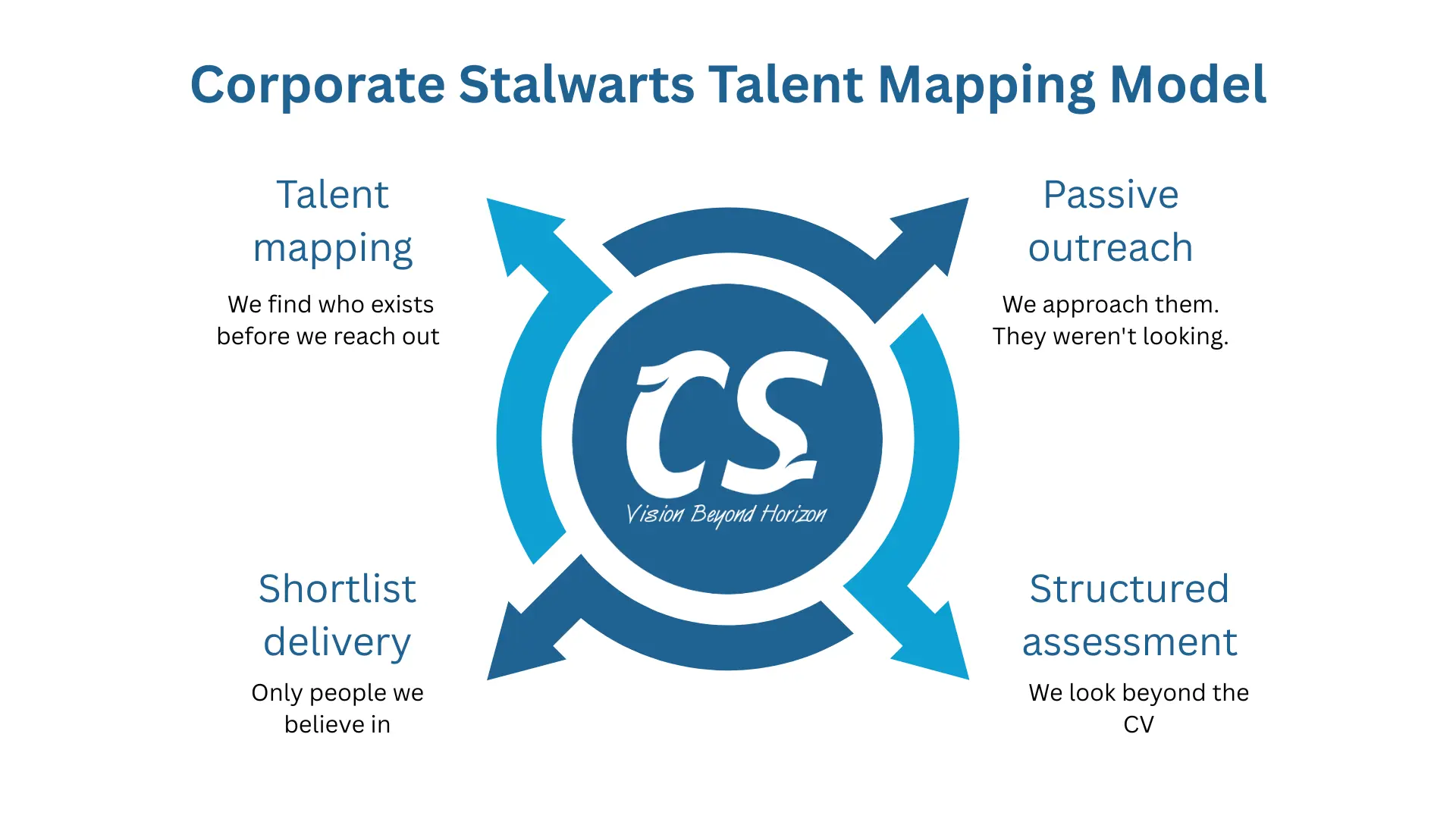
One firm, one mandate, full focus
A retained search works on a fundamentally different principle from a contingency arrangement. One firm holds the mandate exclusively, which means one dedicated researcher maps the full talent landscape for the role before a single approach is made.
At Corporate Stalwarts, we call this the Talent Mapping Model: a structured process that typically surfaces 40 to 60 names across India who could credibly fill the role, based on sector, seniority, functional track record, and organisational context. From that mapped universe, the team personally contacts the most relevant 15 to 20.
Every candidate who reaches your shortlist has cleared a structured assessment against your specific brief, drawing on over 10,000 placements across India and APAC. You review people our team has evaluated, not CVs that landed in an inbox.
Sector depth that earns the conversation
There’s a reason a senior leader in pharma or FMCG will take a call from certain search consultants and ignore everyone else. It’s because those consultants have spent years building credibility in that sector; they know the landscape, they know the people, and their call carries the implicit endorsement of that knowledge.
A generalist agency reaching out to a VP who has never heard of them rarely gets past voicemail. A specialist whom the candidate’s peers recognise gets a real conversation.
Start the senior role search before the seat is empty
One of the less obvious insights from two decades of executive search is that the outcome of a leadership hire is often determined before the search formally begins. Companies that start mapping senior talent six to twelve months before a transition is expected give themselves time to run a proper process, to let the right candidates come to a decision thoughtfully, and to negotiate from a position of strength.
Companies that start when the seat is already empty are working under pressure, and pressure produces compromises that affect the business for years.
What changes when your senior role search has stalled
Most companies undercount the cost of a vacant senior role. A VP Sales seat being open for three months is not just an empty desk. It means a team running without direction, pipeline conversations that nobody senior is closing, and a signal to competitors that the company may be in transition.
At the Director and VP level, the combined cost of lost revenue, management distraction, and team attrition typically exceeds the total retained search fee within eight to ten weeks. The search is not the expensive option. The delay is.
When a search has been running for several months without a credible shortlist, the instinct is often to add more agencies, widen the criteria, or revisit the job description. In our experience, none of those things addresses the actual problem, which is usually that the search is still accessing the same thin pool of active candidates through the same channels.
- Redefine the brief around the outcome, not the profile. Rather than describing the ideal candidate, describe the specific problem they need to solve in the first 12 months. High-performers evaluate opportunities by impact, not by job description. A brief that’s written around outcomes attracts a different quality of conversation entirely.
- Ask your current agency a direct question: of the profiles you’ve received, how many people held an active role and were not looking when your agency contacted them? If the answer is few or none, the search is drawing from the wrong market segment.
- Move to a dedicated retained mandate. One firm, full accountability, and proactive research into the full talent market. The difference in the quality of the shortlist is not marginal; it is the difference between finding the person you want and settling for the best of what happened to be available.
- Once you find someone strong, move fast. Passive candidates who engage with an opportunity remain interested for a shorter window than active candidates. They have less urgency on their side. If your internal process takes three weeks to produce feedback after a first meeting, you will lose candidates at this stage more often than you might expect.
The candidates you need aren’t applying to anyone. Here is what to do about it.
At Corporate Stalwarts, we’ve placed 10,000+ leaders across FMCG, IT, pharma, manufacturing, and logistics across India and APAC. We reach passive candidates through targeted search, not portals, not mass outreach. If your senior role has been open for more than four weeks without a shortlist worth looking at, our team is ready to help.
Talk to our executive search team


Corporate Stalwarts is a trusted recruitment firm with 20+ years of expertise in executive search and leadership hiring.
We’ve placed 10,000+ candidates across 600+ companies in FMCG, Manufacturing, IT, Pharma, and more. Our 1M+ candidate pool and 48-hour turnaround enable fast, high-quality hiring solutions.
We help businesses build high-performance teams with precision, speed, and industry expertise.