
Loading...

How to Build Future-Ready Leadership Team in GCCs in 2025

If you run or support a GCC today, you already know this… things aren’t the same anymore. What used to be back-office hubs have become the engines of global strategy....
How to Build Future-Ready Leadership Team in GCCs in 2025

If you run or support a GCC today, you already know this… things aren’t the same anymore. What used to be back-office hubs have become the engines of global strategy. And none of that happens without a future-ready leadership team in GCCs. In 2025, GCCs are expected to drive digital transformation, own innovation, and, in many cases, run entire business functions end-to-end.

But none of that happens without the right leaders in place. Building a future-ready leadership team in GCCs is the foundation of whether your centre thrives or becomes another cost centre.

And let’s be real: building that leadership bench is harder than it sounds.


Why does building a future-ready leadership team in GCCs matter in 2025?
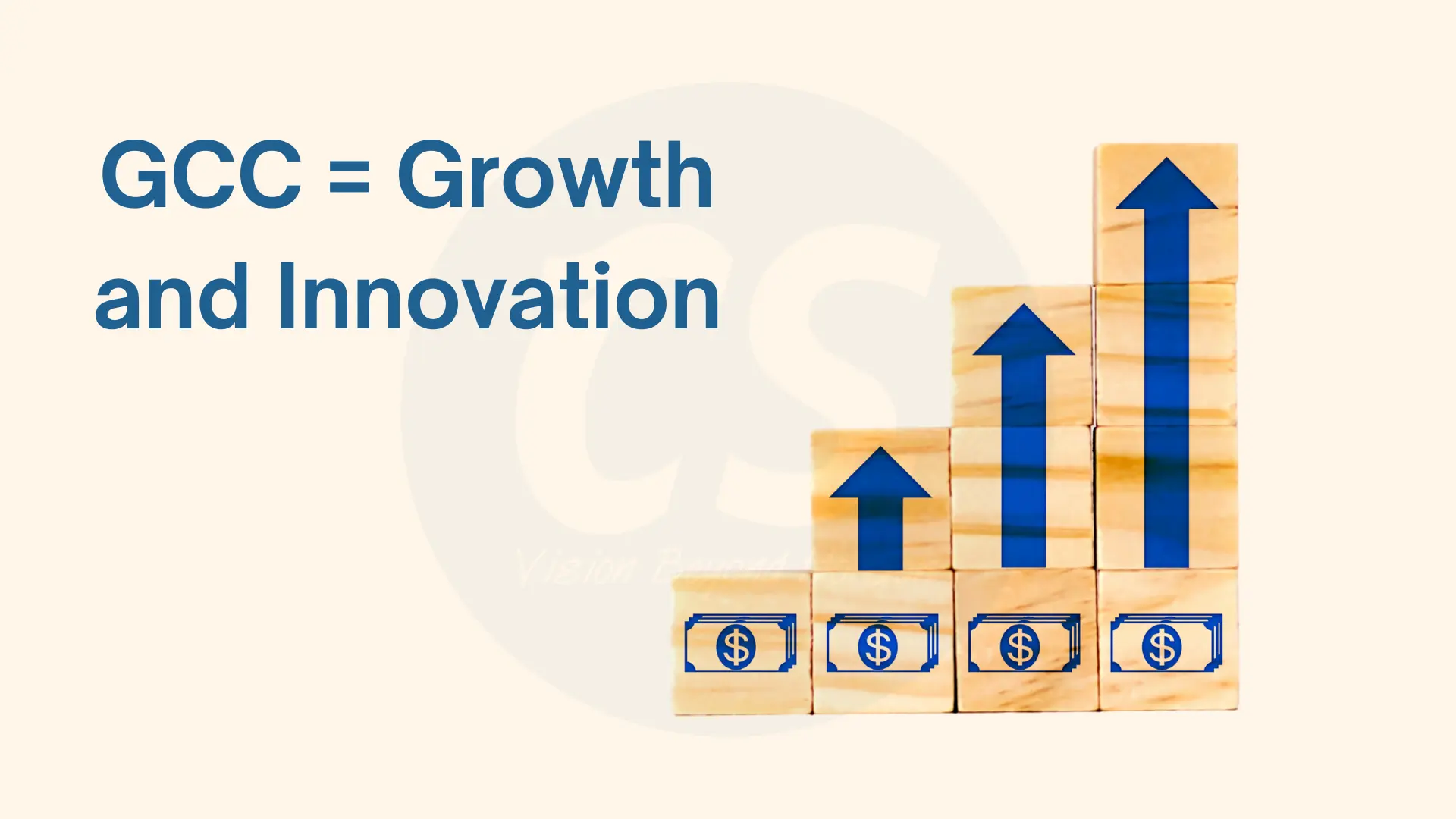
The leadership team in GCC equal to growth and innovation in 2025

GCCs used to be about saving costs. That story is over. Now, they’re being asked to deliver growth, innovation, and transformation. That means your leadership team in GCCs can’t just be good managers. GCCs need to be bold, strategic, and plugged into both local realities and global expectations.

I often tell HR heads this: your GCC’s leadership team is the bridge.

If that bridge isn’t strong, nothing flows: knowledge, strategy, innovation, or even culture. And in 2025, weak leadership is too expensive, especially when disruption is the only constant.

What makes leadership in GCCs uniquely tough right now?

Here’s what I’ve seen while working with GCC talent leaders:

  • Leaders sit in a dual world. They need to please global HQ while staying credible in the local talent market. That’s a delicate balance.
  • Senior talent supply is thin. Everyone wants AI heads, data leaders, and cybersecurity chiefs, and there just aren’t enough of them.
  • Attrition at leadership levels hurts more than attrition anywhere else. One senior exit can push a transformation back by months.
  • And finally, the roles keep evolving. A digital lead hired three years ago looks nothing like the digital leader you need today.

This is why building visionary leadership teams in GCCs feels like playing a moving target game, and you’re always adjusting.

What defines a “future-ready” leader in GCCs?
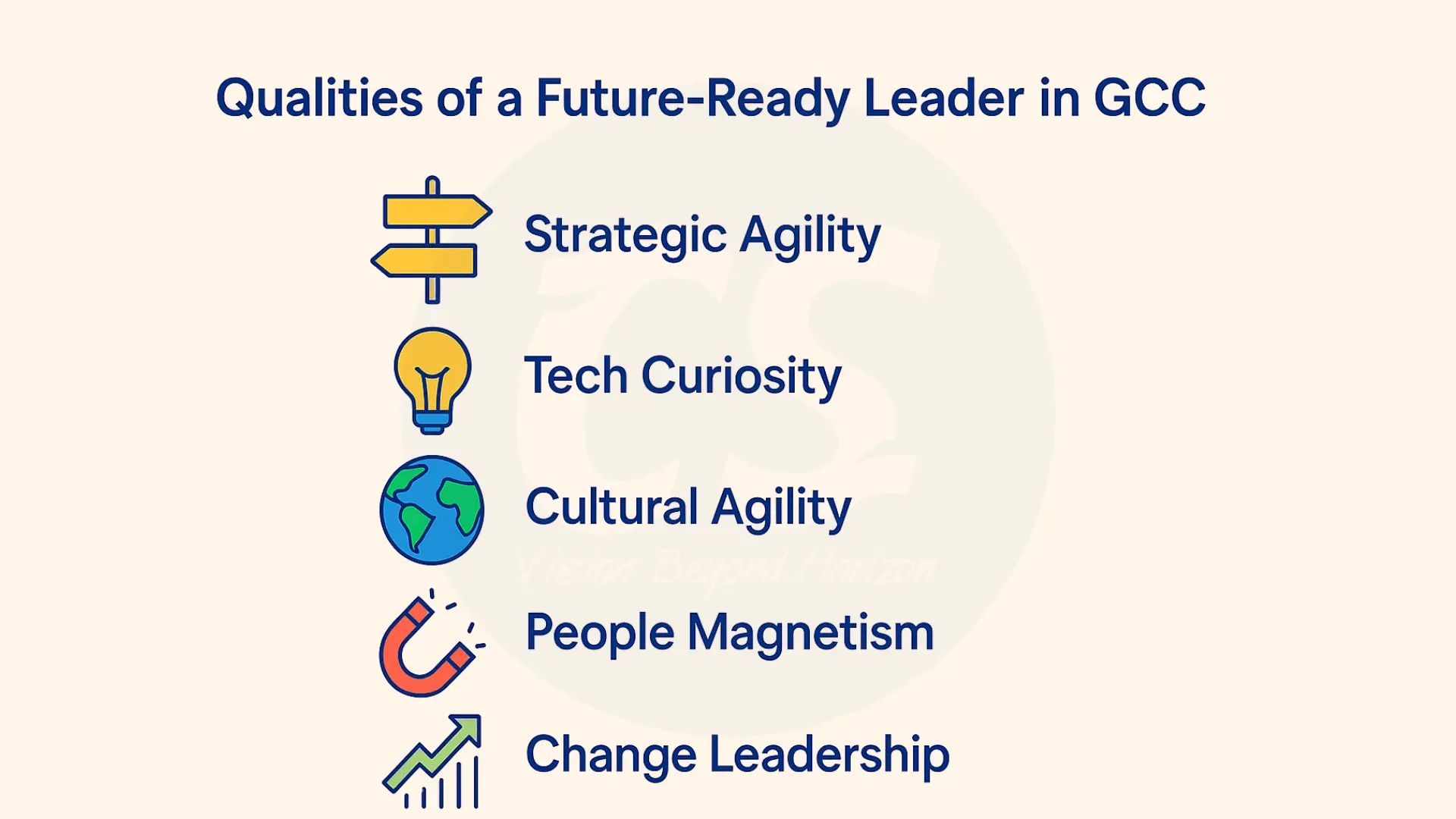
List of qualities of a future-ready leader in GCC

The real differentiators of a progressive leader are:

  • Strategic agility: Can they pivot fast when HQ changes direction?
  • Tech curiosity: Not coding, but the willingness to understand AI, automation, and data, not fear it.
  • Cultural agility: Can they speak both “corporate global” and “India talent market” without losing trust on either side?
  • People magnetism: The ability to attract, develop, and hold on to the next layer of talent.
  • Change leadership: Because every GCC is in transformation mode all the time.

If a leader can’t influence across time zones and inspire teams locally, they won’t last long, no matter how sharp their resume looks.

Build vs. Buy: When do you grow leaders internally vs. hire from outside?
What is best for GCC growth? Grow leaders internally or hire them externally

This question comes up in almost every GCC conversation.

Build (internal development):

Perfect when you already have high-potential people who understand your DNA. They need mentoring and structured growth opportunities to step up. 

Buy (external hiring):

It is best when you need speed or niche skills you don’t have internally. For example, if you suddenly need a global AI strategy lead, you can’t wait three years for an internal high-potential to mature. 

The smartest GCCs I’ve worked with do both.

They invest heavily in developing internal leaders while still hiring externally to fill critical gaps.

Best practices to actually build that leadership team

Now let’s talk about what works.

1. Identify your truly critical roles

Not every leadership role needs the same intensity of focus. The ones I see shaping GCC futures are:

  • Digital/technology leaders who drive automation and AI adoption. 
  • Operations leaders who keep scaling without breaking delivery. 
  • HR/talent leaders who anchor culture and retention. 
  • Strategic program leaders who connect the GCC’s work to HQ’s business outcomes. 

Without clarity on which roles move the needle, you’ll spread your energy too thin.

2. Use data and tech in hiring, but with a human lens

AI-based assessments, predictive analytics, and behavioural tests; they’re great tools. They can flag potential, predict attrition, and save time.

But remember, leadership hiring in GCCs is still a human decision.

You’re not just hiring skills; you’re hiring influence, trust, and resilience. A dashboard won’t tell you if someone can earn credibility across a global matrix team. That’s still your call.

 3. Nail cultural fit from day one

I’ve seen brilliant leaders fail simply because they couldn’t adapt to the GCC “glocal” context. The best ones know how to respect local culture while representing HQ with confidence.

Interview for this. Test for it. Don’t assume technical brilliance will cover the gaps. 

4. Rethink onboarding

Leadership onboarding should feel like an immersion, not a checklist. New leaders need:

  • Context on HQ’s vision. 
  • Deep exposure to local teams. 
  • A mentor who has walked this path before. 

Without this, even strong hires can get lost in translation. 

Can technology boost leadership recruitment in GCCs? 

Yes, but with restrictions. Tools today can map leadership potential, predict retention risks, and even suggest personalised growth paths. I’ve seen predictive attrition models save companies from losing a leader at the wrong time. 

But tech works best as an enabler. Don’t outsource the judgment. Use tools to sharpen decisions, not make them for you.

Common mistakes I see GCCs make

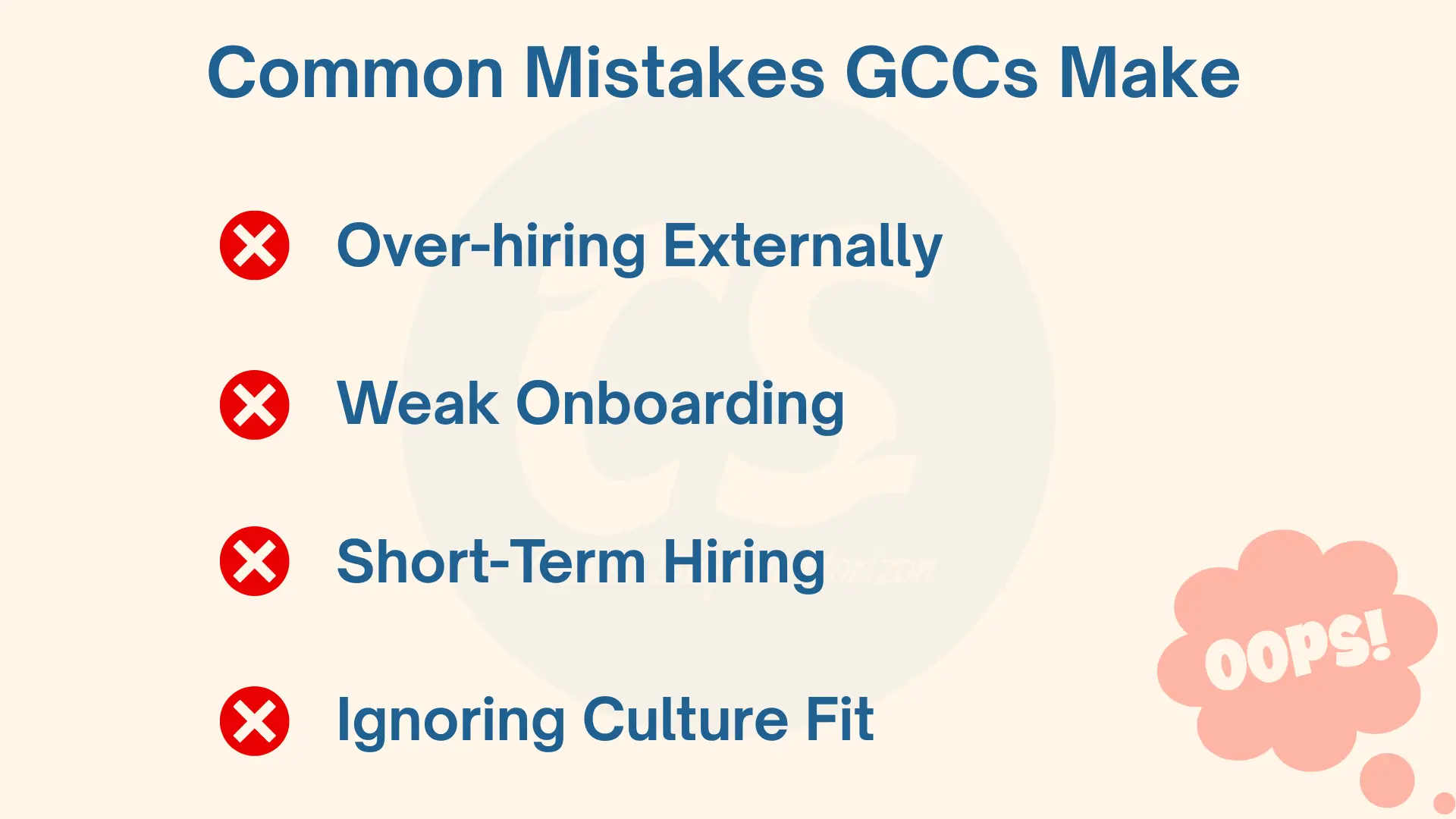
List of common mistakes GCCs make

  • Over-relying on external hiring and ignoring internal pipelines. That demotivates high potential.
  • Skipping structured onboarding, assuming smart people will figure it out. They won’t.
  • Hiring only for today’s needs. The role you’re filling will evolve in 18 months; hire with that horizon.
  • Underestimating cultural adaptability. Leaders fail less for skills, more for fit.

Avoiding just these four mistakes saves companies months of frustration.

What’s next for GCC leadership after 2025? 

The next wave of GCC leadership will face even bigger shifts:

  • AI won’t just support decisions; it will drive them. Leaders will need to be fluent in partnering with algorithms. 
  • Sustainability and governance will creep into leadership KPIs as global HQs push for responsible growth. 
  • Leadership talent pools will go borderless. You may have a GCC leader managing hybrid teams spread across multiple continents. 

In short, the bar for GCC leadership is only going higher. The earlier you start building that future-ready bench, the stronger your edge will be.

Final word from a recruiter’s lens 

There’s no shortcut to building a future-ready leadership team in GCCs. It takes clarity on roles, balance between internal growth and external hiring, a strong cultural filter, and yes, the courage to let go of leaders who can’t scale. 

But if you get this right, your GCC stops being a support centre and becomes a true growth engine.

Want leaders who can rewrite them for tomorrow? Contact.

Frequently Asked Questions

The FAQ: What Employers and HR Heads Ask

Because, you’re hiring influence, vision, and the ability to bridge HQ expectations with local realities.

Look beyond the CV. Use structured interviews, 360-degree references, and simulations to see how they influence, not just what they know.


A lack of cultural agility. Leaders who can’t adapt between global and local contexts often fail despite strong technical skills.

Plan your strategy ahead. Leadership searches can’t be rushed. A short-term quick hire often costs more than investing time in the right fit.

Structured onboarding, continuous development, and giving leaders visibility with HQ helps build stickiness.


Curiosity. Leaders who stay open to AI, automation, and new ways of working adapt faster than those relying only on past playbooks.

Share this article

Related Articles

Browse the latest career advices

Top 5 Leadership Hiring Trends Shaping India’s C-Suite Market
India’s C-suite is no longer defined by experience alone. It’s defined by adaptability. Across industries, from manufacturing to pharma, renewables to technology, companies are reshaping what they expect from leadership....
Why Emotionally Intelligent Hiring Defines the “Right Fit”
Have you ever met someone brilliant at their job but suddenly “not themselves”? That’s often where emotionally intelligent hiring makes all the difference.  During one of his corporate leadership training...
Why Emotional Intelligence in Leadership Matters
When it comes to leadership, technical skills open the door, but emotional intelligence keeps it open.  That was the focus of a recent conversation between Amit Sidana, founder of Corporate...
Leadership Retention in India: The Rising CXO Exit Wave
Every time a CXO quits, a company doesn’t just lose a leader; it loses a version of its future. Yet across India, more top executives are walking out mid-strategy than...