
Loading...

How to Write a Job Description and Why it Matters for Employers

If you want fewer hiring headaches and better candidates on your team, it starts with a job description that’s clear, honest, and specific. Knowing how to write a job description...
How to Write a Job Description and Why it Matters for Employers

If you want fewer hiring headaches and better candidates on your team, it starts with a job description that’s clear, honest, and specific. Knowing how to write a job description effectively means crafting a post that says exactly what you need, attracting the right people. When your job post says exactly what you need, it attracts the right people.

But when details are unclear or the text feels too generic, the candidates best suited for your company simply look elsewhere, and you’re left reviewing resumes that don’t fit your needs.

You’re focused on making the hiring process smoother and your reputation stronger. The right job description does this for you; it saves you time, reduces awkward interviews, and brings in qualified talent. Think of it as your filter, allowing you to spend time on applicants who “get it” from day one.


How job descriptions shape your hiring results

One recruiter struggling with a generic job description and another one is thriving with a clear job description

Have you spent hours reading applications from people who aren’t a match?

That’s the result of an unclear job description. When you align your job ad with the role and your goals, you set expectations early, keep your hiring team focused, and turn your recruitment into a talent acquisition strategy instead of guesswork.

Whether you handle hiring in-house or partner with a recruitment agency, a well-crafted job description is your essential foundation for success.

When candidates start saying, “I can see myself in this job,” your job description is working in your favour.

What’s in it for employers and candidates

Your job description is more than a list of tasks. It’s the first introduction people get to your company. This is your opportunity to highlight what your business stands for, what you value, and who you’re looking for.

Candidates get clear direction about what you need, where they might fit, and how they could grow with you.

So, a clear JD means a win-win for both.

What You Should Include in a Modern Job Description
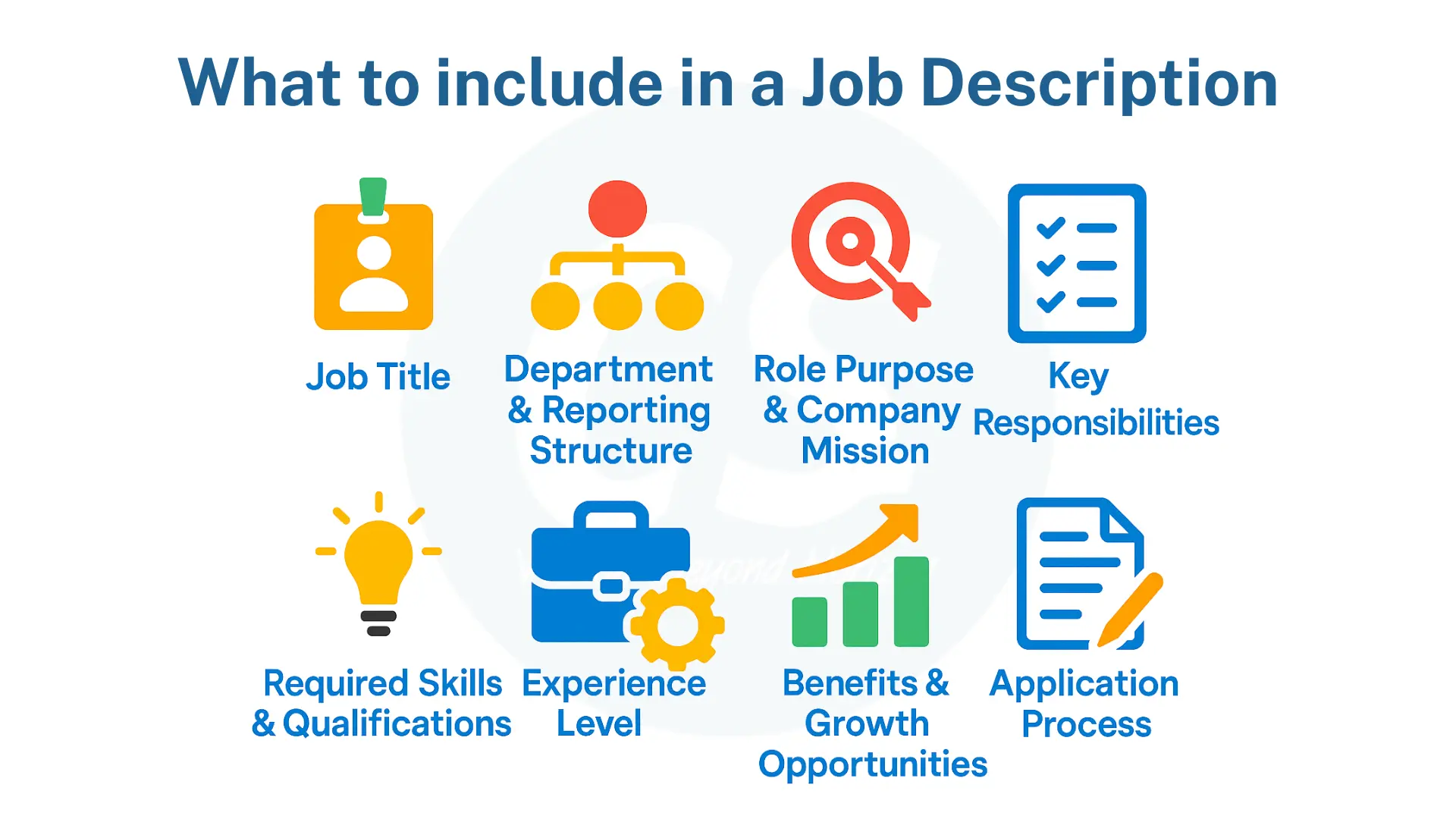
 

list of icons depicting 8 steps on how to write a job description

If you want your job description to stand out and attract the best candidates (and rank high in search), always include: 

  • Job Title: Use a common, accurate title like “Sales Executive.” It will draw more relevant applicants than creative terms. 
  • Department & Reporting Structure: Name the team and clarify who they’ll report to. It helps applicants understand where they’d fit. 
  • Role Purpose & Company Mission: Explain how this job helps achieve broader company goals. Show why the work matters. 
  • Key Responsibilities: Use clear bullet points. Each point should describe what needs to be done and, when possible, what it achieves. 
  • Required Skills & Qualifications: Be specific about must-have versus preferred skills to help candidates self-select. 
  • Experience Level & Working Conditions: Say whether the position is entry-level, mid, or senior, and outline work hours, flexibility, or remote options. 
  • Benefits & Growth Opportunities: Share what you offer—career advancement, company perks, training, or workplace culture. 
  • Application Details: Make it easy to apply and explain what happens next. Tell candidates exactly how to send their application and what response time to expect.

Step-By-Step: How to Write a Job Description That Works for Employers 

1. Tie Every Role Directly to Your Mission 

Action: Start your JD draft with a statement showing how the role supports your company’s big picture. 

Example: “This role helps our company deliver exceptional customer service, which is our brand promise.” 

2. Describe Responsibilities as Measurable Outcomes

Action: For each responsibility, list what success looks like. 

Example: Change “Manage sales pipeline” to “Achieve monthly growth targets by managing the sales pipeline and following up on leads.” 

3. Separate Must-Have from Nice-to-Have Skills

Action: List essential skills separately from desirable ones to help candidates quickly assess fit.

Example: Instead of mixing skills, write “Must have 5 years of accounting experience” and separately list “Nice to have experience with SAP software.”

4. Use straightforward language

Action: Write your job description as if speaking to a future teammate; keep it simple, clear, and friendly.

Example: Change “Facilitate cross-departmental collaboration to optimise synergy” to “Work closely with other teams to get things done smoothly.”

5. Define your application process

Action: Provide clear instructions on how to apply and outline what candidates can expect next.

Example: “Send your resume and cover letter by email. We’ll review applications within two weeks and update you on next steps.”

By breaking each section down and being as direct as possible, your job description will work harder for you, attracting the right candidates for your team. 

How to Use AI Tools Effectively for Job Descriptions

a person using AI in laptop

There are plenty of AI tools like ChatGPT or Perplexity to create job descriptions. In fact, as soon as you type “How to create a job description” and press enter, they provide you with results at lightning speed. It’s tempting to rely on the convenience they offer with just one click.

However, AI-generated content is often too generic, which leads to confusion for both applicants and your talent acquisition (TA) team. Many job descriptions written with AI, or simply copied and pasted from the internet, lack the clarity that comes from thoughtful customisation.

AI tools can jumpstart the process of writing job descriptions, but they require the judgment and insight of a skilled recruiter. Someone who truly understands both the job requirements and the needs of candidates and clients.

AI can make your job descriptions truly effective if:

  • Clearly separate “must have” and “good to have” skills.

  • Double-check that all requirements are truly needed.

  • Match the tone to your company’s culture.

  • Personalise with team and workplace details.

  • Use AI as a helper; the final review should be yours.

Treat artificial intelligence (AI) as an assistant, not the final editor. Only by thoughtfully refining and humanizing what AI tools like ChatGPT or Perplexity draft can you achieve clarity and attract the right talent for your business needs.

Ready to take the next step? Request a callback from Corporate Stalwarts and start building your best team.

The FAQ: What Employers and HR Heads Ask

Frequently Asked Questions

Use standard, commonly searched job titles and industry-relevant terms (e.g., “Sales Manager”, “Data Analyst”). Include specific role-related skills and phrases candidates use when searching.

Review and update job descriptions at least annually or whenever there are major changes in job responsibilities or company strategy to ensure accuracy and relevance for candidates.

Job descriptions are detailed documents outlining the role’s duties and requirements for internal HR use; job postings are external advertisements designed to attract candidates, optimized with persuasive language and SEO.

Clearly specify the work arrangement (remote, in-person, hybrid) upfront. Detail expectations about location, schedule, communication tools, and any remote-work benefits or flexibility.

Popular AI tools include ChatGPT, Perplexity, and ATS-integrated writing assistants. They provide good drafts but require human customization to fit your company’s tone, clarify must-have skills vs. preferences, and avoid generic content. 

Share this article

Related Articles

Browse the latest career advices

Top 5 Leadership Hiring Trends Shaping India’s C-Suite Market
India’s C-suite is no longer defined by experience alone. It’s defined by adaptability. Across industries, from manufacturing to pharma, renewables to technology, companies are reshaping what they expect from leadership....
Leadership Retention in India: The Rising CXO Exit Wave
Every time a CXO quits, a company doesn’t just lose a leader; it loses a version of its future. Yet across India, more top executives are walking out mid-strategy than...
How to Build Future-Ready Leadership Team in GCCs in 2025
If you run or support a GCC today, you already know this… things aren’t the same anymore. What used to be back-office hubs have become the engines of global strategy....
Leadership Hiring Challenges in 2025: How to Fix Them
If you’re trying to hire senior leaders in 2025, you’ve probably noticed how tough it’s become. Every conversation with HR leaders, CEOs, or talent heads circles back to the same...