
Loading...

Lateral Hiring in India: Complete Guide for Companies Hiring Experienced Talent

What happens when someone experienced leaves your team and you need a replacement fast? The team gets overwhelmed, and training someone takes months. Lateral hiring in India is how companies hire experienced professionals...
Posted in Lateral Hiring   •   Services
20/02/2026
Lateral Hiring in India: Complete Guide for Companies Hiring Experienced Talent

What happens when someone experienced leaves your team and you need a replacement fast? The team gets overwhelmed, and training someone takes months. Lateral hiring in India is how companies hire experienced professionals from other organisations without the long training periods. Unlike campus hiring, where you wait years for productivity, lateral hiring gives you someone contributing in 30 days. 

Most companies need lateral hiring when critical team members leave, when they’re expanding fast, or when they need skills their current team doesn’t have. But it only works if you understand how experienced hiring differs from campus recruitment, especially in India, where 90-day notice periods and compensation expectations change the entire process. 

This article explains exactly when lateral hiring fits your needs, how it works, what you’ll pay, and common mistakes that turn good hires into quick exits. 

What is lateral hiring? 

Lateral hiring means recruiting experienced professionals from other organisations to fill roles at similar seniority levels. You’re not hiring freshers who need training. Instead, you’re not promoting internally and creating cascade gaps. Rather, you’re bringing in someone who has already done this job successfully elsewhere. 

Key characteristics of lateral hiring:

  • Target: 3-10+ years of relevant experience 
  • Level: Mid-level individual contributors to senior managers 
  • Timeline: Immediate contribution expected (30-90 days maximum ramp-up) 
  • Compensation: Market rates or a premium for specific expertise 
  • Industries: Especially common in IT, BFSI, manufacturing, pharma, FMCG 

How lateral hiring differs from alternatives 

vs Campus hiring:

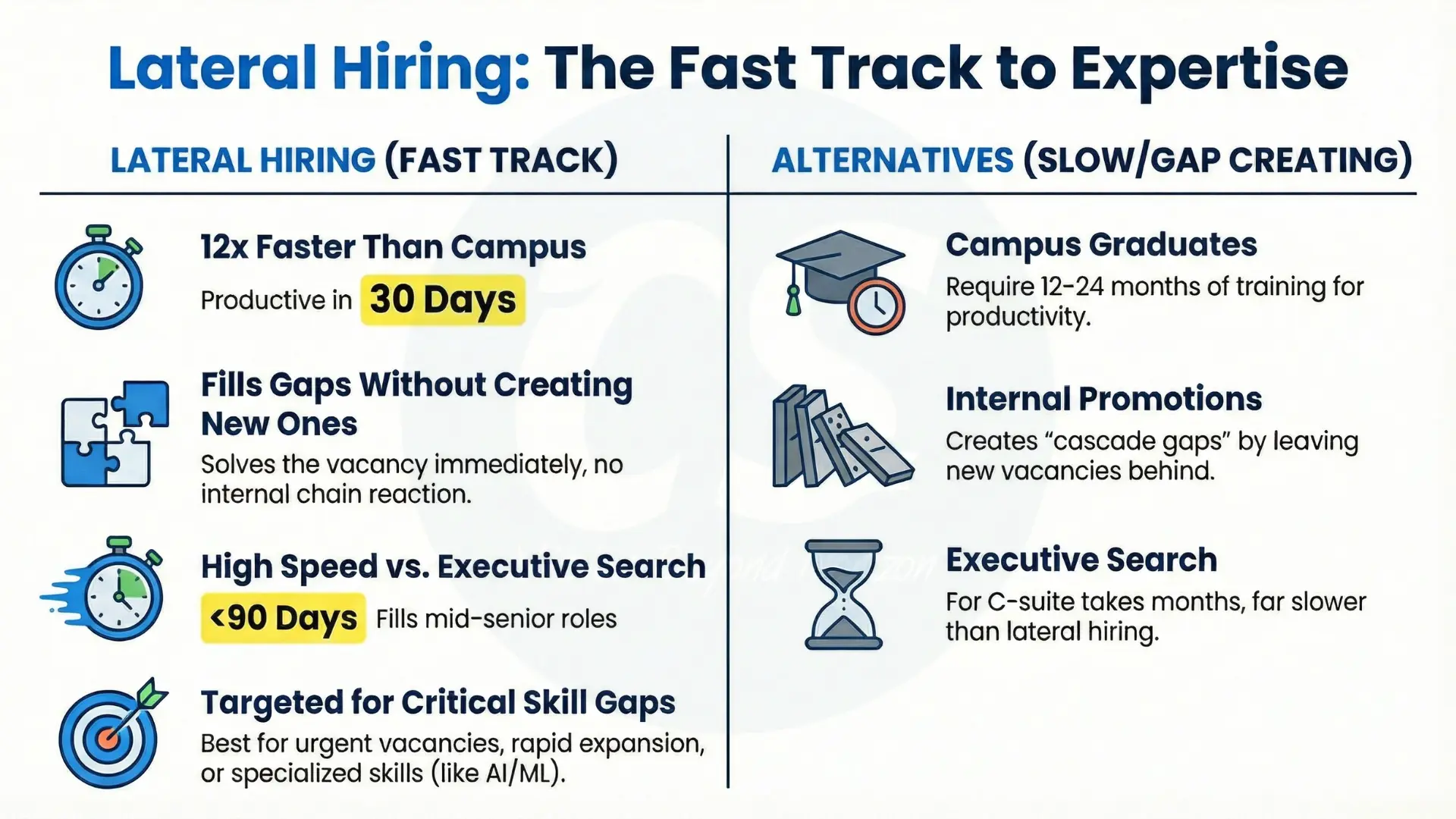
The campus provides graduates who require 12-24 months of training before making a productive contribution. In contrast, lateral gives you professionals contributing in 30 days. While campus costs less initially, it requires an investment in training. Lateral costs more upfront but delivers immediate returns. 

vs Internal promotion:

Promotion develops existing employees but creates another vacancy that needs filling. Essentially, you solve one gap by creating another. Lateral hiring in India fills the gap without cascading effects. However, promotion maintains institutional knowledge and cultural continuity. 

vs Executive search:

Executive search targets VP and C-level roles requiring months of passive candidate engagement. Lateral hiring focuses on mid-senior individual contributors and managers available within 30-90 days. 

According to SHRM research, 75% of organisations struggle to fill full-time roles, with technical and soft-skill gaps among applicants being the primary challenge. Lateral hiring addresses this by accessing professionals who’ve already developed these capabilities. 
Lateral-hiring-perks

When do you need lateral hiring in India? 

Use this framework to determine if lateral hiring fits your situation: 

Critical role vacancy with immediate impact needs 

Your finance controller resigned during audit season. Your quality head left before product certification. Similarly, your senior developer departed mid-project release. These aren’t positions you can leave vacant for 6 months whilst training someone. 

Consequently, you need someone who understands audit processes, knows certification requirements, or can review code immediately. In India, lateral hiring finds professionals who’ve handled these exact situations before. 

Skill gaps your internal team cannot fill 

Your company is building AI capabilities, but nobody internally has machine learning expertise. Additionally, you’re expanding to manufacturing but lack supply chain specialists. Furthermore, you’re entering fintech but have no regulatory compliance experience. 

Training existing employees takes 12-24 months minimum. Meanwhile, competitors with these capabilities gain market share. Lateral hiring brings the required expertise immediately. 

Rapid expansion across cities 

You’re opening offices in Bangalore, Hyderabad, and Pune simultaneously. Each location needs team leads, project managers, and senior contributors. However, promoting from within leaves too many gaps. Furthermore, campus hiring provides juniors who need supervision, not professionals who can establish new locations. 

Lateral hiring in India’s metro markets gives you experienced professionals who understand local talent dynamics, salary expectations, and cultural nuances in each city. 

Replacement for high performers who left 

SHRM data shows 61% of employees leave jobs within the first 12 months of hiring. Consequently, when your top performers leave for competitors, you cannot afford skill downgrades. You need like-for-like replacements, maintaining team capability and project momentum. 

Lateral hiring finds professionals at equivalent or superior skill levels, preventing performance drops when key people leave. 

Competitive hiring where speed matters 

Your competitor is expanding their Pune engineering team. They’re offering sign-on bonuses and aggressive timelines. Consequently, if you don’t hire fast, the best available talent will be locked into 90-day notice periods elsewhere. 

In competitive hiring markets, speed determines success. Therefore, lateral hiring processes optimised for quick decisions, offer negotiations, and notice period management win talent battles. 

Start CXO search

Lateral hiring is not for you when

Being honest prevents costly mistakes. Lateral hiring doesn’t fit these situations:

Building junior teams requiring training and mentorship 

If you’re building a team of entry-level engineers, operations associates, or sales development representatives who’ll grow into senior roles over 2-3 years, campus hiring or graduate training programmes work better. Lateral professionals expect immediate autonomy and meaningful work, not supervised learning. 

Budget constraints are preventing market-rate compensation 

Lateral candidates with 5+ years of experience expect salaries 30-50% above entry-level rates. Therefore, if your budget only allows fresher salaries, campus hiring or internal development makes more sense. Underpaying experienced professionals leads to quick attrition. 

Roles requiring deep organisational knowledge 

Some positions need years of understanding your internal systems, politics, stakeholder relationships, and institutional history. Finance roles managing complex inter-company transactions, HR roles handling sensitive employee relations, or operations roles dependent on proprietary processes often perform better with internal promotions than external lateral hires. 

Hiring in bulk where training infrastructure exists 

If you’re hiring 50 similar roles (call centre agents, sales executives, junior analysts) and have robust training programmes, campus or early-career hiring delivers better ROI. Lateral hiring works for specific expertise, not volume. 

Leadership positions requiring culture alignment 

VP and C-level roles need cultural alignment, leadership presence, and organisational influence beyond technical skills. Consequently, these positions require executive search processes with months-long evaluation, not lateral hiring’s speed-focused approach. 

How lateral hiring works in India 

The lateral hiring process differs from campus or executive recruitment in timeline, evaluation methods, and negotiation dynamics. 

Step 1: Role definition and market intelligence 

Define exactly what “experienced” means for this role. Specifically:

  • Minimum years of relevant experience (not just total experience) 
  • Specific technical skills or domain knowledge required 
  • Expected output in first 90 days 
  • Current market availability for these skills 

Subsequently, research market conditions: Are these skills scarce in Bangalore? Does Pune have better availability? What compensation do competitors pay? Understanding market intelligence prevents unrealistic expectations. 

Step 2: Sourcing and screening 

Unlike campus hiring with pre-defined candidate pools, lateral hiring requires active sourcing. Specifically:

LinkedIn outreach: Targeting professionals at similar companies, roles, and experience levels 

Industry networks: Leveraging connections in professional associations, alumni groups, and industry events 

Employee referrals: Your team likely knows talented former colleagues willing to switch 

Recruitment partners: Specialists in lateral hiring services with ready talent pools and market access 

Initial screening focuses on technical match and availability. Can they join within your timeline? Are their salary expectations aligned? Do they have relevant domain experience? 

Step 3: Technical and cultural evaluation 

Lateral candidates undergo rigorous assessment:

Technical evaluation: Practical tests, case studies, or project reviews demonstrating current capability. Importantly, you’re not assessing potential; you’re verifying existing expertise. 

Cultural fit: Values alignment, work style compatibility, and team dynamics matter more for experienced hires who won’t undergo extensive onboarding. Therefore, misalignment leads to quick exits. 

Reference checks: Speaking with previous managers reveals work ethic, collaboration ability, and reasons for leaving past employers. Notably, in India’s interconnected professional networks, references carry significant weight. 

According to industry data, organisations implementing comprehensive lateral hiring evaluation processes achieve 87% higher retention rates compared to speed-focused hiring without proper assessment. 

Step 4: Offer negotiation and notice period management 

Lateral hiring negotiations differ from campus offers. Specifically:

Compensation: Expect 20-40% increment requests. Notably, candidates switching jobs seek significant upward movement, not marginal increases. 

Notice periods: 30-90 days are standard. Furthermore, discuss early release possibilities with candidates. Some negotiate buyouts (you pay your current employer to release them early). 

Counter-offers: Strong performers often receive counter-offers from current employers. Consequently, your offer must be compelling enough to reject retention attempts. 

Joining timelines: Clarify exact joining dates, accounting for notice periods, any gap between jobs, and relocation if relevant. 

Indian professionals often juggle multiple offers simultaneously. Speed and decisiveness in your process determine whether you win desired candidates.

Common mistakes in lateral hiring

Organisations repeatedly make these errors. Avoid them: 

Assuming experience = performance 

A candidate with 8 years at one company may have 1 year of experience repeated 8 times. Rigorous technical assessment prevents hiring people who’ve stagnated in comfortable positions. Evaluate what they’ve actually accomplished, not just tenure. 

Skipping cultural fit evaluation 

Technical skills without cultural alignment create friction. An aggressive, competitive individual joining a collaborative, consensus-driven team struggles regardless of capability. Research from MIT Sloan Management Review found that toxic culture is 10 times more important than compensation in predicting turnover. Cultural mismatches account for 60% of lateral hire failures in the first year. 

Unrealistic expectations for immediate contribution 

Even experienced professionals need 30-60 days to understand your context. Expecting day-one productivity from someone learning new systems, teams, and processes sets everyone up for frustration. Define realistic 30-60-90 day goals. 

Ignoring notice period realities 

“We need someone to start Monday” doesn’t work in India’s 30-90 day notice period environment. Planning hiring timelines that respect standard notice periods prevents desperation hiring and excessive buyout costs. 

Competing only on salary 

Whilst compensation matters, top lateral candidates evaluate growth opportunities, work environment, team quality, and leadership. Companies winning talent battles offer compelling career narratives, not just the highest salaries. 

Inadequate onboarding for experienced hires 

Assuming lateral hires don’t need onboarding because they’re experienced leaves them struggling with your internal processes. Studies show that strong onboarding boosts retention by 52% and productivity by 60%. Structured onboarding covering systems, stakeholders, and expectations accelerates integration and prevents early departures.

Which hiring model suits your needs? 

Different situations require different approaches. Find your fit: 

Need immediate skilled professionals to replace departures or fill gaps? 

 → Lateral Hiring Services – Experienced talent contributing from day one 

Hiring 15-50 people annually with unpredictable volumes? 

 → Virtual Hiring – Fixed cost, unlimited capacity 

Need dedicated recruiting resources for 6-18 months? 

 → Dedicated Resource Model – Your extended recruitment team 

Hiring VP and C-level leaders? 

 → Executive Search – Specialised leadership acquisition 

Building GCC teams across India? 

 → Combined lateral and volume hiring strategies for the capability centre expansion 

Not sure which model fits your situation? 

 → Talk to our hiring consultants – Get personalised recommendations 

Transform your hiring with Corporate Stalwarts Lateral Hiring

Corporate Stalwarts provides lateral hiring in India that connect you with experienced professionals ready to contribute immediately. Whether you’re replacing critical departures, filling skill gaps, or expanding teams across multiple cities, our lateral hiring expertise delivers quality candidates faster than traditional recruitment. 

What we deliver:

  • Access to pre-screened talent pools across IT, FMCG, manufacturing, pharma, and BFSI 
  • Technical assessment and cultural fit evaluation 
  • Notice period negotiation and joining timeline management 
  • Coverage across Bangalore, Mumbai, Pune, Hyderabad, Delhi, and tier-2 cities 
  • Replacement guarantee if hires don’t meet performance expectations 

Real results:

“We needed a senior QA engineer with pharma domain knowledge within 30 days. Corporate Stalwarts delivered three qualified candidates in 10 days. Our chosen hire was productive from week two.” — Rajesh Kumar, Engineering Head, Hyderabad-based Pharma Company 

We’ve helped organisations hire from 5-person startups to 500+ employee enterprises, across industries and experience levels. Whether you need specialised technical talent, experienced managers, or domain experts, our lateral hiring process delivers professionals who match your requirements and join within your timelines. 

Ready to fill critical positions fast? 

Start CXO search

Frequently Asked Questions

Lateral hiring specifically targets experienced professionals from similar roles in other organisations. Regular recruitment encompasses all levels, including freshers, entry-level, and mid-senior positions. Lateral hiring assumes minimal training needs and immediate contribution capability.

Combine technical assessments (practical tests, case studies), behavioural interviews (past accomplishment discussion), reference checks (previous manager feedback), and trial projects (paid assignments before full hiring). This multi-method evaluation predicts performance better than resume reviews alone. 

Yes, but strategically. Hire lateral professionals for critical roles where experience matters (technical leads, domain experts, revenue-generating positions) whilst building junior teams through campus hiring. This hybrid approach balances speed and cost. Virtual hiring models also make lateral recruitment more affordable through fixed-cost structures. 

Most lateral hiring services offer 60-90 day replacement guarantees. If hires leave or underperform within this period, replacements are provided at no additional cost. Internally, have clear performance expectations, regular check-ins, and exit criteria defined upfront to address issues quickly. 

We offer what large organisations cannot: meaningful impact, faster career progression, direct leadership access, and equity opportunities for lateral hiring in India. Top professionals often trade big company brand names for startups and mid-size firms offering substantial ownership and influence. 

Yes, actively target candidates serving notice. They've already decided to leave, cleared emotional hurdles, and are more committed to switching than passively browsing opportunities. Understand their notice period end date and plan onboarding accordingly. 

Share this article

Related Articles

Browse the latest career advices

20/02/2026
Retained Search in India: When to Pay Upfront for Executive Hiring
Most companies discover retained search in India the hard way. A critical CXO hire fails. The board asks questions. Someone finally explains that filling leadership roles the same way you fill mid-level positions...
13/02/2026
Virtual Hiring Model: Hire Unlimited Candidates at One Fixed Cost
How much did you actually spend on recruitment last year? Not the number your staffing agencies invoiced. The real cost: ₹6.8 lakhs in placement fees, 127 hours your hiring managers spent in interviews, 3...
Dedicated Resource Model: Scalable Hiring Without Payroll
Every article explaining the hiring model gives you the same useless comparison table: “RPO is scalable, staffing is flexible, and permanent hiring gives you control.” Great. But which one actually works when you’re hiring 35 people over 8 months for a...
09/02/2026
RPO Services: Complete Guide to Recruitment Process Outsourcing in India
RPO services: Why do companies hire 100+ people annually but still can’t build an internal TA team that works? The problem becomes visible when startups scale from 50 to 300 employees in 18...