
If you’re trying to hire senior leaders in 2025, you’ve probably noticed how tough it’s become. Every conversation with HR leaders, CEOs, or talent heads circles back to the same concern: leadership hiring challenges are eating up more time, resources, and opportunities than ever before.
The reason is clear. Today’s organisations are looking for leaders who can drive transformation, adapt to uncertainty, and inspire teams to perform at their best. And yet, the leadership talent shortage means the pool of candidates who can do all of that is shrinking fast.
This guide walks you through the most common leadership recruitment challenges companies are facing in 2025, why they matter, and how to solve them. From practical leadership hiring solutions to the role of a leadership recruitment firm or executive search partner, you’ll find clear, actionable steps to attract and retain the leaders your business needs.
Table of Contents
ToggleWhy is leadership hiring more difficult than other roles?

When you’ve been in leadership recruitment long enough, you notice one big truth:
Hiring a senior leader is about betting on the company’s future.
What makes it tricky is the margin for error. A mis-hire at mid-level sets you back a few months. But if a C-suite executive doesn’t fit, you can derail an entire strategy, shake investor confidence, and push good employees out the door.
I’ve watched organisations lose millions because the wrong leader was sitting in the chair for just a year. That’s why senior management hiring challenges carry such heavy consequences.
What most employers don’t always see is that hiring leaders work very differently from other roles:
- They’re rarely actively applying; most are approached through networks or executive search firms.
- They’re usually balancing multiple offers, sometimes from several industries at once.
- They want more than a pay cheque; succession plans, company culture, flexibility, and reputation weigh heavily.
- It’s never one-sided; leaders evaluate you as much as you assess them.
- In 2025, expectations are even higher. Hybrid work and digital disruption mean leaders must guide teams they might never meet in person.
When I assess senior candidates, I look far beyond resumes. I’m asking: can they adapt quickly? Do they show emotional intelligence? Can they inspire dispersed teams?
These qualities are hard to test in an interview, and missing them leads to exactly the employer leadership recruitment problems so many companies are struggling with.
Hiring leaders today requires more than traditional recruitment. It’s about sharp insight, strong networks, and the ability to spot true potential beyond credentials.
Leadership hiring challenges employers face in 2025
1. Shortage of qualified leadership candidates
The most common of all recruitment challenges for employers today is the lack of qualified executive-level talent. This challenge isn’t only about numbers but also about quality. Candidates have technical expertise but lack the leadership maturity needed for today’s fast-changing markets.
Industries like technology, healthcare, and FMCG face the toughest top-level hiring difficulties. The result? Higher salaries, dragged-out hiring processes, and, in many cases, misaligned hires. No wonder employer hiring challenges are at their peak in this area.
2. Struggling to match leaders with company culture
Of all the executive recruitment challenges in 2025, especially when recruiting for CEO/CXO roles, cultural misfit remains one of the hardest to solve. Technical skills may get someone hired, but cultural alignment determines whether they succeed.
Organisations are addressing this with leadership assessment for hiring, which includes behavioural interviews, values alignment testing, and conflict-resolution exercises. The ultimate goal is finding the right leader who elevates both performance and culture.
3. Slow hiring process for senior roles
In recruitment, speed matters. And yet many face C-suite recruitment issues caused by slow decision-making and long interview loops. Approvals often stall, interviews stretch into weeks, and top candidates drop out midway.
Globally, the average hiring process for senior executives goes beyond 60 days. Companies using automation, AI-driven sourcing, and streamlined workflows cut that number in half, giving them a clear edge in the war for leadership talent.
4. Difficulty judging leadership skills in interviews
Traditional interviews fall short when it comes to evaluating how a potential executive will perform under pressure. This gap is why so many employers face persistent executive hiring challenges.
Forward-thinking companies now combine:
- Scenario-based evaluations to test real-world decision-making
- Leadership-specific assessments
- Comprehensive reference checks
These executive talent acquisition strategies dig deeper than standard Q&A and highlight leaders’ actual ability to guide organisations through change.
5. Negotiation challenges with executive salary and benefits
While hiring senior executives, you’ve probably felt the squeeze of rising compensation expectations. Leaders want more than salary. They weigh equity, flexibility, perks, and long-term growth opportunities. These demands often reflect broader CEO hiring challenges facing organisations globally.
Transparency and flexibility are the antidote. Share salary ranges early and position offers holistically. Factors such as succession planning and hiring opportunities, leadership autonomy, and personal growth paths can make just as much of a difference as raw pay.
6. Losing new leaders soon after they start
Recruitment is not the finish line; it’s only the start. Unfortunately, nearly 40% of leadership hires leave within 18 months, usually due to unclear expectations or poor onboarding programmes.
This is where leadership retention issues surface. Companies that invest in role clarity, structured onboarding, executive coaching, and consistent feedback loops see far higher retention rates when hiring leaders for senior roles. According to SHRM, employees are 58 per cent more likely to stay if the onboarding is clear.
7. Not enough diversity in leadership hires
Despite progress, diverse leadership pipelines remain a major blind spot. Lack of diversity is one of the most visible leadership recruitment challenges today, limiting innovation and adaptability.
Forward-looking organisations broaden sourcing pipelines, work with leadership staffing agencies specialising in underrepresented talent, and build inclusive panels. Ultimately, attracting top leadership talent requires an authentic demonstration of inclusion as a business priority.
8. Poor company reputation scaring off top leaders
Successful executives evaluate your company’s culture and reputation carefully before they engage. Company reviews, leadership credibility, and employer history all play a part. Weak branding equals missed hires.
Data backs this up. LinkedIn’s Employer Branding Report highlights that 86% of job seekers read company reviews before applying for a job. Improving reputation can cut many leadership hiring challenges you may be experiencing.
9. Lack of leadership succession planning
Many long-term executive hiring challenges stem from a lack of planning. Far too often, businesses wait for leaders to resign before scrambling for a replacement. This reactive approach causes unnecessary delays and disruption.
Robust succession planning and hiring strategies, frequent leadership reviews, and external pipeline-building help organisations avoid costly gaps and maintain momentum, even during C-suite exits.
How to solve leadership hiring challenges
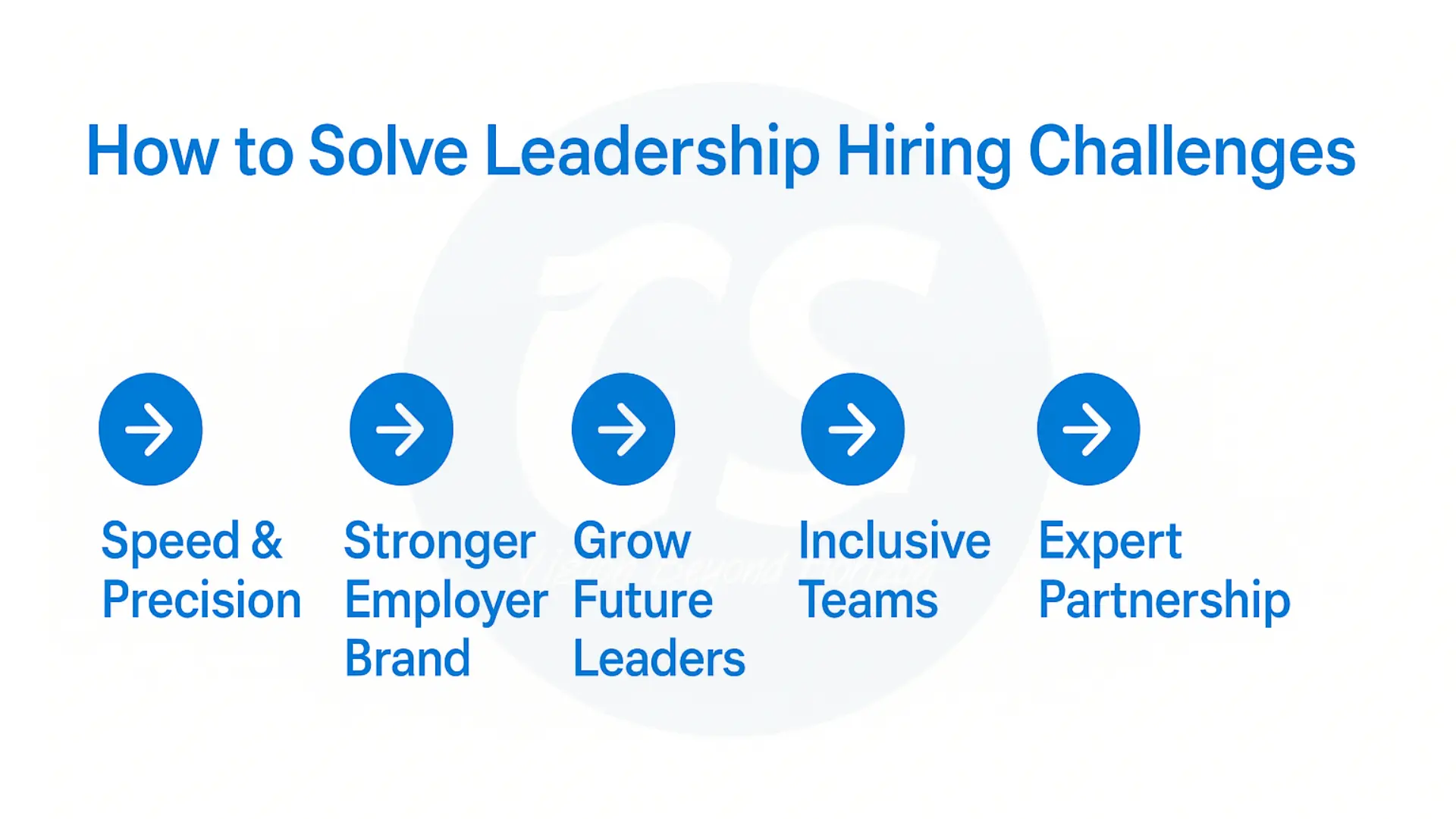
Here are proven leadership hiring solutions employers are using in 2025:
• Make Your Process Faster and Smarter
Use automation and AI to accelerate leadership talent acquisition while keeping human interaction central. Combine technology with scenario-based evaluations for speed and quality.
• Build a Strong Employer Brand
Your culture, values, and growth vision are your best recruiters. Executives choose brands with a powerful identity.
• Keep and Develop Leaders Post-Hire
Clear onboarding, mentorship support, and leadership upskilling reduce turnover and reinforce long-term loyalty.
• Expand Diversity in Executive Hiring
Casting wider nets attracts unique perspectives. Inclusive pipelines nurture more agile and creative leadership teams.
• Partner With a Leadership Recruitment Firm or Executive Search Expert
Sometimes the best move is outsourcing. A leadership recruitment firm or executive search partner brings networks, confidential sourcing, and negotiation expertise. Plus proven leadership staffing solutions that save time and cost.
Related: Avoiding Executive Hiring Mistakes
Leadership hiring success stories

European Auto Giant’s India Entry
A 100-year-old European auto giant entered India with almost no local setup; just one transferred employee and no infrastructure. Building credibility depended on securing the right leadership for their new bearings division.
Challenge: High-stakes first hire; need for a trusted senior leader to drive growth with minimal local support.
Solution: Corporate Stalwarts identified and placed a proven national sales head aligned with their business goals and industry outlook.
Impact:
- The bearings division recorded rapid growth
- Partnerships built across the railways, auto, textile, and government sectors
- Profitability increased, and expansion momentum was secured
Logistics Company in India
A Europe-based logistics company entered India with no office infrastructure and just one transferred employee. They needed a dependable CFO/financial controller to build credibility and drive growth.
Challenge: Bare-minimum setup, no local support, and a critical need for a trustworthy financial leader to spearhead operations.
Solution: Through targeted executive search, candidate mapping, and background verification, Corporate Stalwarts secured a proven CFO/financial controller.
Impact:
- CFO hire established financial control and trust
- Team grew from 1 to 150+ employees
- Strong India operations set up from scratch
- Long-term leadership provided for ongoing expansion
Conclusion
Yes, leadership hiring challenges in 2025 are complex but also solvable. With sharper evaluations, technology, employer branding, and diversity strategies, organisations can find and retain transformational leaders.
Whether you’re struggling with executive hiring challenges, senior management hiring challenges, or more general employer hiring challenges, the solution lies in being proactive.
Partnering with the right leadership recruitment firm gives you access to curated networks, market intelligence, and customised leadership hiring solutions that deliver measurable results.
The FAQ: What Employers and HR Heads Ask
Frequently Asked Questions
Leadership roles demand unique strategic skills, vision, and cultural fit. The candidate pool is smaller, and a wrong hire can have major consequences, making the process more difficult than for other positions.
Combine behavioral interviews with scenario-based questions and in-depth reference checks. This approach reveals how candidates handle real challenges and fit with your company culture.
Avoid rushing decisions, neglecting cultural fit, failing to provide a good candidate experience, and not investing in onboarding; these mistakes often lead to turnover and wasted effort.
Yes. AI helps speed up candidate sourcing, screening, and scheduling, but it should support recruiters (not replace them) in the nuanced judgement needed for leadership hiring.
Leaders shape company culture and values. A poor fit can disrupt teams, reduce morale, and increase departures, while good alignment drives performance and engagement.
Effective onboarding, consistent communication, leadership development, and aligned expectations are key to keeping new hires motivated and committed.
Expand recruiting channels, remove biases in hiring tools, use diverse interview panels, and create an inclusive culture to attract and retain diverse leaders.
Expect more AI integration, a focus on soft skills and adaptability, remote leadership capabilities, diversity initiatives, and faster, candidate-focused processes.
Ensure clear, timely communication, respect candidates’ time, provide honest feedback, and offer flexibility in interviews and assessments.
Succession planning prepares your organisation for smooth transitions, reduces gaps, and identifies internal talent ready to step up when needed.

Corporate Stalwarts is a trusted recruitment firm with 20+ years of expertise in executive search and leadership hiring.
We’ve placed 10,000+ candidates across 600+ companies in FMCG, Manufacturing, IT, Pharma, and more. Our 1M+ candidate pool and 48-hour turnaround enable fast, high-quality hiring solutions.
We help businesses build high-performance teams with precision, speed, and industry expertise.