


Why does a recruitment agency keep sending the wrong candidates?
In most cases, the recruitment agency sending wrong candidates is not incompetent. The model they are working under makes it structurally difficult to do what a senior search requires.
Why the contingency model fails at the senior level
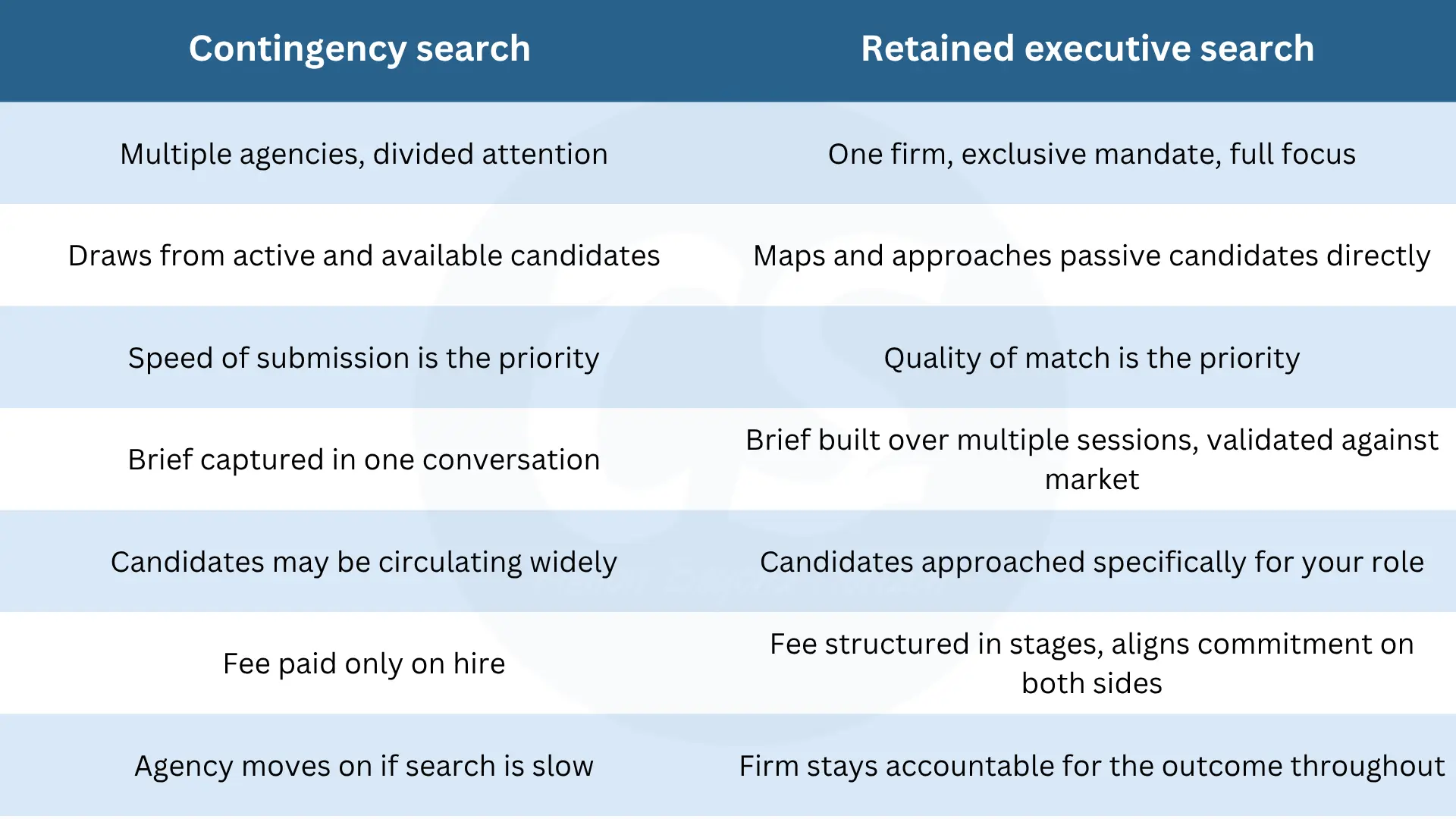
Most recruitment agencies in India operate on contingency. They only earn a fee when a candidate they submit gets hired. That single fact changes everything about how they run the search.
When working on contingency, an agency typically carries four or five other open mandates at the same time. Their revenue depends on speed, not depth. The fastest path to a placement fee is to submit candidates who are:
- Already in the database
- Already available and between roles
- Already interviewing with other companies
That is the pool the contingency model draws from. It is not the pool where your ideal candidate sits.
What the brief never captures
In a contingency arrangement, the agency invests a limited time understanding the brief deeply. That investment does not generate a fee on its own. So the search starts before the nuance is understood.
The things that determine whether a candidate will succeed go unexamined:
- The leadership style the team needs right now
- The specific commercial challenge the role owner inherits on day one
- The cultural dynamics that caused previous hires in this seat to struggle
Without that depth, the agency searches on the profile. Profile alone rarely predicts performance at the senior level. Research from the Center for Creative Leadership consistently finds that senior leaders fail not because of technical gaps but because of misalignment in judgment, style, and context. These are exactly the things a surface-level brief never surfaces with.
What the wrong CVs are telling you
Rather than reviewing each profile individually, look at them together. Three patterns tend to emerge. Each one points to a different root cause.
- Everyone on the list is currently available. Every profile belongs to someone between roles or has been on the market for several months. The agency draws from its existing database rather than mapping who to approach. That pool skews toward people with gaps to explain, not people with momentum in a current role.
- The role has been read at the title level. A B2C sales head submitted for a B2B mandate. A services finance leader was put forward for a manufacturing role. This signals the agency interpreted the job title and stopped. The sector context and commercial specifics that determine fit did not factor in.
- Profiles sent to show activity. Some agencies contact candidates briefly, get a polite response, and submit the profile hoping the client’s interest creates momentum. If you call these candidates and find they were lukewarm from the first conversation, this is what happened.
Knowing which pattern applies tells you exactly what needs to change.
4 steps to fix a ‘not-working’ recruitment agency search
The instinct when an agency search produces nothing useful is to add more agencies or lower the brief. In my experience, both moves make the situation worse.
Adding agencies increases the volume of profiles without improving quality. Adjusting the brief to fit what is available means hiring to the wrong standard. That decision stays with the business for years.
Here is the sequence that works.
Step 1 — Audit the profiles you have received
Look across all the profiles and identify what they have in common. Use the three patterns above as your diagnostic.
Ask yourself:
- Are all the candidates currently available and not in active roles?
- Is the seniority level consistently off across all profiles?
- Do profiles share a background adjacent to but not quite right for the role?
The pattern of what is wrong tells you more than any individual CV. Diagnosis first. Action second.
Step 2 — Rebuild your brief around outcomes
The standard job description format lists responsibilities, required experience, and competencies. That works well for mid-level roles. At the VP and CXO level, it drives a search toward CV matching rather than leadership matching.
The most useful brief for a senior search answers three questions:
- What does success look like at 6 months, 12 months, and 3 years?
- What specific challenge does the incoming leader inherit on day one?
- What are the team and business dynamics they are stepping into?
That brief attracts a fundamentally different quality of conversation. It speaks directly to what strong leaders evaluate when considering a move.
Step 3 — Have a direct conversation with your recruitment agency
Before moving to a different model, be direct about what you are seeing. Share specific feedback on why each profile did not work.
Then ask two questions:
- Of the candidates submitted so far, how many held an active role and were not looking when the agency first contacted them?
- How many other clients is the agency currently working for on a similar role?
Those two answers tell you whether the search has a future or whether the model needs to change entirely.
Step 4 — Check if the model fits the role
If your recruitment agency keeps sending wrong candidates at this level, the issue is almost always the model, not the market.
For most roles at the VP level and above, a retained executive search will consistently produce better outcomes than a contingency arrangement.
The reason is structural. Retained search aligns the firm’s incentive with the quality of the outcome, not the speed of the submission.
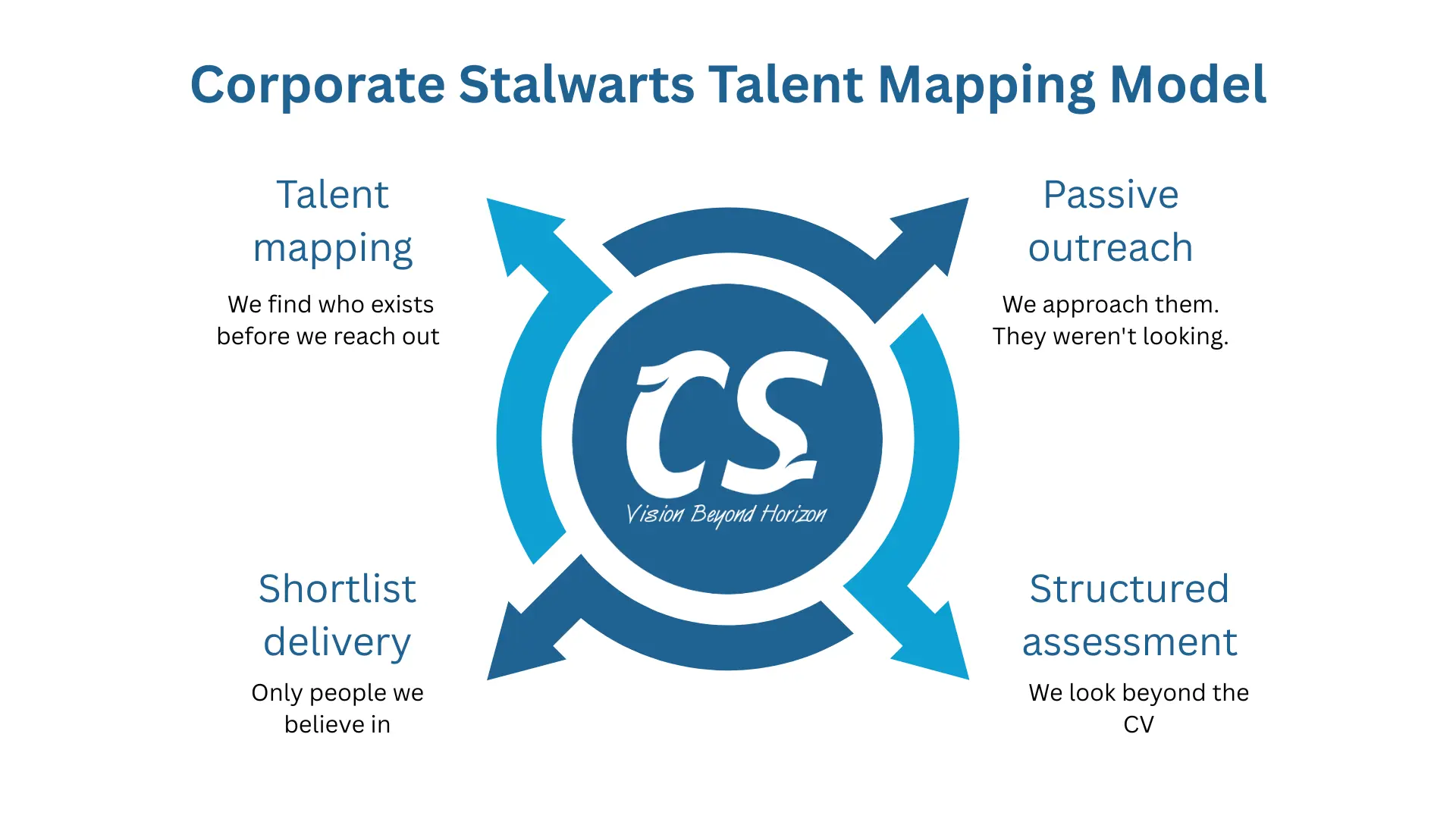
One firm holds the mandate exclusively. They map the full talent market, approach passive candidates directly, and present a shortlist of people they have assessed, not simply identified.
The fee is higher upfront. The cost of a prolonged vacancy or a wrong hire at this level runs considerably higher still. According to SHRM research, replacing a poor senior hire can cost up to five times their annual salary. That figure includes disruption, lost productivity, and attrition.

What does a recruitment agency search that delivers look like?
A well-run retained search feels different from the inside. At Corporate Stalwarts, India’s global executive search experts, here is what that looks like across our searches in FMCG, IT, pharma, manufacturing, logistics, and GCC mandates.
Longer Briefs
A search firm that captures a job description in one call and starts submitting within 48 hours has not built the understanding required to find the right person.
The brief session in a well-run retained search involves multiple conversations, often with different stakeholders. It produces something that goes well beyond a standard JD. By the time the search starts, the firm understands:
- Not just who you need but why the role exists
- What it will take to make the hire work long-term
- What the incoming leader is walking into on day one
Market before the candidates
Before anyone approaches a candidate, Corporate Stalwarts presents a talent landscape overview. This gives you information you would otherwise not have access to.
It covers:
- How many people with the right profile exist in the market
- Which organisations they currently sit in
- What the competitive context looks like for this role
This sets realistic expectations before the search begins. No surprises halfway through.
Profiles assessments
Each person on the shortlist arrives with a consultant’s note. It covers:
- Why this person was selected
- What the initial conversation covered
- How they responded to the opportunity
- Where the fit sits and where the risk is
A CV tells you what someone has done. An executive search assessment tells you whether they are the right person for your specific situation.
Protecting candidate’s confidentiality
This is something most companies do not think about until it is too late.
When a candidate’s CV circulates through multiple contingency agencies simultaneously, their current employer often finds out. It happens through:
- Shared contacts in sector networks, calling references
- Colleagues picking up signals from a change in behaviour
- A peer mentioning they heard something through the network
The candidate then withdraws from all active searches before making any decision. Simply to protect their current position.
When one firm holds the mandate and controls all outreach, the candidate decides who knows they are considering a move. They engage seriously with the opportunity without it surfacing prematurely.
At this level, protecting the candidate’s confidentiality is not a courtesy. It is a practical requirement of running the search well.
If your recruitment agency is sending wrong candidates, the search model needs to change.
At Corporate Stalwarts, India’s global executive search experts, we have placed 10,000+ leaders across FMCG, IT, pharma, manufacturing, and logistics across India and the APAC.
Every engagement runs on a retained, exclusive basis through the Corporate Stalwarts Talent Mapping Model. Full accountability for every shortlist we deliver.
If you are not getting what you want, we are ready to show you what the search should look like.
Speak to our executive search team

Corporate Stalwarts is a trusted recruitment firm with 20+ years of expertise in executive search and leadership hiring.
We’ve placed 10,000+ candidates across 600+ companies in FMCG, Manufacturing, IT, Pharma, and more. Our 1M+ candidate pool and 48-hour turnaround enable fast, high-quality hiring solutions.
We help businesses build high-performance teams with precision, speed, and industry expertise.