


Funding stages in startup executive searches
The roles you hire, the profiles you target, and the process you run must change with every round. A Series A search is not a smaller version of a Series C search. In fact, they are fundamentally different exercises, shaped by entirely different board expectations, operating contexts, and candidate profiles.
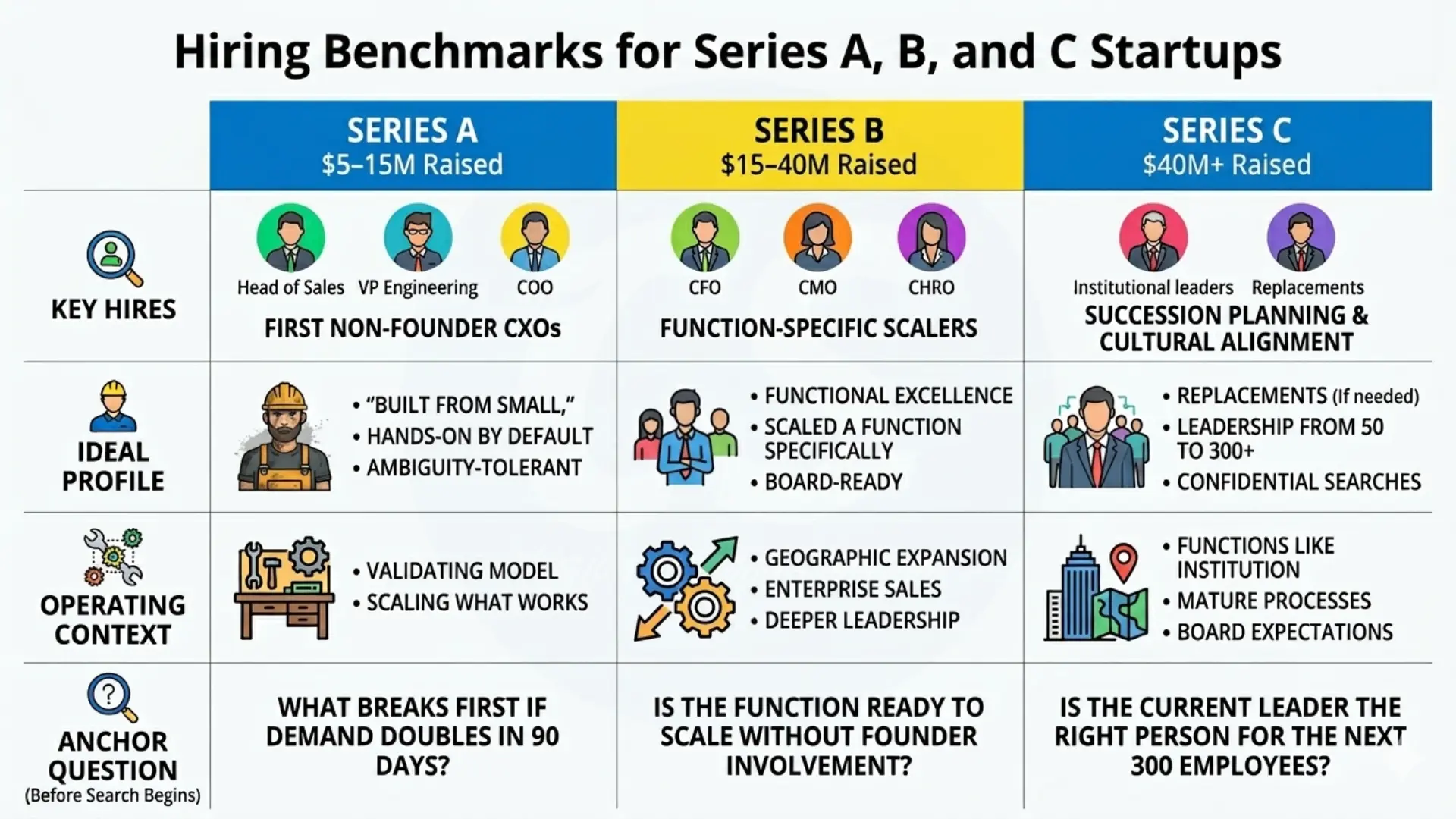
Series A ($5–15M raised)
At this stage, the startup has validated its model and needs to scale what works. More specifically, leadership hires here are typically the first non-founder CXOs.
The profile that succeeds at Series A:
- Built from small — not someone who optimised a working machine, but someone who built one
- Hands-on by default — comfortable in the work, not just above it
- Ambiguity-tolerant — able to make decisions without complete information or a defined process
Common first hires: Head of Sales, VP Engineering, and COO if the founder is product-led.
The right anchoring question before this search begins: what breaks first if demand doubles in 90 days? That answer, specifically, tells you the hire.
Series B ($15–40M raised)
Capital at Series B typically goes toward geographic expansion, enterprise sales, and deeper leadership investment. For this reason, this is often when a CFO, CMO, or full CHRO becomes necessary for the first time.
Two things shift at this stage:
- Profiles move toward candidates who have scaled a function specifically
- Your board becomes vocal, and their view of your CXO team directly influences your Series C readiness
Furthermore, investor due diligence at Series B involves your leadership team more than founders expect. The people you hire at this stage are the people a Series C term sheet will be written for.
Series C ($40M+)
By Series C, the company functions more like an institution than a startup. Specifically, leadership hires at this stage are often replacements – founders realising the COO who built the first 50 is not the right person to lead the next 300.
These searches are, as a result, more confidential, more time-sensitive, and more culturally charged than any previous round. Importantly, succession planning, which most founders ignore until it becomes a crisis, becomes unavoidable here.
In 2026, India’s startup hiring has settled into what experts now call precision hiring: high selectivity, strong demand in AI, product engineering, and revenue-focused roles, and a clear preference for leaders who combine technical understanding with commercial thinking. This means the passive talent pool is larger and more valuable than ever. That pool, however, does not respond to job postings.
Why do most startup leadership hires fail within 18 months?
The data is not encouraging. A CBInsights post-mortem study of 101 startups found that 23% failed specifically because of the wrong team. Similarly, according to SHRM research on executive hiring costs, a failed leadership hire can cost up to 213% of that executive’s annual salary, accounting for lost productivity, re-hiring costs, team disruption, and strategic delay.
For a startup burning through its raise, therefore, that number is an existential threat, not a line item.
Three patterns repeat consistently across industries and stages. That said, all three are avoidable with the right process.
The charisma trap
The candidate is impressive across three interviews. Consequently, the offer is made on the basis of “I like how they think.”
However, interview performance tells you almost nothing about:
- Decision-making under pressure
- Ambiguity tolerance in a resource-constrained environment
- How someone handles conflict when there is no hierarchy to escalate to
As one founder described it after a failed CTO hire: “I hired solely based on gut feelings. I wasn’t testing the right things.” He discovered too late that being impressive in conversation and executing quickly are two entirely different competencies. Ultimately, the search had to restart six months and significant runway later.
Stage mismatch
A candidate who ran a function at a 2,000-person company brings structure, process, and a playbook. In a 30-person startup, however, all three are liabilities, because the playbook needs to be written, not imported.
In contrast, a scrappy Series A operator often struggles with the institutional expectations of a Series C board. Matching the candidate’s operating experience to the stage of the company, not just the role, is therefore the central task of any structured startup executive search.
Hiring for title, not outcome
A job description lists responsibilities. A scorecard, on the other hand, defines measurable outcomes. Those are not the same document.
Before any search begins, a founder should specifically be able to answer:
- What does success look like at 90 days?
- What does success look like at 6 months?
- What does success look like at 12 months, in specific and measurable terms?
If the answer is vague, the brief is not ready. Consequently, the search should not begin.
For the full financial picture, explore our analysis of the real cost of a wrong C-suite hire in a Series A startup.
How to reduce mis-hires in startup executive search process
A structured executive search does not look like a recruitment process. It looks like a decision-making process in which sourcing is one step, not the first step.
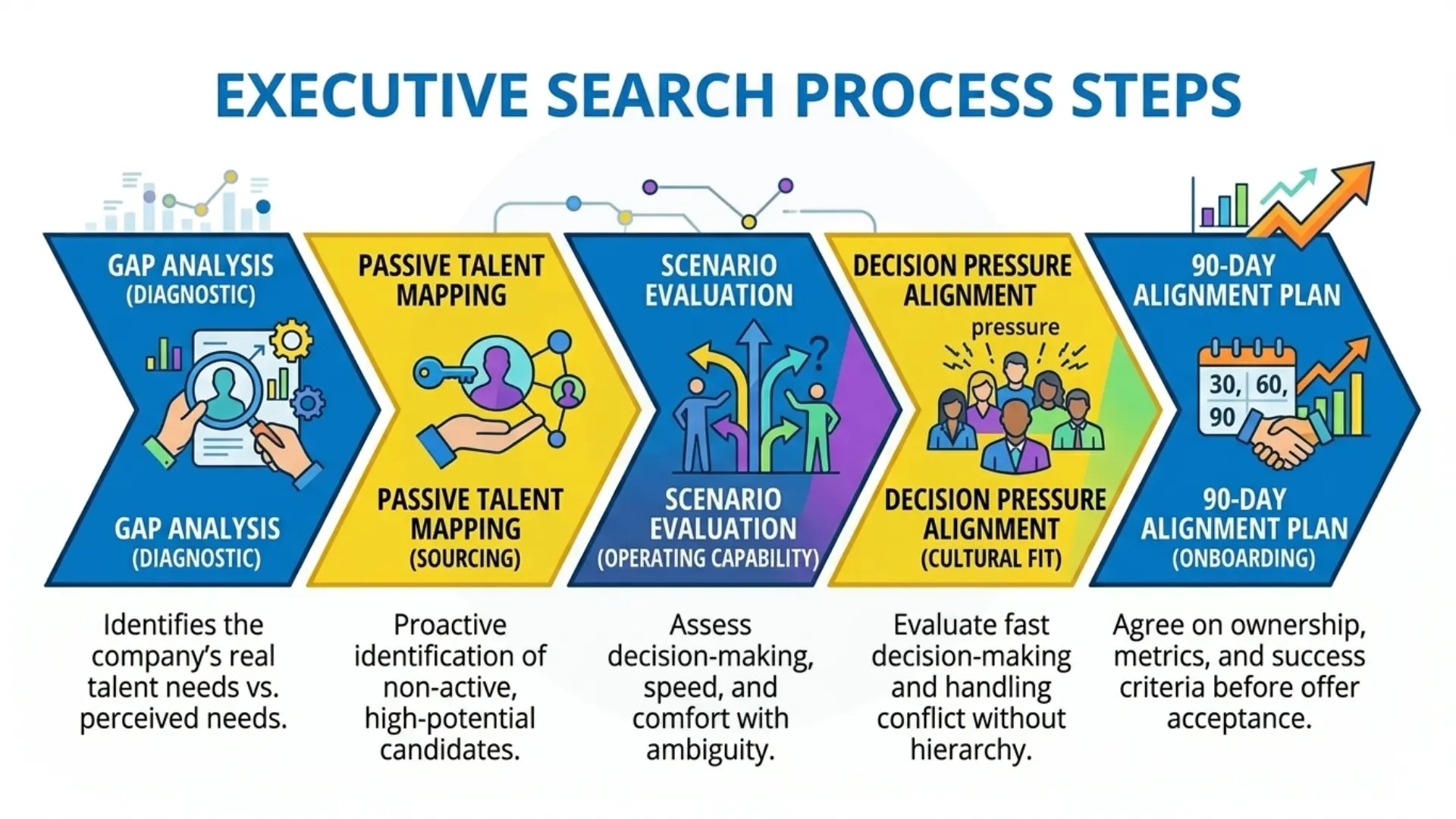
Step 1: Hiring gap analysis
The process begins with a deep diagnostic that surfaces what the company actually needs versus what the founder thinks they need. These are, more often than not, very different things.
For instance:
- A founder who believes they need a CFO often needs a Head of Finance first
- A founder who wants a CRO may need the sales process rebuilt before any new leader can have meaningful impact
- A founder hiring a COO under board pressure may actually need clarity on the founder’s own role first
Consequently, this step regularly redefines the brief entirely before any search activity begins.
Step 2: Passive talent mapping
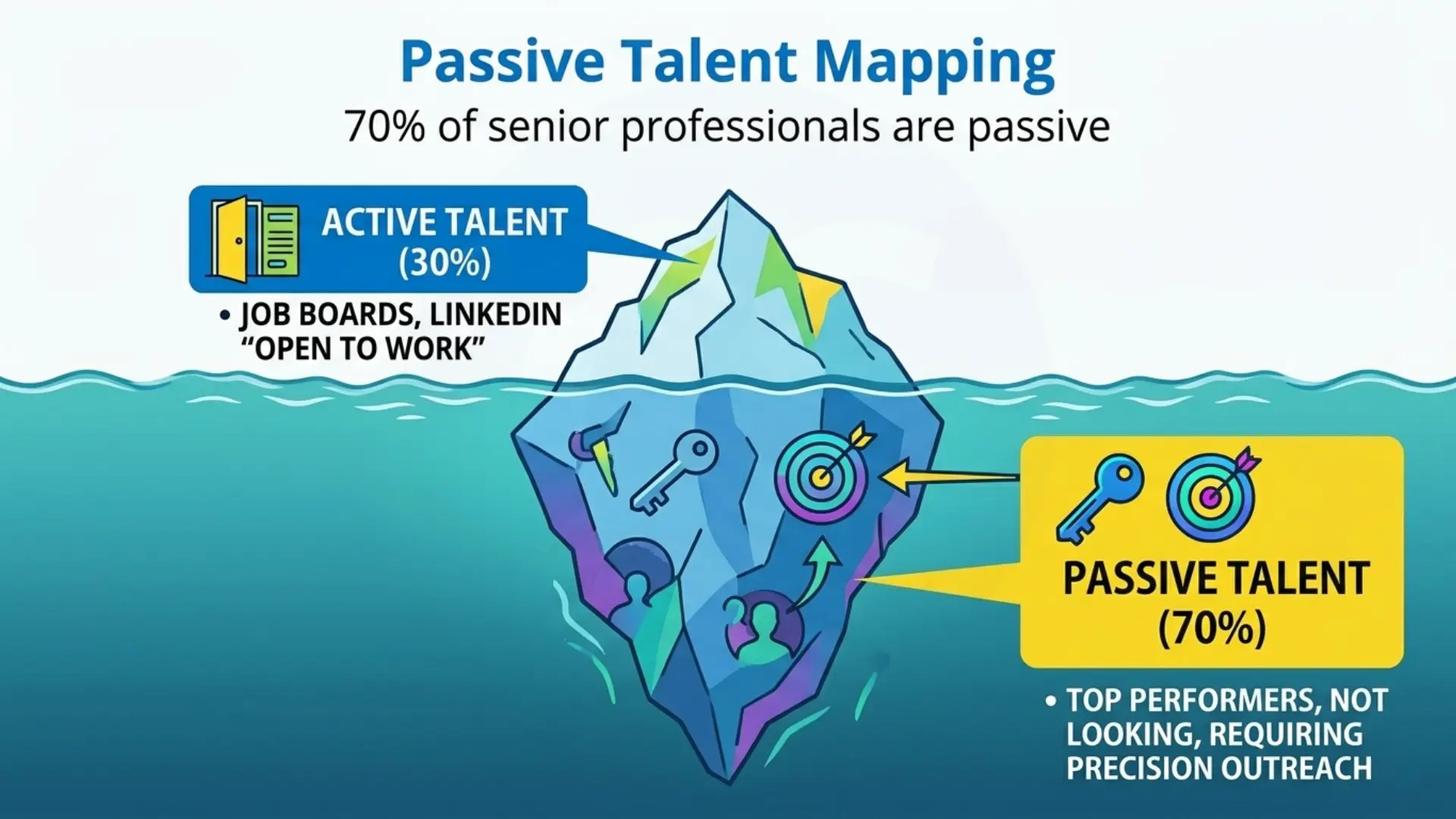
As LinkedIn Talent Solutions research consistently shows, more than 70% of senior professionals are passive: not actively searching, not on job boards, and not reachable through a standard application process.
Reaching them, therefore, requires a credible, personalised approach that speaks to where they are in their career, not where your vacancy sits in your org chart. In other words, the strongest candidate for your role is almost certainly not looking for you.
Step 3: Realistic scenario evaluation
Standard interviews measure confidence and communication. Realistic scenario evaluation, by contrast, presents candidates with problems they will actually face in the role and measures how they reason through them without a clear answer.
This step specifically separates:
- Interview performance — articulate, confident, prepared
- Operating capability — judgment under constraint, decision speed, comfort with incomplete information
These are ultimately the competencies that determine whether a leader stays and delivers, or exits within 18 months.
Step 4: Cultural fit under decision pressure
Cultural fit is not about personality. It is specifically about decision pressure alignment: how fast decisions are made, how conflict is handled, and how comfortable the leader is operating without complete information.
A leader who spent 12 years in a consensus-driven corporate environment may be technically excellent and personally likeable. They may, however, still be fundamentally wrong for a startup where every decision is visible to the entire team and consequences arrive the same week.
For role-specific searches, understanding why a senior developer is rarely the right CTO for a scaling startup requires a different evaluation lens entirely.
Step 5: 90-day alignment plan
This is a document agreed upon before the offer is accepted. It defines:
- What the new leader owns from day one
- What they do not own yet and why
- How success is measured at 30, 60, and 90 days
Most companies skip this step. Most importantly, most companies that skip it are running the same search again 14 months later.
Why funded startups work with Corporate Stalwarts
Twenty years. 10,000+ placements. Every engagement starts with the brief — not the shortlist.
We have worked with Series A to C founders at the exact moments this guide describes:
- A function breaking under growth with no clear successor in sight
- A board asking leadership questions mid-fundraise
- A first CXO hire for a founder who had never hired at this level
- A confidential replacement search with a 10-week deadline
The result is not a CV pile. It is a decision made with clarity at the right stage, with a leader who knows exactly what they are walking into.
If your next leadership hire cannot afford to be wrong, let’s talk.

Corporate Stalwarts is a trusted recruitment firm with 20+ years of expertise in executive search and leadership hiring.
We’ve placed 10,000+ candidates across 600+ companies in FMCG, Manufacturing, IT, Pharma, and more. Our 1M+ candidate pool and 48-hour turnaround enable fast, high-quality hiring solutions.
We help businesses build high-performance teams with precision, speed, and industry expertise.