

TLDR: Senior hiring challenges rarely start with a shortage of names but with a shortage of process. The leaders you need are not refreshing their Naukri profiles or waiting on your LinkedIn InMail. This article explains why and what it takes to reach them.
When senior hiring stalls, the instinct is to do more of the same: repost on LinkedIn, broaden the search on Naukri, or try a new job board. Each week without the right hire is a deferred decision, a stretched founding team, and a missed growth window. According to ManpowerGroup’s 2026 Talent Shortage Survey, 72% of employers globally report difficulty filling roles. The platforms are not the problem. The approach, however, is.
Senior hiring challenges are not a sourcing problem. They are a process problem. This article is for founders, CEOs, and CHROs who have hit that wall and want to understand why databases consistently fall short at the senior level and what a structured search looks like instead.
QUICK ANSWER
Senior hiring challenges come down to one gap: platforms show you who is available, not who is right. The strongest senior leaders are employed, performing well, and not refreshing Naukri or responding to LinkedIn InMails. Reaching them takes a structured, brief-led, proactive search – not a better job post. Corporate Stalwarts works exclusively on senior and leadership mandates. Every search starts with the brief, maps passive talent first, and is built around what the role actually needs – not what the database returns.
What LinkedIn, Naukri, and job platforms give you
Let’s be clear: LinkedIn, Naukri, and job databases are useful, widely used, and part of how most searches begin, including ours. They are, in fact, the best tools available for reaching candidates who are actively looking.
That, however, is precisely the limitation.
According to SHRM’s 2025 Talent Trends Report, 55% of organisations rely on social media as their top recruiting strategy. As a result, everyone is fishing in the same pond. Consequently, platforms get noisier, response rates drop, and the search takes longer. The roles are not the issue. The problem is that the right people are not there to find.
At the senior level, however, that gap is even sharper:
- Active candidates — updating profiles, applying to roles, open to InMails — represent roughly 30% of the talent market
- Passive candidates — currently employed, performing well, not looking — represent the other 70%
- The leaders most likely to succeed in your role are almost always in that 70%
Platforms are built for the first group. Senior hiring challenges, therefore, live in the second.
Why the senior candidates you need are not in any database
Databases show you who is available. Senior hiring, however, needs the person who is right. And available and right are rarely the same person at the leadership level.
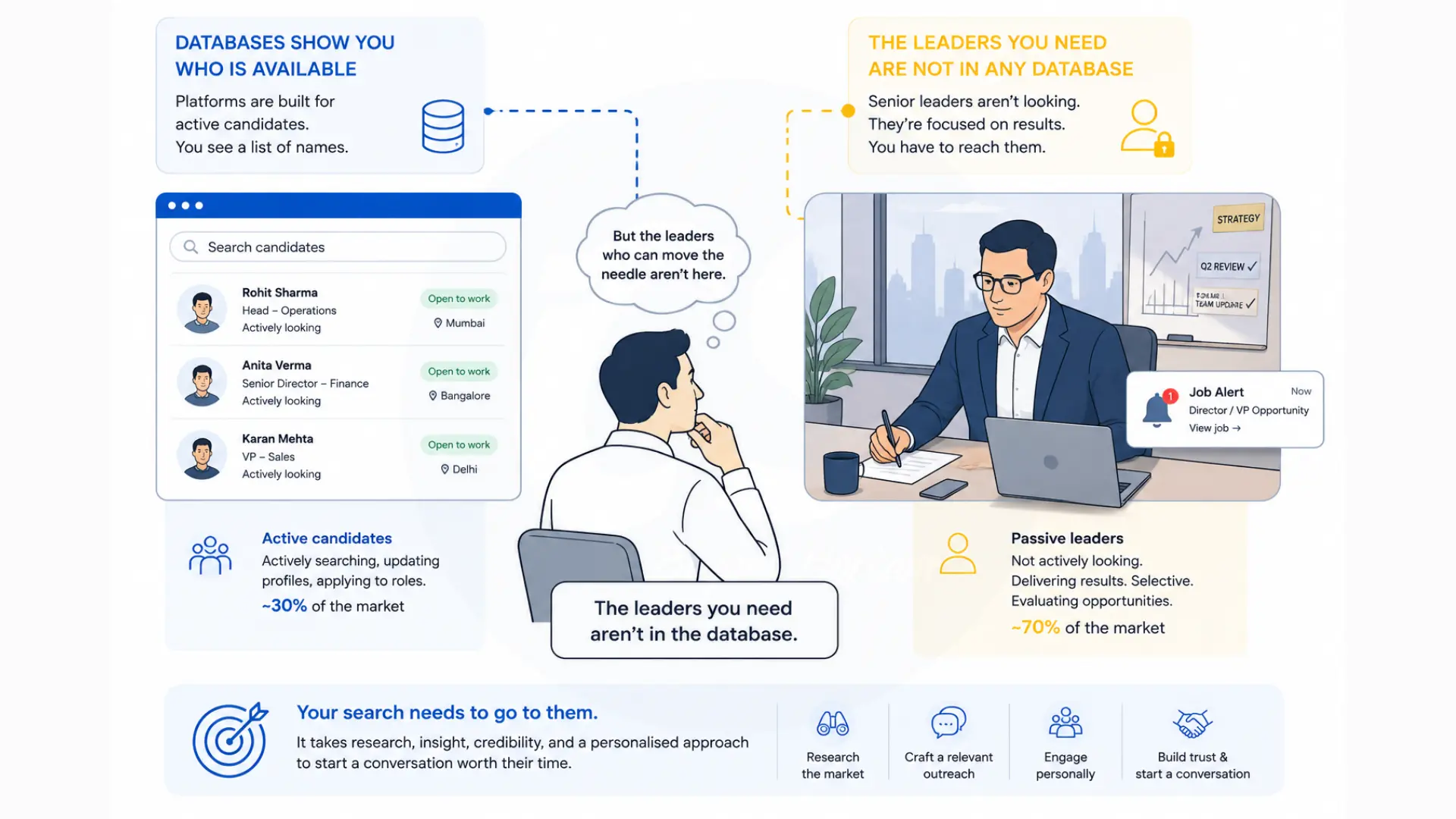
To illustrate: LinkedIn and Naukri give you raw ingredients: a shelf of names you can see. A structured search sources, qualifies, pressure-tests, and brings you the final dish. The difference is not the database. It is everything that happens before the name reaches you.
Here, specifically, is the gap in practice. According to SHRM’s Recruiting Executives report, only 15% of recruiting executives prioritise passive sourcing, meaning candidates who are not actively searching. Yet passive talent represents the majority of senior leaders worth hiring. Most organisations are spending 85% of their effort on 30% of the market.
In practice, the leaders you want are:
- Delivering results in their current role — no reason to update a job profile
- Being approached by multiple firms – selective about who they respond to
- Evaluating your company as much as you are evaluating them
- Unlikely to respond to a generic InMail or a Naukri job alert
Therefore, reaching them requires a credible, direct, and personalised approach, rather than a job post. In other words, the search has to go to them. They will not come to you. They will not come to you.
The real senior hiring challenges no platform solves
Even when the right candidate is found, most senior searches fail upstream — before the first interview. Three specific problems repeat across industries and stages.
The brief problem:
Senior hiring challenges start before the search.
A job description lists responsibilities. A hiring brief defines outcomes, stage expectations, decision authority, and the operating context the leader will walk into. These are not the same documents. More often than not, senior searches begin with a job description copied from a previous hire or a competitor’s website. Specifically, the brief rarely answers:
- What does this leader need to deliver in 90 days?
- What decisions will they own?
- What will they not own yet?
As a result, even the right candidate on paper becomes the wrong hire in practice.
Related: Avoid Costly Hiring Mistakes
The stage fit problem:
Big-company leaders in small-company roles.
For instance, a leader who ran a 500-person function at a large conglomerate brings process, structure, and a playbook. In a 30-person funded startup or a lean mid-market company, all three can be liabilities. Similarly, a scrappy operator who thrived in an early-stage environment may struggle with the governance expectations of a PE-backed or Series C board.
Importantly, according to Cornerstone India’s 2026 CXO research, 40% of senior executive hires fail within the first 18 months, primarily due to misalignment with culture, context, or expectations. Stage fit, therefore, is not a soft consideration. It is the single most common cause of senior hire failure.
The stakeholder delay problem:
Too many opinions, too little ownership.
At the senior level, hiring involves multiple decision-makers: founders, boards, incoming peers, and sometimes investors. Consequently, the process stretches. Candidates receive delayed feedback, accept competing offers, or lose confidence in the company’s decisiveness. Furthermore, the mandate loses momentum with every delay. Consequently, the search that could have closed in 10 weeks runs for 20. Not because the right person was hard to find, but because no one owned the decision clearly enough to make it.
Why senior hiring cycles stretch to 4–6 months on databases
The timeline cost of a poor senior hiring process is rarely discussed honestly. That said, the numbers tell a clear story that is rarely discussed honestly. According to MME’s senior management hiring research, without a strong leadership acquisition strategy, CXO-level hiring cycles extend by 4–6 months. Furthermore, 69% of organisations still struggle to fill full-time roles even after extended searches, according to SHRM 2025.
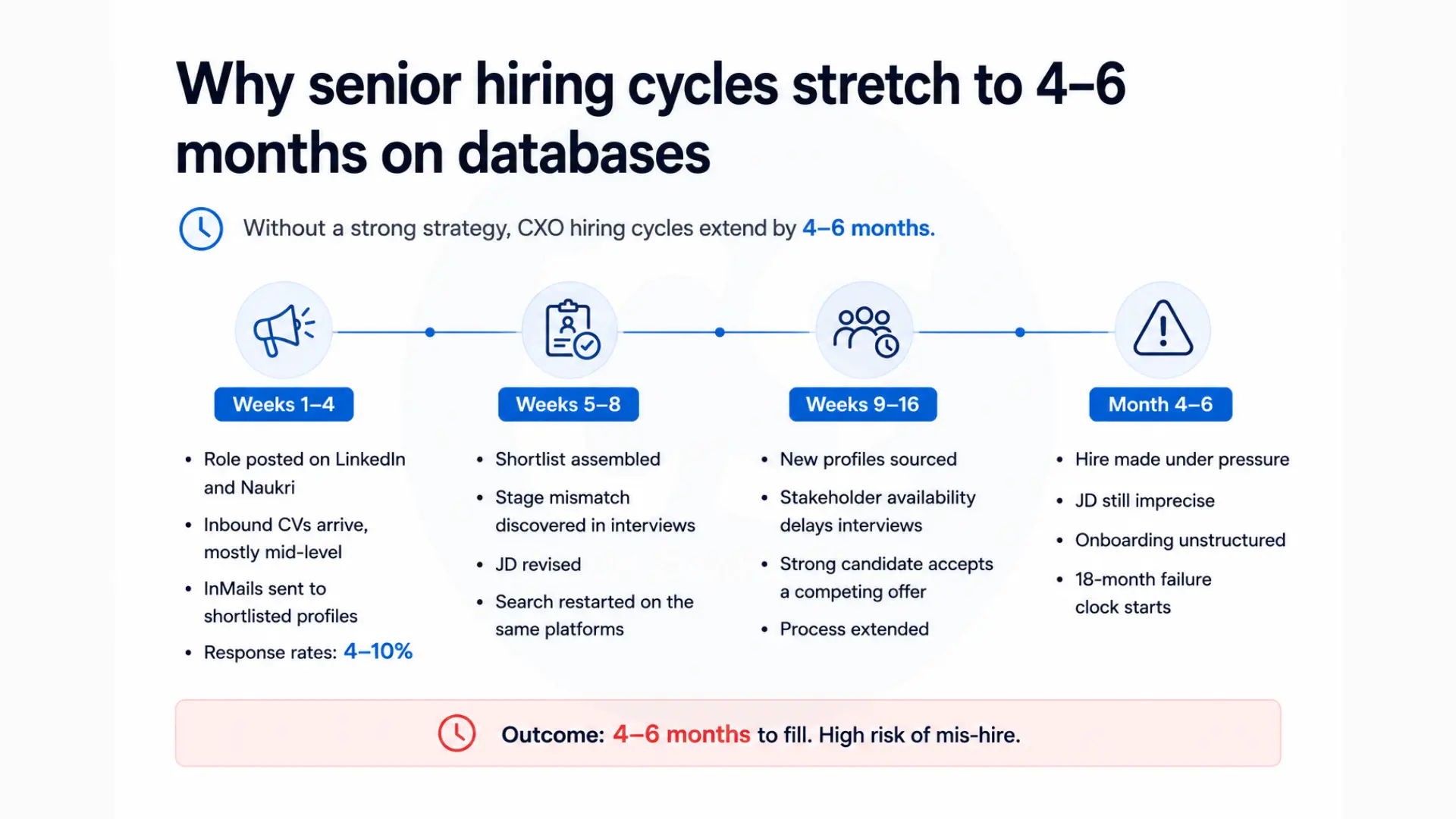
In practice, the compounding damage looks like this:
- Weeks 1–4: Role posted on LinkedIn and Naukri. Inbound CVs arrive, mostly mid-level. InMails sent to shortlisted profiles. Response rates: 4–10%.
- Weeks 5–8: Shortlist assembled. Stage mismatch discovered in interviews. Job descritpion (JD) revised. Search restarted on the same platforms.
- Weeks 9–16: New profiles sourced. Stakeholder availability delays interviews. Strong candidate accepts a competing offer. Process extended.
- Month 4–6: Hire made under pressure. JD is still imprecise. Onboarding is unstructured. 18-month failure clock starts.
By contrast, a structured senior search, starting with a sharp brief and proactively mapping passive talent, typically closes the right hire in 8 to 12 weeks. Ultimately, the difference is not speed for its own sake. It is that the process is built for the candidate you actually need, not the one who happened to apply.
The real cost of a wrong C-suite hire extends well beyond the salary: lost momentum, team disruption, and a search that starts again from zero.
What a structured senior hiring process looks like
Importantly, platforms are part of the process, not the whole of it. A structured search uses LinkedIn and Naukri as one input, not the entire strategy. Here, specifically, is how the process differs in practice.
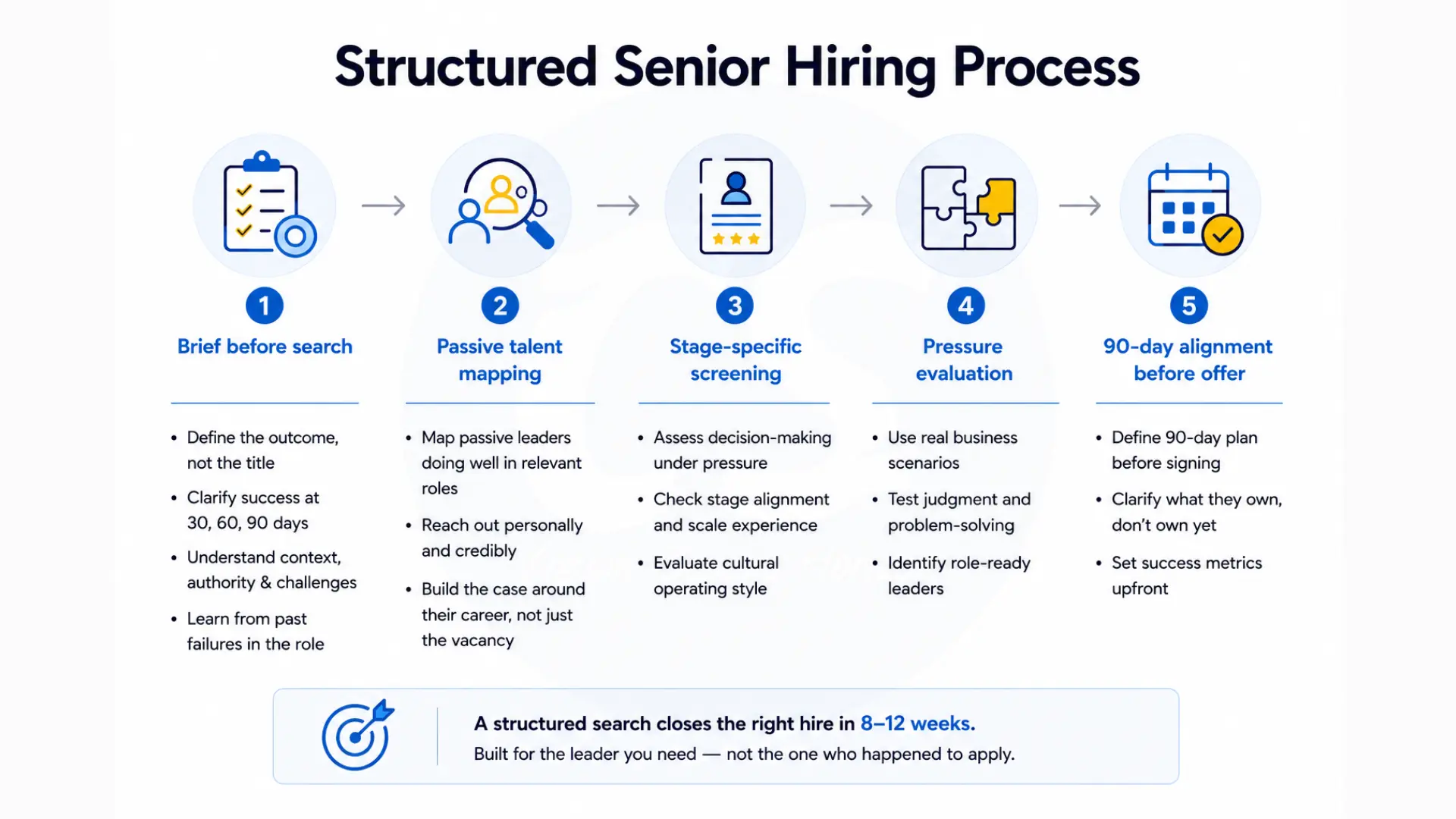
Step 1: Brief before search — define the outcome, not the title
Before any search activity begins, the right questions need sharp answers:
- What does success look like at 30, 60, and 90 days?
- What is the operating context — stage, pace, and decision authority?
- What has failed in this role before, and why?
- What profile fits this company right now, not the company you want to be in two years?
In fact, this step alone eliminates 60% of stage mismatches before the first CV is reviewed.
Step 2: Passive talent mapping — reaching leaders who are not looking
Once the brief is defined, therefore, the search maps the market, specifically the passive pool. This means, in practice, identifying leaders who are currently performing well in relevant roles, approaching them through a credible and personalised channel, and making a case for the opportunity that speaks to their career, not just the vacancy.
This is, specifically, where LinkedIn becomes useful again: as a research tool and outreach channel, not a job board. The approach is direct, specific, and built around the candidate’s context, not a template InMail.
Related: What leadership hiring experts do differently when assessing a candidate
Step 3: Stage-specific screening — not just skills, but operating fit
At the senior level, screening must go beyond credentials. Most importantly, it must assess:
- Decision-making under pressure — not just strategic thinking in a calm interview
- Stage alignment — has this leader built at this scale or only managed at a larger one?
- Cultural operating style — how do they handle conflict, ambiguity, and pace?
Step 4: Pressure evaluation — testing judgment, not interview performance
Realistic scenario evaluation presents candidates with actual problems the company faces and observes how they reason through them. Specifically, this separates interview-ready candidates from role-ready ones, a distinction that platforms cannot make and standard interviews rarely surface.
Step 5: 90-day alignment before the offer
The offer, however, is not the finish line. Most importantly, a 90-day plan agreed upon before signing defines what the leader owns, what they do not own yet, and how success will be measured. Most senior hires that fail do so because this step was skipped.
For role-specific searches, understanding why strong senior leaders rarely respond to job posts in India is a sharper lens than most platforms provide.
How Corporate Stalwarts handles senior hiring challenges
Corporate Stalwarts uses LinkedIn, Naukri, and every available platform as part of the process. However, we do not stop there. We map passive talent, approach leaders who are not looking, and run structured evaluations that go well beyond what any platform surfaces.
We have worked with founders who had been searching for six months and had nothing right to show for it. With CHROs navigating confidential replacements mid-fundraise. With boards that needed a CXO in 10 weeks and a brief that needed rebuilding before the search could begin.
In every case, the platform was not the problem. The process was.
- Passive talent mapping across LinkedIn, Naukri, and beyond
- Brief diagnostics before any search activity begins
- Stage-specific screening and pressure evaluation
- Post-hire alignment support
If your senior search has stalled, the brief is where we start. Let’s talk.
Frequently Asked Questions

Corporate Stalwarts is a trusted recruitment firm with 20+ years of expertise in executive search and leadership hiring.
We’ve placed 10,000+ candidates across 600+ companies in FMCG, Manufacturing, IT, Pharma, and more. Our 1M+ candidate pool and 48-hour turnaround enable fast, high-quality hiring solutions.
We help businesses build high-performance teams with precision, speed, and industry expertise.