


Loading...

Smart Ways to Use AI Tools for Executive Job Search

TLDR: AI will not get you the role. But if you use AI tools for executive job search correctly, they will make sure you show up prepared enough that the right...
21/05/2026
Smart Ways to Use AI Tools for Executive Job Search

TLDR: AI will not get you the role. But if you use AI tools for executive job search correctly, they will make sure you show up prepared enough that the right firm takes notice. The simplest ones are LinkedIn, ChatGPT, and Perplexity.

Most senior professionals fall into one of two camps with AI. The first ignores it entirely, relying on the same approach they used five years ago. The second uses ChatGPT to rewrite their resume, generate interview answers, and craft LinkedIn summaries and ends up sounding like everyone else who did the same prompt. 

Both approaches, however, lose. The third approach, using AI tools for executive job search as a research and preparation engine, is what works at the senior level. This article covers what a search firm notices, what raises a flag, and which free tools are worth your time.


QUICK ANSWER

AI tools do not get executives hired. Preparation does. The candidates who stand out in executive searches arrive having researched the company’s context, articulated why their experience maps to the role, and asked questions that signal genuine understanding. AI made that preparation faster. It did not replace it. Corporate Stalwarts works exclusively on senior and leadership mandates, and this is what we see on our end. 

What executive search firms notice in a senior profile 

87% of companies now use AI in some part of their recruitment process, according to DemandSage’s 2026 AI recruitment research. Consequently, the bar for what passes basic screening has risen — and so has the bar for what impresses a search consultant who reviews senior profiles daily. 
What-executive-search-firms-notice-in-a-senior-profile

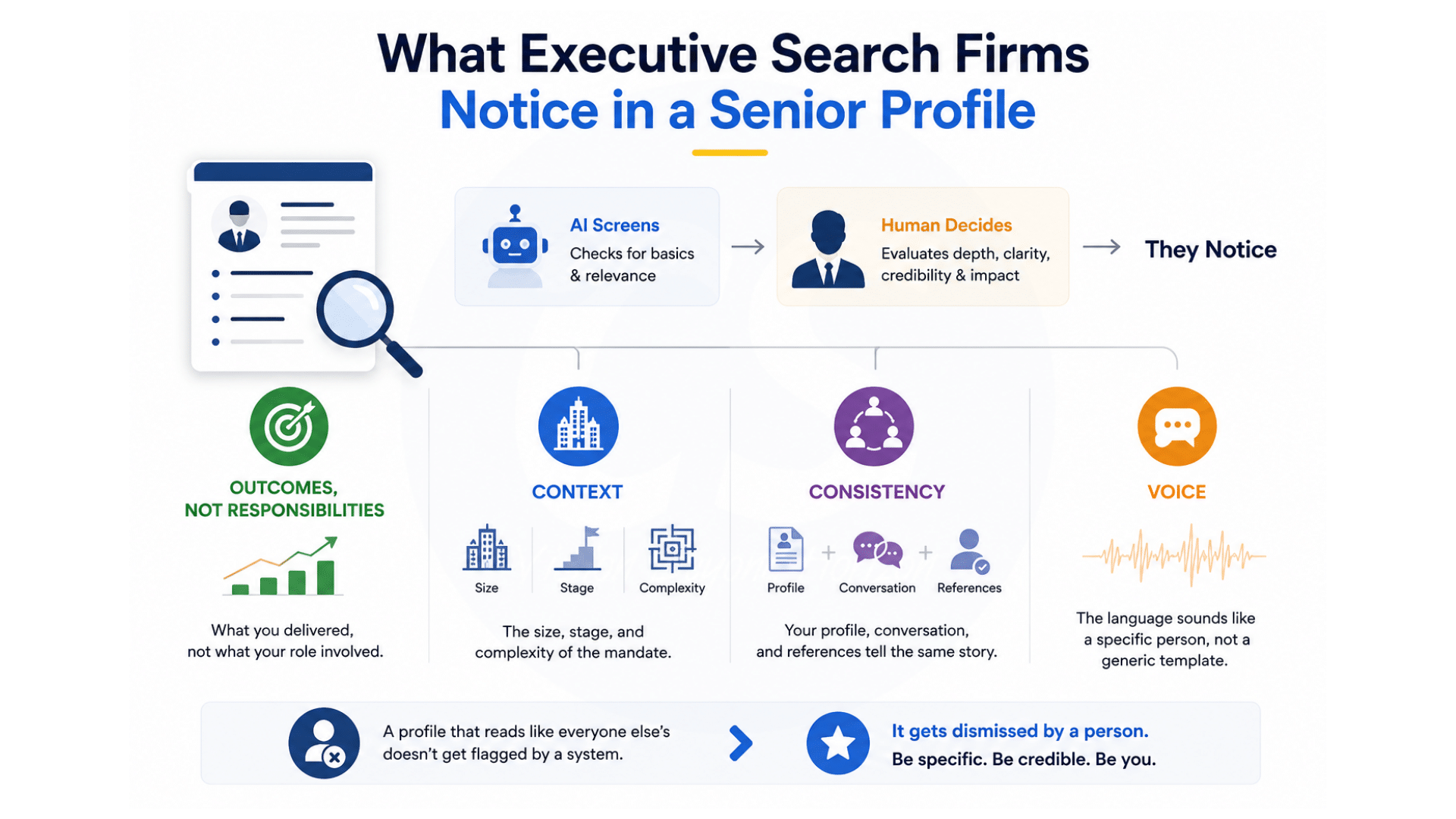
Search firms at the senior level are not scanning for keywords. They are reading for specificity, voice, and evidence of independent thinking. In particular, they look for: 

  • Outcomes, not responsibilities — what you delivered, not what your role involved 
  • Context — the size of the organisation, the stage, the complexity of the mandate 
  • Consistency — whether your profile, your conversation, and your references tell the same story 
  • Voice — whether the language sounds like a specific person or a generic executive template 

A profile that reads like it was written by the same prompt as every other candidate does not get flagged by a system. It gets dismissed, however, by a person. 

Where AI tools help in executive job search and where they backfire

It is worth acknowledging upfront: some degree of AI polish is now table stakes. A senior professional who has never used AI to tighten their language or research a company is leaving preparation time on the table. That is not the argument here. 

The argument, specifically, is about where the line sits between enhancement and replacement. 
Where-AI-tools-help-in-executive-job-search

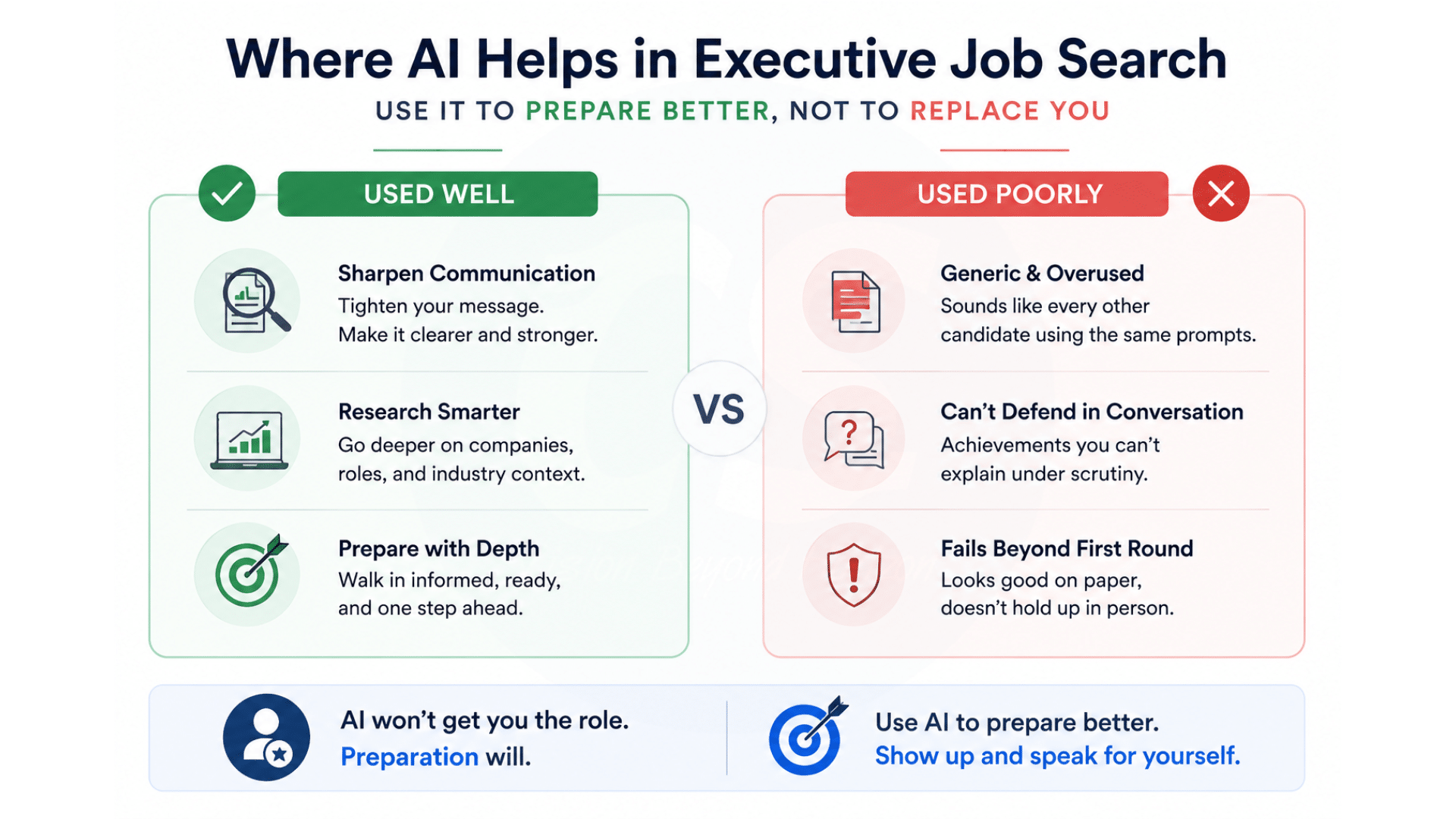
Used well, AI helps you: 

  • Sharpen how you communicate what you have already done 
  • Research faster and more thoroughly than manual methods allow 
  • Prepare for conversations with the depth of someone who has done the homework 

Used poorly, in contrast, AI produces: 

  • Summaries identical to every other senior candidate using the same prompts 
  • Achievements written in language you cannot defend under direct questioning 
  • A profile that passes no scrutiny beyond the first conversation 

Ultimately, the executives who use AI tools for executive job search well are the ones who understand this distinction. They use AI to prepare better. They show up and speak for themselves. 

Free AI tools for C-Suite job search

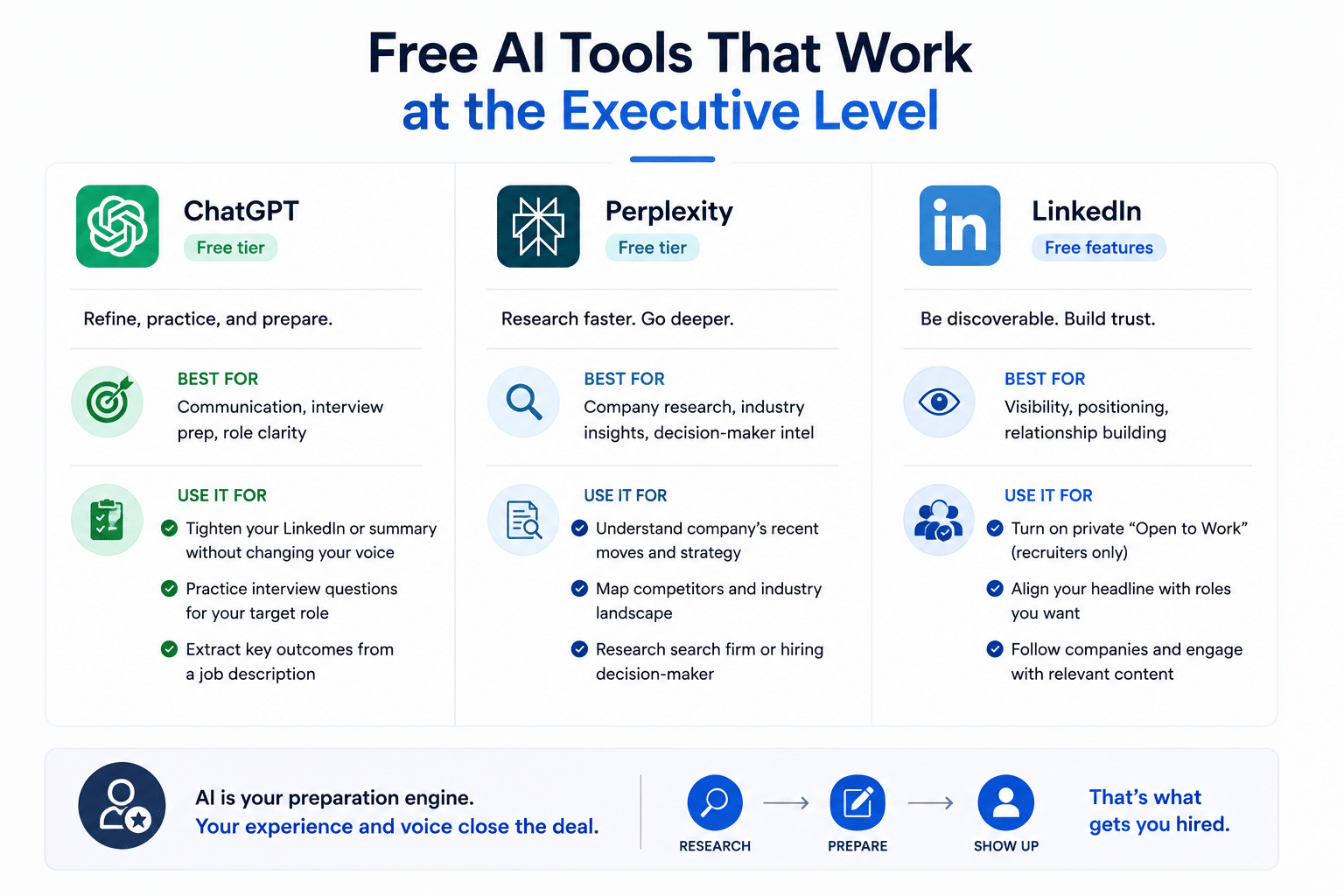
ChatGPT (free tier) 

ChatGPT is most useful for preparation and refinement — not generation. 

What works: 

  • Paste your existing LinkedIn summary and ask it to tighten the language without changing the voice. Specifically, the instruction matters: “make this clearer and more specific; do not change the tone or add new claims.” 
  • Use it for scenario-based interview preparation. For instance, a prompt that works: “Ask me the questions a retained executive search firm would ask a CFO candidate for a Series B manufacturing company.” Answer out loud. Repeat until the answer is yours, not the AI’s phrasing. 
  • Paste a job description and ask: “What are the three outcomes this role is hired to deliver?” Consequently, that reframe changes how you position your experience in every subsequent conversation. 

What to avoid: Generating your resume or producing interview answers you cannot defend in the room. If an interviewer asks a follow-up on anything AI wrote for you, the gap shows immediately. 

Perplexity (free) 

Perplexity is a research tool — and at the senior level, research is where most candidates fall short. 

Specifically, before any approach or interview, use it to: 

  • Understand the company’s recent moves: leadership changes, funding rounds, strategic shifts 
  • Map the competitive landscape of the sector the role sits in 
  • Research the search firm or hiring decision-maker before a conversation 

In practice, a candidate who arrives knowing the company’s last three years of context is a fundamentally different conversation from one who only read the job description. Therefore, Perplexity makes that depth of preparation achievable in 20 minutes. 

LinkedIn (free native features) 

LinkedIn’s own features are, importantly, underused by senior professionals. Three worth using: 

  • Private “open to work” signal — visible to recruiters only, not your current employer. This, specifically, puts you in front of search consultants without a public signal that you are looking. 
  • Keyword alignment — search firms use LinkedIn’s search function with specific terms. Your headline and about section should reflect the language of the roles you want, not a creative summary of who you are. 
  • Profile completeness — an incomplete profile at CXO level is noticed. It signals disengagement or that the profile was never built for visibility. 
Free-AI-tools-that-work-at-senior-level

Google Docs (free) 

One that senior professionals often overlook: use Google Docs to draft, refine, and get a trusted peer’s eyes on your narrative and key achievements before transferring to your MS Word final. 

A well-structured MS Word resume remains the standard for submission to executive search firms — not a PDF from a template tool, not a Canva design, not an ATS builder. Those formats create parsing problems and, more importantly, signal unfamiliarity with how professional search works. Draft in Google Docs. Finalise in MS Word. 

What gets flagged in executive hiring 

At the senior level, getting flagged is rarely about AI detection software. It is, instead, about human pattern recognition. Search consultants read profiles every day and notice the following immediately: 

Identical phrasing to other candidates. AI tools trained on the same prompts produce the same output. “Results-driven leader with a proven track record of driving strategic growth” appears in thousands of profiles. It communicates nothing. 

Achievements that cannot be defended in conversation. Write only what you can speak to specifically. If your resume says you led a transformation that delivered a 40% cost reduction, the first follow-up question is, ‘How?’ A vague answer does more damage than the achievement did. 

A LinkedIn summary that reads like a press release. Passive voice, no specificity, no individual voice. These are the markers of a summary that was generated rather than written. At the senior level, voice matters. 

Generic responses to outreach. Furthermore, when a search firm reaches out, a reply that mirrors the job description back signals no independent thinking. A strong response shows you have done the research and can articulate a specific reason the conversation is worth having. 

How Corporate Stalwarts works with senior candidates

Corporate Stalwarts works exclusively on senior and leadership mandates. We reach out to candidates directly, which means the strongest opportunities we bring to the table never appear on LinkedIn or Naukri. 

What we notice when we review a profile is exactly what this article describes: specificity, voice, and evidence that the person behind the profile has thought carefully about what they have built. 

We do not wait for applications. We reach out. Make sure we can find you. 
banner image executive hiring


Frequently Asked Questions

Most applicant tracking systems do not explicitly flag AI-generated text. In fact, the bigger risk is not detection software. It is a human reviewer who has read thousands of profiles and identifies generic phrasing in the first paragraph. The interview is, therefore, where AI-generated content fails completely: there is no AI in the room to answer follow-up questions.
ChatGPT for preparation, refinement, and scenario-based interview practice. Perplexity for company and sector research before an approach or interview. LinkedIn's native features for profile visibility and keyword alignment. Google Docs for drafting before transferring to an MS Word final. These four tools, used with discipline, cover the full preparation cycle without a paid subscription.
Specifically, the most effective method is scenario-based practice rather than scripted answer generation. Prompt ChatGPT to ask you the questions a search firm or board would ask for your specific role and sector. Answer out loud. Ask it to identify where the answer is vague or where a follow-up would expose a gap. Repeat until the answers are specific, defensible, and entirely yours.
No, but using it as a ghostwriter, however, does. Search firms do not object to AI-assisted preparation. They object to AI-generated content that replaces the candidate's own voice and accountability. The distinction, in fact, matters enormously: AI that makes your preparation better is an advantage. AI that writes your story for you is a liability the moment anyone asks a follow-up question. 
Specifically, start with what you have. Paste your existing headline, summary, and top three roles into ChatGPT and ask it to identify where the language is generic, where outcomes are missing, and where the voice is inconsistent. Then rewrite in your own words using those observations as a guide. Ultimately, do not outsource the rewrite to AI. Use it to diagnose. Write it yourself.
Specificity of experience, consistency across profile and conversation, and the ability to articulate the context, why a decision was made, what the operating environment looked like, and what was at stake. Furthermore, search firms evaluate how a candidate handles a question they were not prepared for. That response, unscripted and entirely human, is often the most revealing moment in a senior search conversation. 
Share this article

Related Articles

Browse the latest hiring insights

Senior Hiring Challenges: Why you need more than a Database
TLDR: Senior hiring challenges rarely start with a shortage of names but with a shortage of process. The leaders you need are not refreshing their Naukri profiles or waiting on your LinkedIn InMail....
Startup Executive Search: Architecting Your Series A-C Leadership Team
TL;DR: Most Series A to C founders hire their first CXO too late, too fast, and with a brief that was never sharp enough. This guide covers what separates a...
Best Executive Search Firms in India for CXO Hiring
When a founder or CHRO starts evaluating the best executive search firms in India for CXO hiring, the search has usually already taken longer than it should. At the leadership level,...
13/03/2026
HR Compliance for Startups in India: Do You Need It Before 20 Employees?
Do startups in India need HR compliance before reaching 20 employees?   Most people believe HR compliance for startups in India begins only when the company crosses 20 employees, because that is when Provident Fund...