


A CXO with the right pedigree can still fail at the one thing the role actually demands. Skills-based hiring exists because boards kept discovering this the expensive way, after the hire, not before it. Deloitte’s 2026 Global Human Capital Trends report found that 66% of C-suite leaders say traditional ways of structuring roles need to change. Only 7% report real progress toward that shift.
QUICK ANSWER
Skills-based hiring evaluates CXO candidates against the specific capabilities a role demands. It looks past pedigree, tenure, and job titles.
For leadership roles, this means testing judgment, decision-making under ambiguity, and domain-specific execution before a candidate is shortlisted. A strong track record elsewhere is not assumed to transfer cleanly.
Table of Contents
ToggleWhy is pedigree losing ground in CXO searches
Pedigree used to be a reliable proxy. A candidate from a recognizable company, on a clean upward path, was assumed to be safe. That assumption breaks down fastest at leadership level.
The skills that earned someone a promotion at one company rarely map onto what a different business needs. Pace differs. Scale differs. What “leadership” requires differs with it.
Deloitte’s skills-based organization research points to the same root cause. Work has become too dynamic for job titles to describe what a role actually requires. A VP of Operations title means something different at a 200-person GCC than at a 2,000-person enterprise. Hiring against the title, instead of the skill set underneath it, is where most senior mismatches begin.
What does skills-based hiring look like at leadership level
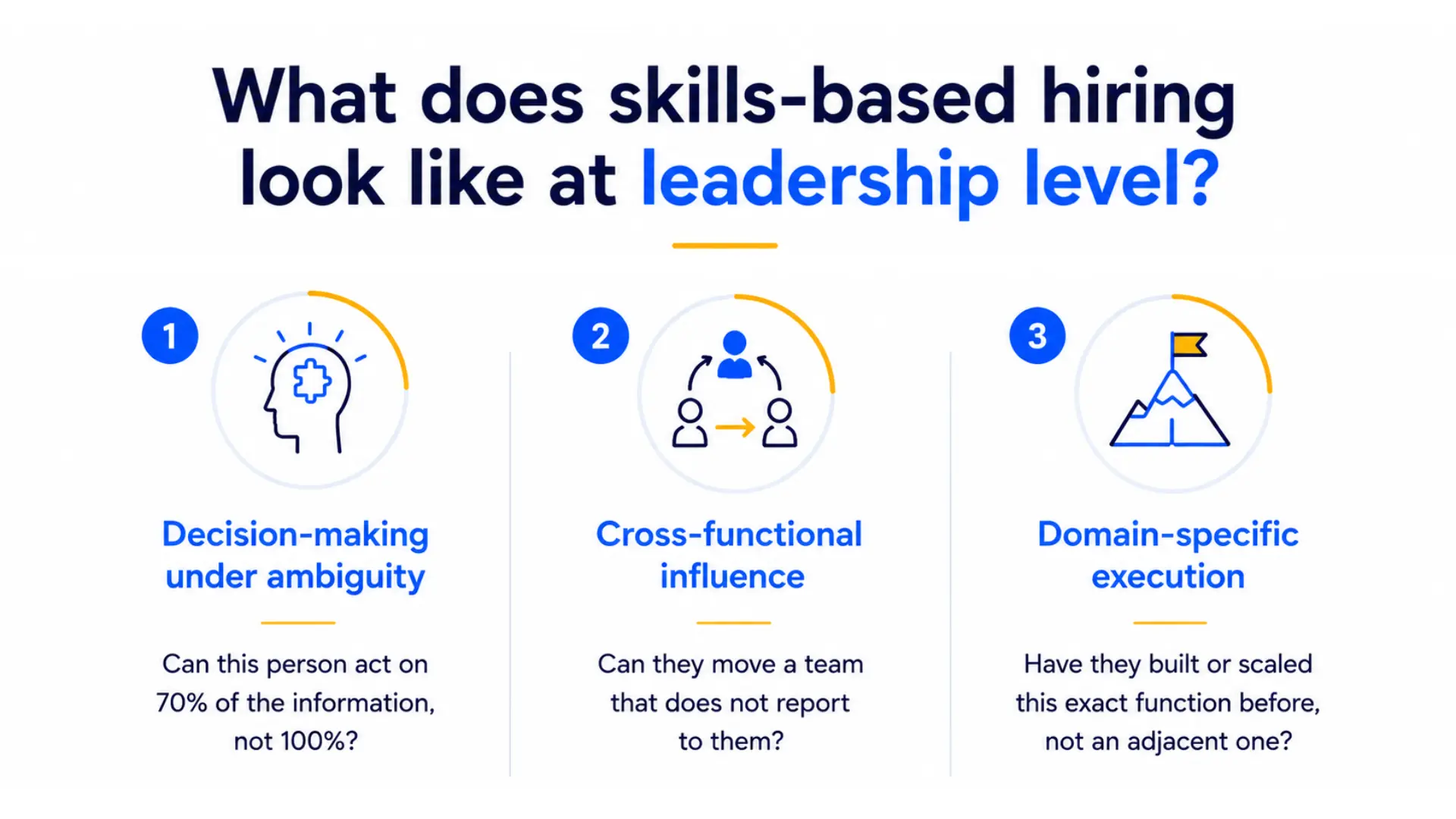
At the individual contributor level, skills-based hiring often tests a technical competency directly. At CXO level, the skills are harder to observe. They are also far more consequential to get wrong.
• Decision-making under ambiguity — can this person act on 70% of the information, not 100%
• Cross-functional influence — can they move a team that does not report to them
• Domain-specific execution — have they built or scaled this exact function before, not an adjacent one
A structured search tests these directly. Scenario-based conversations and reference checks get built around specific decisions the candidate made, not general endorsements of their leadership style. This is where precision hiring and skills-based hiring work together. Precision hiring defines the mandate. Skills-based hiring defines what gets tested inside it.
How does skills-based hiring change what a CXO shortlist looks like
A pedigree-first shortlist tends to look similar across searches. Familiar company names. Similar career arcs. Minimal variation.
A skills-first shortlist looks different, because it is built around what the role needs, not what reads as safe on paper. It often surfaces candidates a pedigree-first search would have filtered out early. Someone who built the exact function needed at a smaller, less recognizable company. Someone whose title undersells what they were actually responsible for.
For GCCs and expansion-stage companies hiring their first India leadership layer, this matters even more. The “safe” pedigree candidate has often never operated at the pace or ambiguity the role demands.
What risks come with skills-based hiring for CXO roles
Skills-based hiring is not risk-free. Skills are harder to verify at a distance than a job title. A poorly designed evaluation can end up testing interview performance instead of real capability. Structure matters more than intent here.
A search built around vague competencies like “strategic thinking,” without defining what that looks like in this specific role, produces the same weak signal a resume screen does. It is just dressed differently. The evaluation criteria need to be as specific as the mandate itself, tied to real decisions the candidate will face in the first six months.
Where Corporate Stalwarts fits into a skills-based CXO search
Corporate Stalwarts is a global executive search firm, and skills-based evaluation is built into its Three-Level Screening process rather than run as a separate step. Functional screening tests domain execution directly. Leadership screening tests decision-making under the role’s real pace and ambiguity. Cultural screening checks whether those skills will actually translate inside this specific company.
With 20+ years in CEO, CXO, and leadership hiring across technology, manufacturing, FMCG, pharma, healthcare, and automotive, the firm runs research-driven searches for startups, enterprises, and GCCs across India and international markets, not generic candidate slates built around familiar titles.
This discipline is part of what separates a search partner worth retaining from a vendor filling a requisition, covered in leadership firm effectiveness. It also connects to hiring challenges companies keep running into, where pedigree-based shortlists are a recurring failure point.
If your last CXO search filtered candidates by company name before it filtered by capability, that is worth revisiting before the next one opens.
Frequently Asked Questions
Vague or poorly defined skill criteria, which can end up testing interview performance rather than real capability. Specificity in the evaluation design is what makes it work.
Precision hiring defines the mandate a search is built around. Skills-based hiring defines the evaluation criteria inside that mandate. The two are complementary, not competing methods.

Corporate Stalwarts is a trusted recruitment firm with 20+ years of expertise in executive search and leadership hiring.
We’ve placed 10,000+ candidates across 600+ companies in FMCG, Manufacturing, IT, Pharma, and more. Our 1M+ candidate pool and 48-hour turnaround enable fast, high-quality hiring solutions.
We help businesses build high-performance teams with precision, speed, and industry expertise.
