


Hiring plans are growing faster than the teams running them. Robert Half’s 2026 hiring research found that 66% of leaders planned to add full-time headcount in the second half of 2026, and 56% expected to add contract talent. Internal recruiting capacity has not grown at the same pace. That gap is why the executive search partner conversation is now a planning question for 2027, not a last resort.
QUICK ANSWER
Companies are bringing in executive search partners because leadership hiring needs more screening time per hire than internal teams can spare during growth. A partner adds capacity and pre-screened candidates at senior level. Internal teams keep ownership of everything else.
Table of Contents
ToggleWhy are internal teams struggling to keep up with leadership hiring
Headcount targets rise in planning cycles. Recruiting teams rarely get resized in the same cycle. Most in-house teams are built for steady hiring, not a sudden jump in senior roles.
Leadership roles also take more time per hire. Reference checks run deeper. More senior stakeholders sit on the interview panel. Screening has to judge fit, not just skill.
Where the strain shows first
Junior roles can absorb delay. A late junior hire pushes a project. A late or weak leadership hire pushes a strategy. That is why quality slips at senior level first, even when growth is spread across every level.
What is adding pressure on leadership hiring going into 2027
Three pressures are building together. Each is manageable alone. Together they stretch internal teams.
- Rising headcount plans. Robert Half’s survey found 66% of leaders planned to grow permanent headcount in late 2026.
- Longer verification. The same research reported that 65% of leaders see hiring issues tied to AI-generated applications. Screening takes more time per candidate. Our piece on AI hiring fraud risk covers what this means at leadership level.
- A thinner skilled pool. 58% of leaders said finding skilled professionals is harder than a year ago.
One caution on the data. Robert Half is itself a staffing firm. Its survey also found 67% of leaders more likely to seek staffing support. Read that as a signal of demand, not as proof any one approach works best.
When internal hiring is still the right call
A search partner is not the answer to every leadership hire. Internal teams hold the advantage in three cases:
- The role sits inside a strong internal succession pipeline
- The company already has deep, tested access to the candidate pool
- Recruiting has spare capacity and senior-search experience
The picture changes when a role stays open longer than planned. It also changes when a past search produced candidates who looked right but were not. Or when recruiting is already stretched across too many open roles.
Which parts of a leadership search should never be outsourced
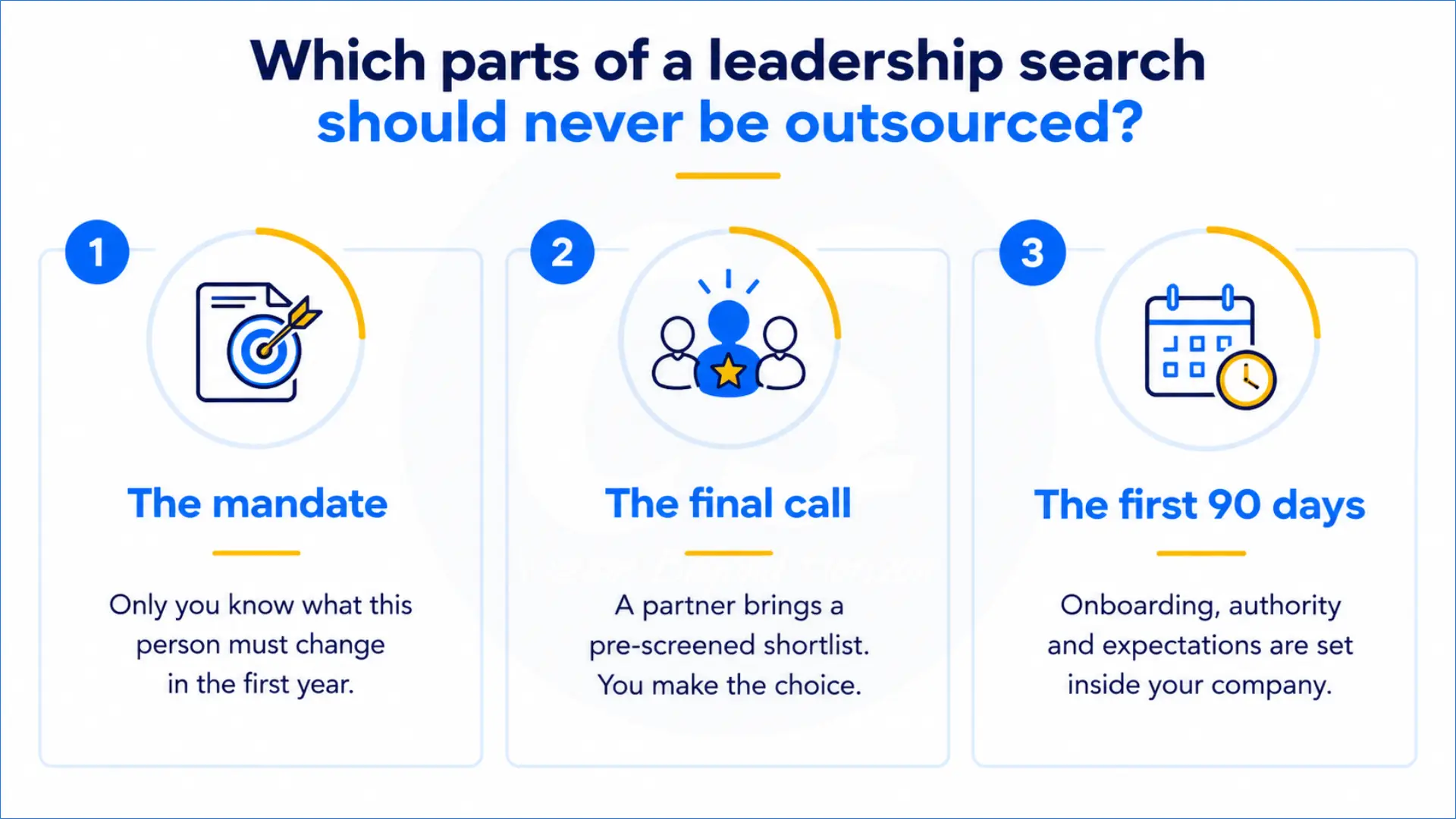
A partner can run the search. It cannot own the decision. Three things stay with your leadership team, whatever you outsource:
- The mandate. Only you know what this person must change in the first year. A partner sharpens the brief, but it can’t invent it.
- The final call. A partner brings a pre-screened shortlist. The person who will work with the hire makes the choice.
- The first 90 days. Onboarding, authority, and expectations are set inside the company, not by the search firm.
Outsource the market mapping, screening, and verification. Keep the judgment on what the business needs. In our experience, searches fail more often from an unclear mandate than from a weak shortlist.
What does an external recruitment partner take off the table
A good search partner does not replace the internal team. It takes on the work that needs the most time and the most market access.
- Mapping the market for senior talent before outreach starts
- Screening candidates against a defined mandate, not just a job description
- Verifying credentials and decisions in depth
- Handing over a short, pre-screened shortlist
This follows the same logic as precision hiring. The search narrows around the mandate first. The internal team then interviews candidates who are already vetted, instead of sorting a long slate.
We have seen this at scale. A leading paint manufacturer needed 200+ sales professionals, 25+ managers, and C-suite roles hired over 12 months. A mandate that wide cannot run alongside business as usual in an internal team. We ran it as an extension of their HR team, with one consistent screening standard from sales roles up to the C-suite.
The cost of skipping this is real. A wrong CTO hire costs far more than the search that could have prevented it.
Where Corporate Stalwarts fits into leadership hiring in 2027
Corporate Stalwarts is a global executive search firm with 20+ years in CEO, CXO, and leadership hiring. We work across technology, manufacturing, FMCG, pharma, healthcare, and automotive. Companies use us as an external recruitment partner, and as an HR outsourcing partner where they want a full hiring workload taken on.
We work as a helping hand to your internal HR team, not a substitute for it. We use AI to speed up mapping and screening. Experienced people make every final call. Your team receives pre-screened candidates through our Three-Level Screening process: functional, leadership, and cultural. That leaves leadership free to focus on the business.
If your open leadership roles are outpacing your recruiting capacity going into 2027, we are glad to talk through where support would help most.
Frequently Asked Questions
It can take on sourcing, screening, and coordination end to end, so the internal team focuses on the business instead of the pipeline.
Usually not. A structured search tends to shorten time to a right fit by avoiding a failed first attempt and a second search.

Corporate Stalwarts is a trusted recruitment firm with 20+ years of expertise in executive search and leadership hiring.
We’ve placed 10,000+ candidates across 600+ companies in FMCG, Manufacturing, IT, Pharma, and more. Our 1M+ candidate pool and 48-hour turnaround enable fast, high-quality hiring solutions.
We help businesses build high-performance teams with precision, speed, and industry expertise.