



Loading...

Why your first GCC leadership hiring decisions define everything that follows

Most GCCs do not fail because of the wrong city, the wrong mandate, or the wrong budget. They fail because of the wrong first three people, and nobody on the...
29/06/2026
Why your first GCC leadership hiring decisions define everything that follows

Most GCCs do not fail because of the wrong city, the wrong mandate, or the wrong budget. They fail because of the wrong first three people, and nobody on the global side realises it until the attrition numbers arrive six months after the centre opens. 

The GCC leadership hiring foundation does not just fill roles. They set the operating culture, the talent standards, and the hiring bar for every person who joins after them. Get those three decisions right, and the centre builds itself. Get them wrong, and the centre becomes something headquarters manages from a distance, a cost line that never becomes a capability. 

This article is for global GCC CHROs and founders who are about to make those decisions and want a clearer view of what the right process looks like. 

QUICK ANSWER 

The first three GCC leadership hiring decisions determine the culture, pace, and talent pipeline of everything that follows. Most global companies make these decisions using a hiring process designed for their home market — and discover too late that it does not work in India. A structured GCC leadership hiring process starts with a culture charter, screens for India-specific operating fit, and reaches passive talent rather than waiting for applications. Corporate Stalwarts has been building GCC leadership teams in India for over 20 years — every engagement starts with the brief, not the job post. 

Why do the first three GCC hires matter more than any that follow

The Head of Center role — sometimes titled GCC Director, Site Head, or Country Head — is the single most impactful hire a global company makes. Getting it right compresses time-to-productivity and dramatically reduces attrition in the first two years. 

The second and third founding hires multiply that impact — or compound the damage. The technology lead sets the engineering culture and attracts or repels the engineers who follow. The HR or people lead defines how talent is evaluated, onboarded, and retained from day one. Together, these three leaders create the environment every subsequent hire walks into. 

The first three GCC leadership hiring decisions do not just fill roles. They set the operating culture, the talent standards, and the decision-making pace for every hire that follows. A centre built on the wrong founding leadership team does not fail loudly. It fails quietly — through attrition, underperformance, and a widening gap between what HQ expects and what India delivers. 

According to Quantalent’s GCC India Talent Retention research 2026, GCC voluntary attrition averages 16 to 22% annually in India, with AI and senior engineering roles running at 25 to 30%. Consequently, the cost of a wrong-finding hire compounds across every departing team member that the leader hired, trained, and then lost. 

What goes wrong in early GCC leadership hiring

The failure pattern Corporate Stalwarts has observed across 20+ years of GCC leadership hiring in India follows a consistent sequence. 

HQ defines the role based on what a similar profile does at headquarters – not what the GCC needs at this specific stage of build. The brief arrives in India as a job description. A search begins. The candidates who respond are the ones who are available, not the ones who are right. 

According to Ceipal and People Matters’ GCC Talentscope India 2026 Report50% of GCCs are making critical hiring decisions without predictive data – relying on instinct and availability rather than structured evaluation against a defined operating context. 

Furthermore, the board pressure timeline makes it worse. When HQ has committed to a Q3 launch, the founding hire decision gets compressed. Speed replaces rigour. The strongest candidates — who are passive, employed, and being approached by multiple firms simultaneously — are not reachable in a compressed timeline built around a job post. 

The result is a founding team that is technically qualified and contextually wrong. Within 12 months, the attrition cycle begins — not at the bottom of the organisation, but at the top. 

What profile does your first GCC leadership hire need

The most common mistake in GCC talent strategy is defining the first hire profile based on seniority and functional depth alone. These are necessary but not sufficient. Three additional dimensions determine whether the leader will build something or stall. 

Builder vs manager 

A leader who has managed a mature, stable function at a large organisation brings process, structure, and a playbook. In an early-stage GCC, all three are liabilities—because the playbook does not exist yet and needs to be written. The right profile for a founding GCC hire has built something from an early stage before, not managed one that was already running. 

Autonomy under remote pressure 

The founding GCC leader operates in a gap. HQ is thousands of miles away; decisions need to be made daily, and the information to make them perfectly is never complete. A leader who is accustomed to escalating decisions upward, or who needs consensus before acting, will create delays that compound across the entire organisation. Specifically, autonomy tolerance is not a soft skill at this stage, it is the operating requirement. 

India market fluency 

A technically excellent leader without India market fluency will consistently make talent decisions that look right from the outside and fail from the inside. They will benchmark compensation against outdated data, misread notice period timelines, and evaluate candidates against criteria that do not account for how Indian professionals operate under ambiguity. The right founding hire understands the India talent market specifically — not India in theory, but the city, sector, and competitive dynamics they are hiring into.
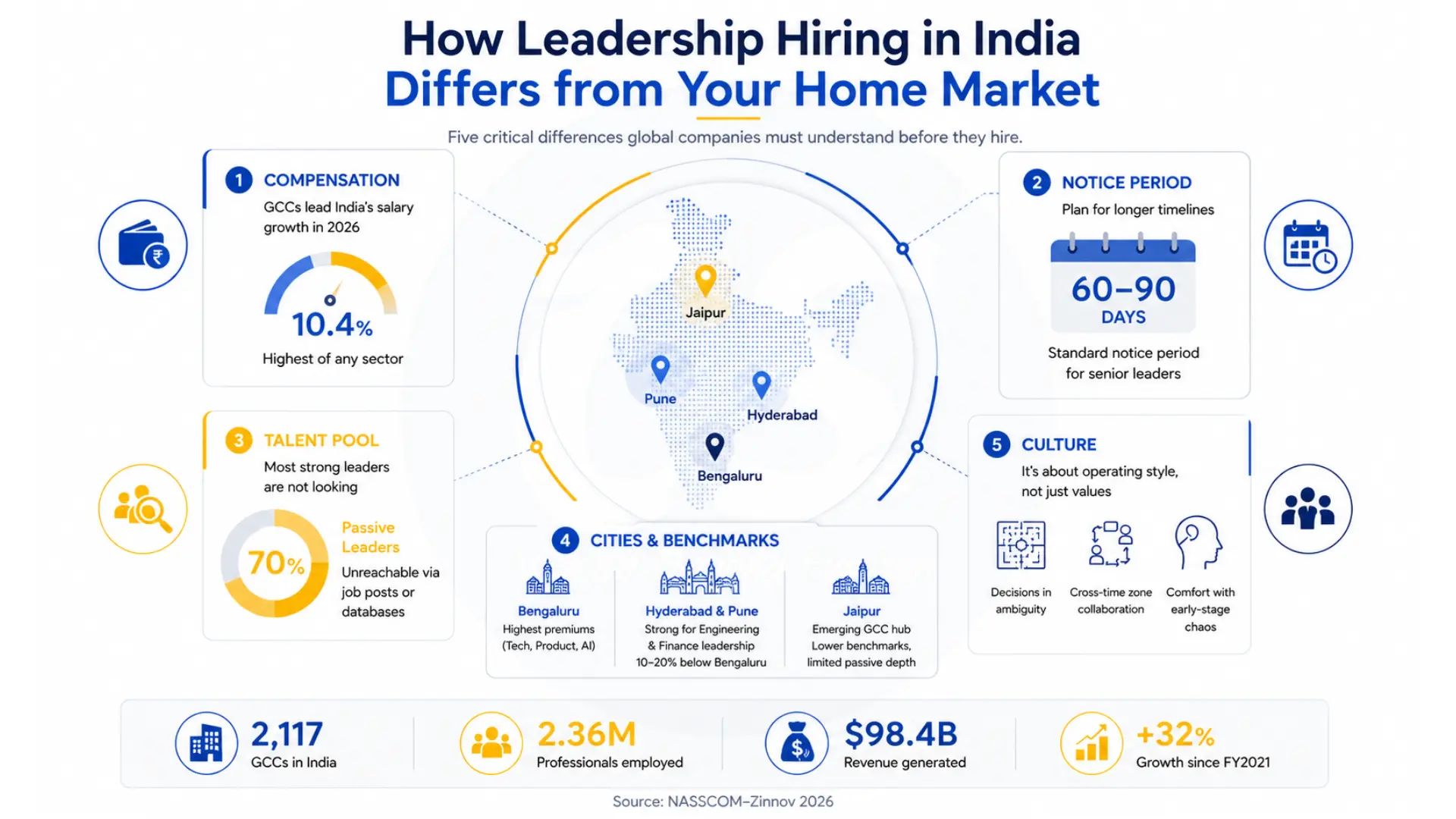
How GCC leadership hiring differs

How to structure your GCC leadership hiring process

A structured GCC leadership hiring process does not begin with sourcing. It begins with three steps that most searches skip — and that determine whether the right candidate is findable, reachable, and evaluable at all. 

Culture charter 

Before any search activity begins, the operating context needs to be documented across six dimensions: decision authority, operating pace, communication norms, culture non-negotiables, leadership style fit, and success definition at 30, 60, and 90 days. 

This document — the culture charter that Corporate Stalwarts develops at the start of every GCC mandate — becomes the filter through which every candidate is evaluated at every stage. Without it, every interview is a subjective conversation. With it, every interview produces comparable, defensible data that HQ and the India team both trust. 

Three-level screening 

Standard searches evaluate functional skills and run two or three interviews. That process finds candidates who interview well. It does not find candidates who will build well. 

Corporate Stalwarts’ three-level screening architecture — built after observing what two-stage processes consistently miss across hundreds of India leadership mandates — evaluates: 

  • Level 1 — functional skills and domain depth 
  • Level 2 — leadership capability, communication style, decision-making approach 
  • Level 3 — cultural alignment against the culture charter, operating context fit, long-term stability 

No candidate moves to offer without clearing all three. Most GCC leadership hiring failures trace back to a search that stopped at Level 2. 

Passive talent mapping 

The right founding GCC hire is not on any job board. They are currently leading a function somewhere in Bengaluru, Hyderabad, or Pune — performing well, being compensated competitively, and open to the right conversation if approached credibly. 

Reaching them requires mapping the market proactively, identifying leaders in relevant roles, understanding their career context, and making a case for the opportunity that speaks to where they are — not where your vacancy is. For a deeper view of how this works in practice, GCC talent strategy India covers the full hiring approach from day one. 
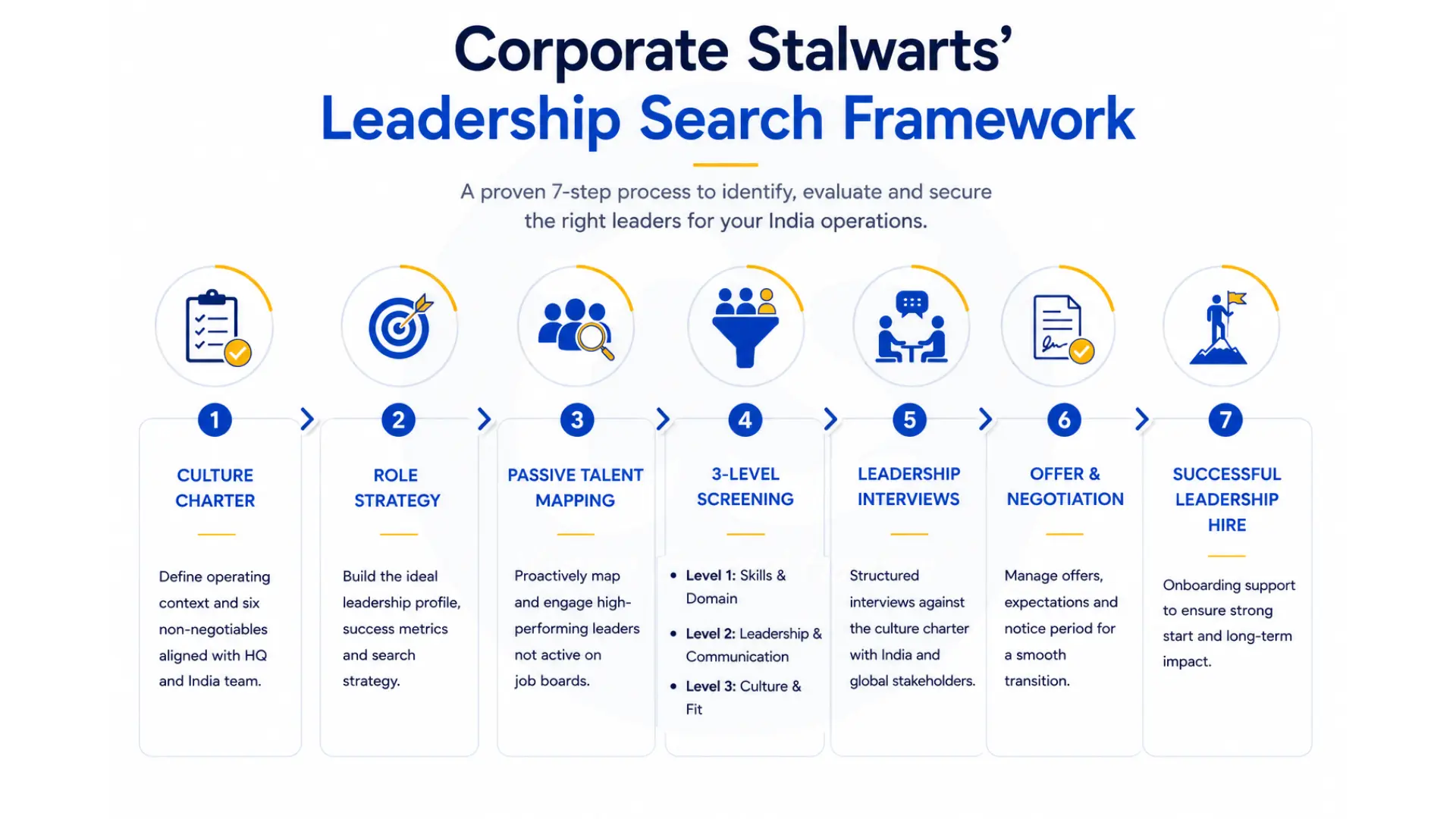
 

CS leadership search framework

How Corporate Stalwarts approach GCC leadership hiring

Why global companies choose Corporate Stalwarts for GCC leadership hiring: 

  • 95% candidate retention rate across 10,000+ senior placements 
  • 20+ years of placing founding and scaling leadership for GCCs, offshore centres, and international mandates in India 
  • Every engagement run by senior partners with direct India GCC placement experience 
  • Culture charter developed before any search begins — six dimensions, agreed by HQ and India team 
  • Three-level screening architecture built specifically for India leadership mandates 
  • Long-term clients, including Cargill, Yokohama, TVS Credit, Everest Masala, and HDFC — retained for 6 to 10+ years 
  • Shortlists delivered in 48 hours once the brief is locked 

For location-specific GCC leadership searches, Executive Search Hyderabad and the broader GCC hiring agencies India pages cover CS’s active delivery across India’s major GCC hubs. 

The founding hire sets the ceiling for everything the centre can become. Every company that has stayed with Corporate Stalwarts for a decade came to us having already discovered what happens when that hire goes wrong. 

If you are making your first GCC leadership hiring decisions, lets us start with the brief

Frequently Asked Questions

The brief is almost always the problem — built around a global profile rather than what an early-stage India centre specifically needs. Culture evaluation gets treated as a final check rather than the primary filter it needs to be throughout the search. By the time the misalignment is visible, it has already shaped the second and third tiers of hires the founding leader made.
A well-run retained GCC leadership search closes in 8 to 12 weeks from brief sign-off to accepted offer. Senior leaders in India serve 60 to 90-day notice periods at minimum, with three to six months standard at country head level. Factor the notice period into the center launch timeline before the search begins, not after an offer goes out.
Standard executive search finds the best available candidate. GCC leadership hiring finds the best candidate for this specific stage, this specific operating context, and this specific India market, which are three different filters that most standard searches do not apply. The founding GCC hire needs to build, not just manage, which requires a different evaluation entirely.
The strongest candidates are currently employed and not looking. Reaching them requires proactive talent mapping — identifying leaders performing well in relevant roles, understanding their career context, and approaching them with a specific and credible case for the opportunity. A job post will not reach them. A credible, personalised approach from a firm they recognise will.

The strongest GCC leadership candidates will not engage with a contingency search — where the firm is only paid on placement and therefore prioritises speed over fit. A retained search signals that the mandate is serious, the process is structured, and the search firm is committed to one brief rather than hedging across multiple clients. At the founding hire level, that signal determines whether the right candidate takes the conversation or declines it.

Share this article

Related Articles

Browse the latest hiring insights

What nobody tells you about India Leadership Hiring
When a US product company opened its offshore centre in Gurgaon, the co-founder did not come to us asking for recruitment help. He came carrying genuine frustration with the organisation...
How to Write a Senior Executive Resume that gets you Hired
TLDR: A search firm decides whether to call you in under two minutes. Your senior executive resume is not a career document. It is a screening document. This guide covers exactly...
Smart Ways to Use AI Tools for Executive Job Search
TLDR: AI will not get you the role. But if you use AI tools for executive job search correctly, they will make sure you show up prepared enough that the right...
Senior Hiring Challenges: Why you need more than a Database
TLDR: Senior hiring challenges rarely start with a shortage of names but with a shortage of process. The leaders you need are not refreshing their Naukri profiles or waiting on your LinkedIn InMail....