


Loading...

What nobody tells you about India Leadership Hiring

When a US product company opened its offshore centre in Gurgaon, the co-founder did not come to us asking for recruitment help. He came carrying genuine frustration with the organisation...
20/06/2026
What nobody tells you about India Leadership Hiring

When a US product company opened its offshore centre in Gurgaon, the co-founder did not come to us asking for recruitment help. He came carrying genuine frustration with the organisation hiring for C-suite roles in India. “People come, join, and leave. Then we hire again, they join, and they leave again. We cannot figure out what we are doing wrong.” 

The team had not hired bad people. They had hired the wrong people for the wrong reasons — and nobody in the process had noticed the difference. Twelve months later, after rebuilding the hiring process entirely, that same centre scaled from under 10 to over 100 professionals. The company transitioned from a services model to a product business – a pivot made possible by the people within it, who were capable of carrying the ambition. 

The difference between a centre that transforms and one that stalls is seldom budget, location, or mandate. The process that works at headquarters will not work in India. This article explains what a process built for leadership hiring in India looks like and why. 


QUICK ANSWER 

Leadership hiring in India fails global companies for one consistent reason: they apply a hiring framework built for their home market to a talent pool that operates by entirely different rules. The Indian leadership market is deep, passive, compensation-sensitive, and city-specific in ways that no job post or database search will surface. Getting it right requires a process built specifically for this market — not a modified version of what works elsewhere. Corporate Stalwarts has been building leadership teams for global companies in India for 20+ years — and every engagement starts with the brief, not the shortlist.

Why is hiring senior leaders in India harder than expected

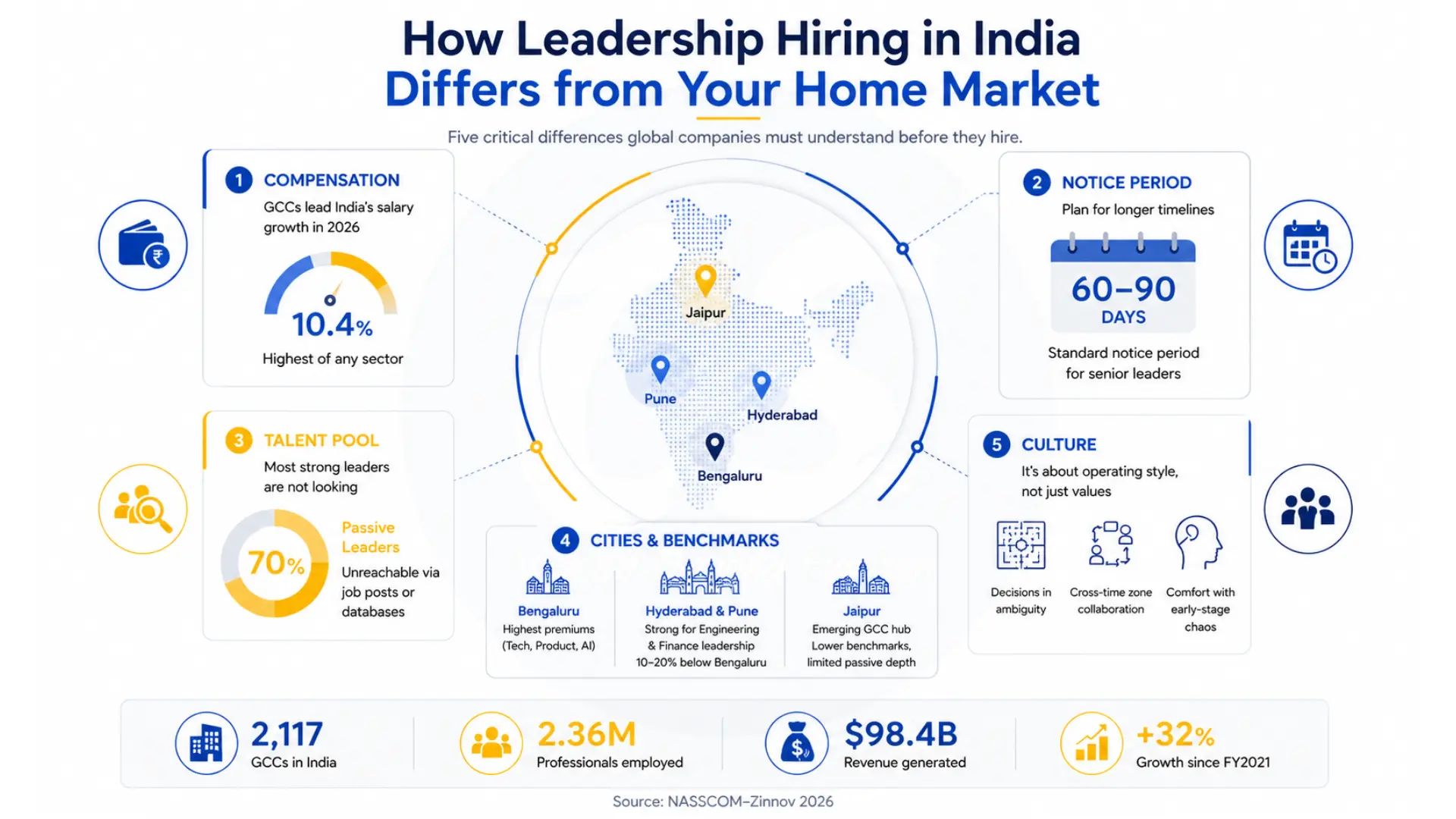
India now houses 2,117 GCCs employing 2.36 million professionals and generating $98.4 billion in revenue — with 32% growth since FY2021, according to NASSCOM-Zinnov 2026 data. Consequently, the competition for senior leadership hiring in India has never been more intense or more consequential. 
Why GCC hiring is harder

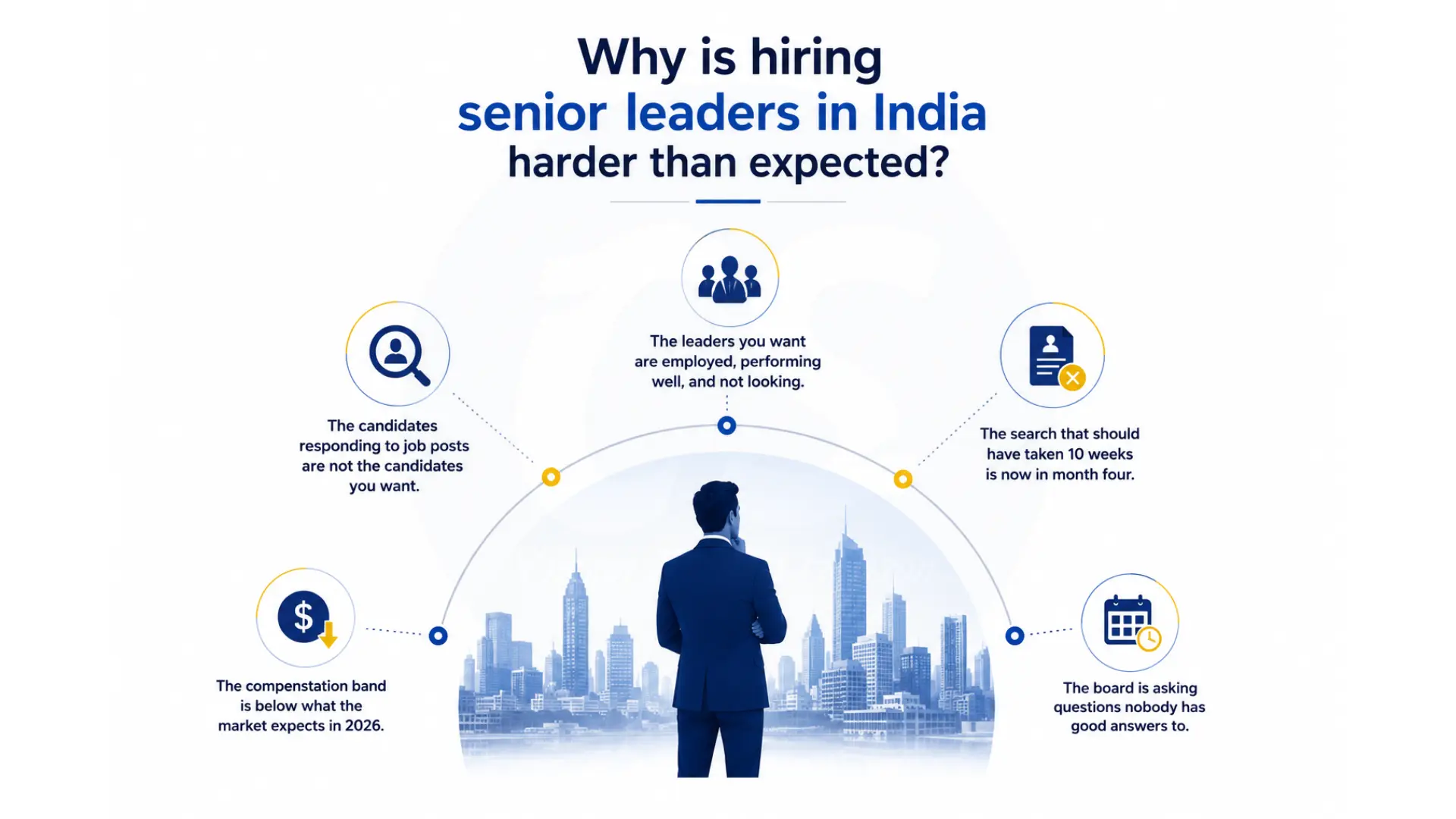
Most global companies arrive at their first India leadership search with a reasonable level of confidence. They have hired senior leaders before. They have a compensation band, a job description, and a timeline from the board. Specifically, here is what they discover within the first eight weeks: 

  • The candidates responding to job posts are not the candidates they want 
  • The compensation band is below what the market expects in 2026 
  • The leaders they do want are employed, performing well, and not looking 
  • The search that should have taken 10 weeks is now in month four 
  • The board is asking questions to which nobody has good answers to 

This is not a talent shortage. India has the leaders. The problem is a search process that was never designed for this market. 

Who should be your first leadership hire for India operations?

Every successful GCC or offshore operation traces its trajectory back to that founding hire. The country head, the India MD, or the GCC lead sets the operating culture, the talent standards, and the decision-making pace for everything that follows. A leader who can manage up to global headquarters while building down into the Indian market is a rare profile. Most HQ teams underestimate how rare. 

In 2026, most GCC country head briefs additionally require AI literacy and the ability to lead distributed, multi-stakeholder teams across geographies. Consequently, the talent pool that meets all of these criteria is smaller than expected — and entirely unreachable through a standard job post. 

The profile that works at this stage: 

  • Operates autonomously — makes decisions without waiting for HQ input on every call 
  • Builds trust in both directions — credible to the global leadership team and respected by the India team 
  • Has built before — not managed a stable function, but constructed one from an early stage in an India-specific context 

Furthermore, this profile is currently employed, delivering results elsewhere, and is being approached by multiple firms. Reaching them requires a proactive, research-led search — not a reactive one. 

How leadership hiring in India differs from your home market

Global companies consistently encounter five specific mismatches when they run their first India leadership search. Understanding them before the search begins saves months. 
How GCC leadership hiring differs

What senior leaders in India expect to be paid 

GCCs lead India’s salary growth in 2026 at 10.4% increments — the highest of any sector — driven by sustained global demand and digital skill scarcity, according to EY’s Future of Pay 2026 report. Consequently, compensation benchmarks are moving faster than most global HQ teams have budgeted for. 

Based on Corporate Stalwarts’ senior placement experience across Bengaluru, Pune, Hyderabad, and Jaipur in 2025 to 2026: 

  • Bengaluru commands the highest premiums — technology, product, and AI leadership roles compete across global tech firms, GCCs, and funded startups simultaneously 
  • Hyderabad and Pune are strong for engineering and finance leadership, typically 10 to 20% below Bengaluru for equivalent seniority 
  • Jaipur is emerging as a new GCC destination with lower benchmarks, but passive talent depth at the country head level remains limited compared to the three established hubs 


The compensation conversation needs to happen with HQ before the search begins — not after the first candidate declines the offer. 

Why India’s notice periods catch global companies off guard 

Senior leaders in India serve 60 to 90-day notice periods as standard. At the VP and CXO level, three months is the norm and six-month clauses are common in large organisations. Therefore, a search that identifies the right candidate in week eight will not produce a start date until week 22 at the earliest. Build this into the timeline before the search begins. 

Why the best Indian leaders are not on any job board 

The candidate pool visible on LinkedIn or Naukri at the senior level represents the available talent — not the right talent. In other words, a search that depends on who responds is already working from the wrong 30% of the market. The strongest senior professionals in India are passive — not updating profiles, not monitoring job alerts, and not responding to generic InMails. 

What culture fit means in an India context 

Culture fit in an India context is specifically about operating style under pressure — how decisions are made without complete information, how conflict is handled across time zones, and how comfortable a leader is with the ambiguity that defines early-stage India operations. A leader who thrived in a structured, process-driven environment at a large Indian conglomerate may be technically excellent and still fundamentally wrong for a GCC that needs someone to write the processes, not follow them. 

Why Indian CVs inflate titles and how to read them 

A Head of Engineering at one company may lead a team of 200. At another, the same title covers a team of four. Similarly, VP and Director carry different weights depending on whether the company is a large conglomerate, a funded startup, or an MNC subsidiary. The title on the CV is the starting point of the evaluation, not the conclusion. Understanding what the role involved — team size, decision authority, operating context — requires a search partner with India market depth, not just a job description match. 

Why culture fit hiring in India keeps failing global companies 

This is the pattern Corporate Stalwarts has observed most consistently across 20+ years of leadership hiring for GCCs, offshore centres, and international companies building in India: the brief screens for skills and experience. The hire fails because of culture and context. 

According to LinkedIn’s 2025 Workplace Learning Report, 88% of organisations are concerned about employee retention, career growth, and culture fit, consistently ranking above compensation as the primary reasons senior employees leave within the first year. Yet most international companies screen almost exclusively for functional competency and salary band. Most treat culture evaluation as a final-stage check, by which point the evaluation is already anchored on the wrong variables. 

The failure pattern CS sees most often: 

  • HQ defines the role based on what the last person did – not what the next phase needs 
  • The India hiring manager screens for years of experience and a recognisable brand on the CV 
  • The shortlist reaches HQ with three technically qualified candidates — none evaluated for operating style, autonomy tolerance, or cultural alignment 
  • An offer is made to the strongest CV. The candidate joins. Within 8 to 12 months, the misalignment is visible across the organisation 
  • The search restarts, under board pressure, with a shorter runway and a team that has already absorbed the cost 

The US IT company: what rebuilding the process looked like 

In 2010, Corporate Stalwarts partnered with a US-based product IT company that had opened an offshore centre in Gurgaon. The co-founder described the pattern directly: “People come, join, and leave. Then we hire again, they join, and they leave again. We cannot figure out what we are doing wrong.” 

The search running at the time screened for functional skill match and years of experience. It did not screen for ownership mindset, product-first thinking, autonomy under remote management, or alignment with a founder operating thousands of miles away. CS rebuilt the process from the ground up, developing a culture charter, implementing three-level screening, and mapping passive talent across the market. 

Within 12 months: 

  • Team scaled from under 10 to over 100 professionals 
  • The second centre opened in Chandigarh alongside the stabilised Gurgaon operation 
  • Every CS placement grew within the organisation — several joined the core leadership team 
  • Company transitioned from services to product — a strategic pivot, the right hiring process made possible 

For more details, the offshore team building India case study covers the full engagement. 


How to run a leadership search in India as a global company

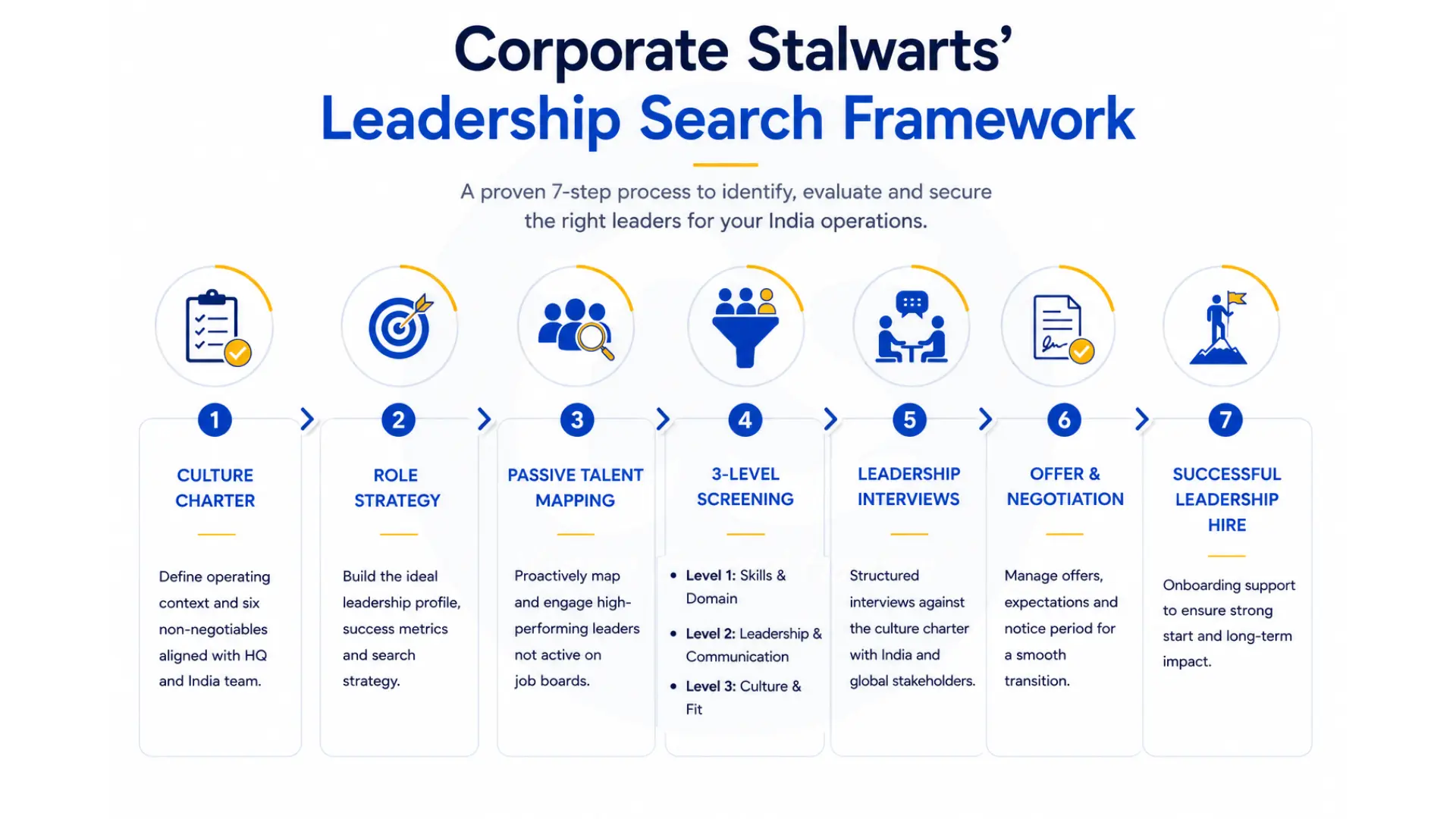
A structured international executive hiring process for India operations does not begin with sourcing. It begins with three steps that most searches skip entirely. 

Culture charter 

Before any search activity begins, the operating context needs to be documented — not as a job description, but as a culture charter. This is a Corporate Stalwarts deliverable developed at the start of every GCC and international mandate, built through direct sessions with both the global leadership team and the India hiring stakeholders. 

It defines six dimensions every candidate is evaluated against at every stage: 

  1. Decision authority— what the India leader owns independently and what requires HQ sign-off across time zones
  2. Operating pace— how fast decisions are expected to move and how the India team functions between HQ touchpoints
  3. Communication norms— meeting cadence, reporting expectations, and how the India leader represents the organisation externally 
  4. Culture non-negotiables— the two or three behaviours that are non-negotiable regardless of seniority or performance 
  5. Leadership style fit— whether the organisation needs a builder, a scaler, or a stabiliser — these are three different profiles requiring three different searches 
  6. Success definition— what the new leader needs to deliver at 30, 60, and 90 days in specific, measurable terms, agreed before the search begins 

Without this document, every interview is a subjective conversation. With it, every interview is a structured evaluation against a defined standard that HQ, the India team, and the search firm all share. 

Three-level screening 

This is the architecture Corporate Stalwarts built after observing what standard two-stage processes consistently missed across hundreds of India leadership mandates. No candidate moves forward without clearing all three levels: 

  • Level 1 — functional skills and domain depth 
  • Level 2 — leadership capability, communication style, decision-making approach 
  • Level 3 — cultural alignment against the culture charter, operating context fit, long-term stability 

Most searches run Level 1 thoroughly and assume Level 3 resolves itself after joining. That assumption is where most India leadership hiring mandates fail. Understanding senior hiring challenges India gives a sharper context on why this step is not optional. 

Passive talent mapping 

The right candidate for most India leadership roles is currently employed and not looking. Therefore, reaching them requires mapping the market proactively — identifying leaders performing well in relevant roles, understanding their career context, and approaching them with a specific and credible opportunity built around what the role offers them, not what the company needs from them.  
CS leadership search framework

How Corporate Stalwarts handles leadership hiring for global companies in India

Why global companies choose Corporate Stalwarts for India leadership hiring: 

  • 95% candidate retention rate across 10,000+ senior placements 
  • 20+ years of dedicated India market experience across GCCs, offshore centres, and international mandates 
  • Every engagement run by senior partners with direct India placement experience — not handed to junior recruiters after sign-off 
  • Long-term clients, including Cargill, Yokohama, TVS Credit, Everest Masala, and HDFC, have been retained for 6 to 10+ years, not because we are the cheapest option, but because we get it right and they feel the difference in their retention numbers 
  • Culture charter developed before any search begins — six dimensions, agreed by HQ and India team 
  • Shortlists delivered in 48 hours once the brief is locked 

We work as an extended arm of your organisation. Neither your internal stakeholders nor the candidates we approach will feel they are dealing with an outside agency. That is by design — and it is why clients who come to us for one mandate almost always return for the next. 

Also read: startup executive search guide 


India’s leadership talent market rewards the firms that understand it. Every company that has stayed with Corporate Stalwarts for a decade or more came to us after finding out what happens when the process does not match the market. 

If you are building a leadership team in India, lets us start with the brief

Frequently Asked Questions

The brief is almost always the problem — built around a global profile rather than an India-specific operating context. Culture evaluation gets treated as a final-stage check rather than the primary filter it needs to be throughout the search. By the time the misalignment is visible, the cost has already compounded across the team, the timeline, and the board's confidence. 
A well-run retained search in India closes in 8 to 12 weeks from brief sign-off to accepted offer. However, senior leaders serve 60 to 90-day notice periods at minimum — with three to six months standard at CXO level. A search that closes in week ten will not produce a start date before week 22 at the earliest.
The strongest senior leaders in India are passive — not on job boards, not responding to generic InMails, and not looking. Reaching them requires retained executive search with India-specific market depth, proactive talent mapping, and a personalised approach built around what the opportunity offers the candidate. A job post will not reach them.
Four differences define the gap: compensation benchmarks rising at 10.4% annually in GCCs, a passive senior talent pool unreachable through job posts; notice periods three to six times longer than Western markets, and a culture fit evaluation that must go beyond values alignment to operating style under pressure. Each one requires a different process — not a modified version of what works at headquarters. 
Share this article

Related Articles

Browse the latest hiring insights

How to Write a Senior Executive Resume that gets you Hired
TLDR: A search firm decides whether to call you in under two minutes. Your senior executive resume is not a career document. It is a screening document. This guide covers exactly...
Smart Ways to Use AI Tools for Executive Job Search
TLDR: AI will not get you the role. But if you use AI tools for executive job search correctly, they will make sure you show up prepared enough that the right...
Senior Hiring Challenges: Why you need more than a Database
TLDR: Senior hiring challenges rarely start with a shortage of names but with a shortage of process. The leaders you need are not refreshing their Naukri profiles or waiting on your LinkedIn InMail....
Startup Executive Search: Architecting Your Series A-C Leadership Team
TL;DR: Most Series A to C founders hire their first CXO too late, too fast, and with a brief that was never sharp enough. This guide covers what separates a...