

TLDR: A search firm decides whether to call you in under two minutes. Your senior executive resume is not a career document. It is a screening document. This guide covers exactly what goes in, in what order, and why a poorly structured profile ends a conversation before it begins.
Thirty years of experience compressed into a Canva PDF. A LinkedIn export submitted as a resume. A five-page document with a creative header, no photograph, and a career gap that nobody mentioned.
These land on executive search firm desks every week. None of them gets a call.
Writing a senior executive resume is not about design. It is, specifically, about giving a search consultant enough to justify picking up the phone. This guide covers the exact format Corporate Stalwarts (CS) uses to evaluate senior profiles, what each section must include, and what gets a resume set aside before the second paragraph.
What do executive search firms look for in a resume
Research from InterviewPal’s 2025 resume review study found that recruiters spend a median of 1 minute 34 seconds reviewing a resume, with most of that time spent verifying quantifiable results and role titles.
At the senior level, that window is not extended by a longer career. In fact, it is shortened by a cluttered or incomplete document. Consequently, every section of a senior executive resume needs to earn its place.
Specifically, what a search consultant looks for in the first pass:
- Complete and current contact information
- Professional photograph that matches the seniority of the role
- A career objective written for this specific role, not the last one
- Quantified achievements, not responsibilities that are listed
- A full, unbroken account of the career, including any gaps explained
According to Resume Genius’s 2026 hiring manager research, 90% of hiring managers say a clear resume summary helps them evaluate candidates faster, and 72% say inconsistent formatting weakens an application. At the CXO level, therefore, formatting inconsistency signals carelessness before reading a single line of experience.
What should a senior executive resume include
A CXO resume format has twelve sections. It reflects how a search consultant reads and what they need to find quickly. Specifically, each section serves a purpose, and a missing section creates a question that the resume answers.
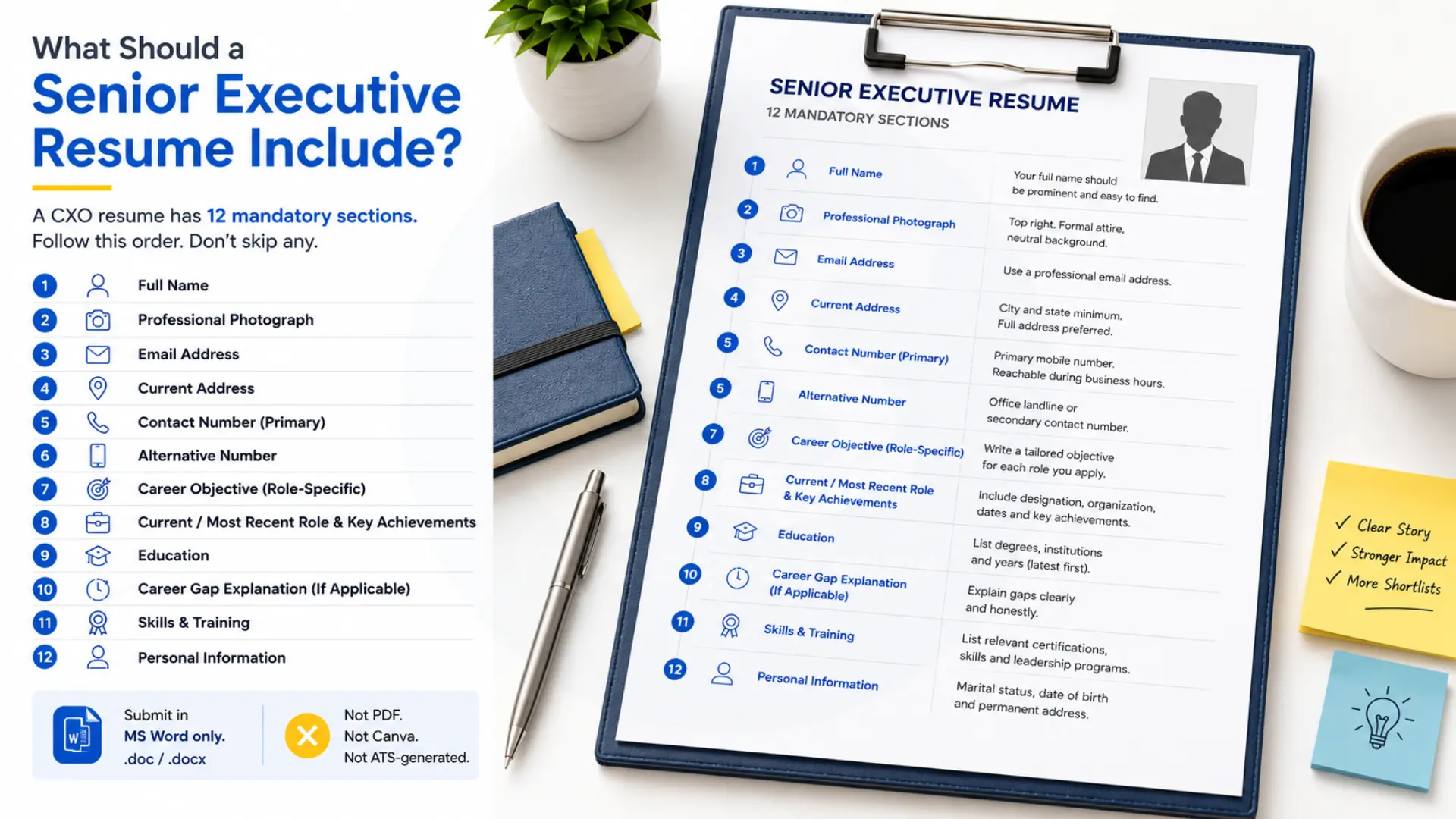
The confirmed sequence:
- Full name — prominently at the top, not buried in a header design
- Professional photograph — top right, formal attire, neutral background
- Email address — professional domain, not a personal handle from 2009
- Current address — city and state minimum; full address preferred
- Contact number — primary mobile, reachable during business hours
- Alternative number — office or secondary contact
- Career objective — role-specific, written fresh for each application
- Current or most recent role — title, organisation, dates, key achievements
- Education — degrees, institutions, years in reverse chronological order
- Career gap explanation — mandatory if applicable, no exceptions
- Skills and training — relevant certifications, technical skills, leadership programmes
- Personal information — marital status, date of birth, permanent address
Submit in MS Word only. Not a PDF or a Canva export and definitely not an ATS-generated file. In practice, format alone disqualifies more profiles than weak experience does.
How to write a career objective for a senior executive resume
The career objective is the section most senior candidates get wrong. It is also the first section a search consultant reads.
A generic objective fails immediately. “Seeking a challenging role in a dynamic organisation” communicates nothing and, more importantly, signals that the candidate did not write it for this specific application.
A role-specific objective does three things:
- States the specific role or function
- Summarises your most relevant experience in one line
- Signals what you bring to this particular stage of the company or sector
What does not work: “Experienced finance professional seeking senior leadership opportunities to leverage expertise in driving organisational growth.”
What works: “CFO with 18 years across FMCG and D2C, specifically Series B to pre-IPO stage, bringing P&L ownership and investor-facing experience to a growth-stage company in its next phase of scale.”
Consequently, the objective sets the context for everything that follows. If it is vague, the rest of the resume carries that cost regardless of how strong the experience is.
How to explain a career gap in a senior executive resume
An unexplained career gap is the fastest way to end a conversation before it starts.
Search consultants do not penalise gaps. They penalise silence. An unexplained gap triggers one question: what is the candidate not saying? That question rarely gets answered in the candidate’s favour.
Furthermore, preparing the explanation in the resume means the interviewer arrives with context rather than a question, which changes the tone of the first conversation entirely.
Keep the explanation short, honest and specific:
- Health matter: “Career break: personal health, fully resolved as of [date]”
- Family responsibility: “Career break: primary caregiver for a family member, [date range]”
- Entrepreneurial attempt: name it, state the outcome, move forward
- Voluntary break: sabbatical, relocation, or further education — state it plainly
Why is my executive resume not getting a response
The answer is almost always in one of four places. In most cases, none of them requires a rewrite — they require a correction.
No photograph. A professional headshot is expected at the CXO level in India. It signals seriousness and an understanding of how executive hiring works. A missing photograph is a red flag — not because it disqualifies the candidate, but because it raises an unnecessary question.
Role-generic objective. If the objective was not written specifically for this role, a search consultant can tell in one read. Generic objectives, in contrast, signal a candidate applying broadly rather than selectively, which is the opposite of how strong senior candidates present themselves.
Responsibilities listed, not achievements. “Managed a team of 50” is a responsibility. “Rebuilt the regional sales structure, reducing cost per acquisition by 32% over 18 months” is an achievement. Search firms look for the second, consistently, across every listed role. The difference is the difference between a profile that gets a call and one that does not.
Wrong format. According to Resume Genius’s 2026 Job Search Statistics Report, 62% of hiring managers say overly designed resumes with excessive colour or visuals hurt their perception of a candidate. A Canva resume, a colour-heavy PDF, or a LinkedIn export creates parsing problems and, moreover, signals unfamiliarity with how professional executive search operates.
How is a senior executive resume different in India
The executive resume India format expected by search firms differs from Western conventions in three specific ways. Understanding those differences is particularly important for senior professionals applying across both markets.
First is personal information; date of birth, marital status, and permanent address are standard inclusions in Indian executive hiring. Omitting them does not signal modernity — it creates an incomplete profile that generates a follow-up question instead of a call.
Second, a professional photograph is standard practice at the senior level. International candidates applying to Indian firms should include one. Indian candidates applying internationally should, similarly, research the convention for that specific market before including or omitting it.
Third, the self-declaration — “I hereby declare that the above information is true to the best of my knowledge” — remains common in mid-level Indian resumes. Senior executives should omit it unless the application explicitly requests it. In its place, a strong professional summary and specific, verifiable achievements carry considerably more credibility.
For a broader view of why senior hiring challenges begin before the search, the resume is consistently one of the first avoidable causes and, ultimately, one of the most correctable ones.
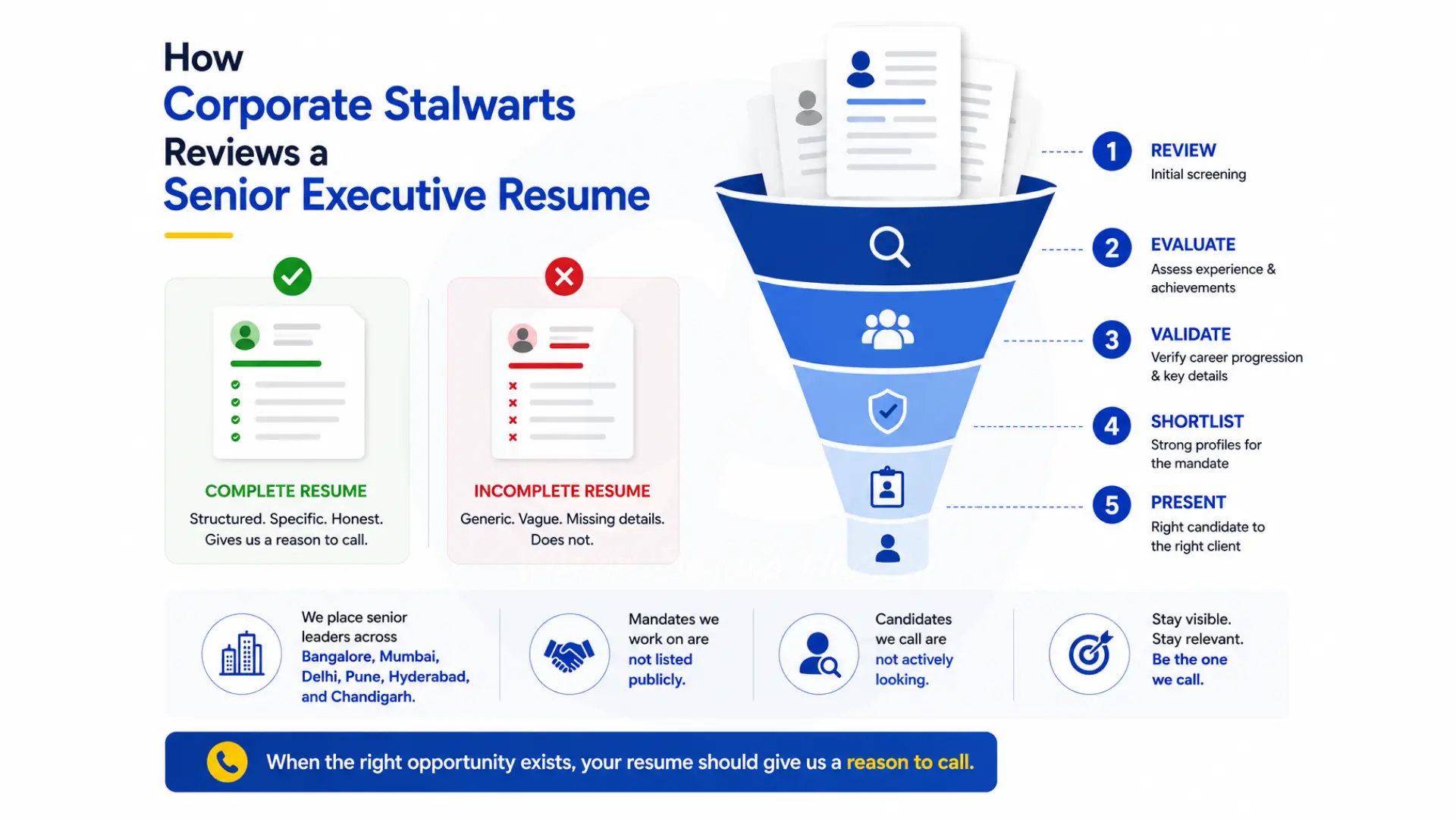
How Corporate Stalwarts reviews a senior executive resume
Every profile that reaches Corporate Stalwarts is reviewed against one question: Does this give us enough to make the case for this candidate to a client?
A complete resume, structured clearly, with specific achievements and an honest account of the full career, including gaps, answers that question.
We place senior leaders across Bangalore, Mumbai, Delhi, Pune, Hyderabad, and Chandigarh. If you want to be found when the right opportunity exists, your resume needs to be the version that gives us a reason to call.
Send us your profile, and we will tell you whether it is ready.
Frequently Asked Questions

Corporate Stalwarts is a trusted recruitment firm with 20+ years of expertise in executive search and leadership hiring.
We’ve placed 10,000+ candidates across 600+ companies in FMCG, Manufacturing, IT, Pharma, and more. Our 1M+ candidate pool and 48-hour turnaround enable fast, high-quality hiring solutions.
We help businesses build high-performance teams with precision, speed, and industry expertise.