


GCC executive hiring in India is not keeping pace with everything else happening in the ecosystem.
Hiring is up. AI adoption is up. Even government ambition is up, with policy now pushing GCCs to own products and platforms, not just running them. But most organisations still hire the executive layer the old way.
That gap does not show up in a hiring dashboard. It shows up eighteen months later, when a GCC has strong technical talent and no one senior enough to direct it.
QUICK ANSWER
GCCs built for capability ownership need executives who can hold decision authority and set direction. Most search processes still screen for delivery management instead, which is why capable centres end up with the wrong leader at the top. Corporate Stalwarts has been building GCC leadership teams in India for over 20 years—every engagement starts with the brief, not the job post.
Table of Contents
ToggleWhat GCC executive hiring in India should look like now
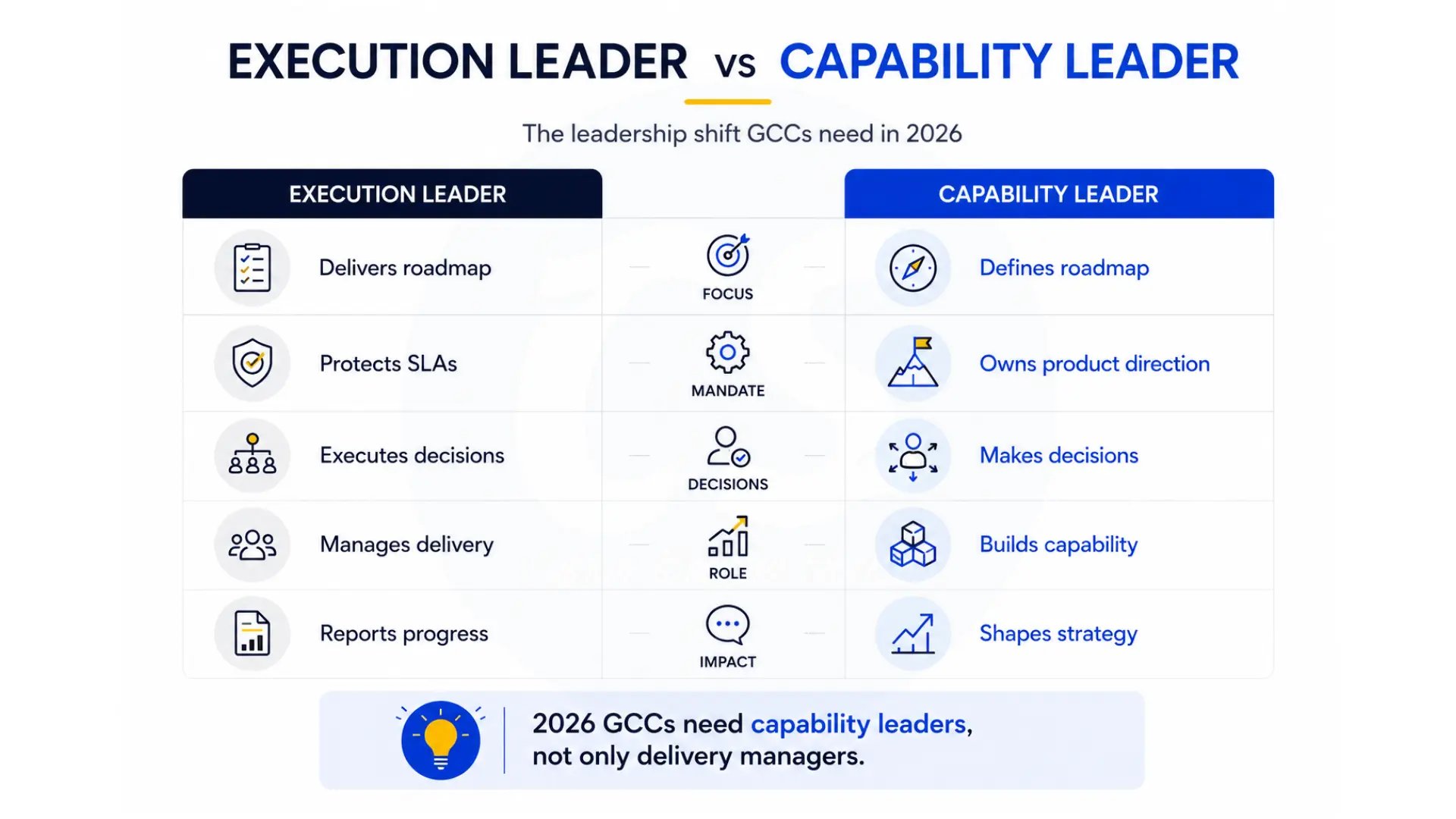
For most of the last decade, a GCC leadership hire was an operations decision. You needed someone who could protect SLAs, manage a delivery calendar, and keep the centre running quietly in the background. The centre’s job was to execute what headquarters designed.
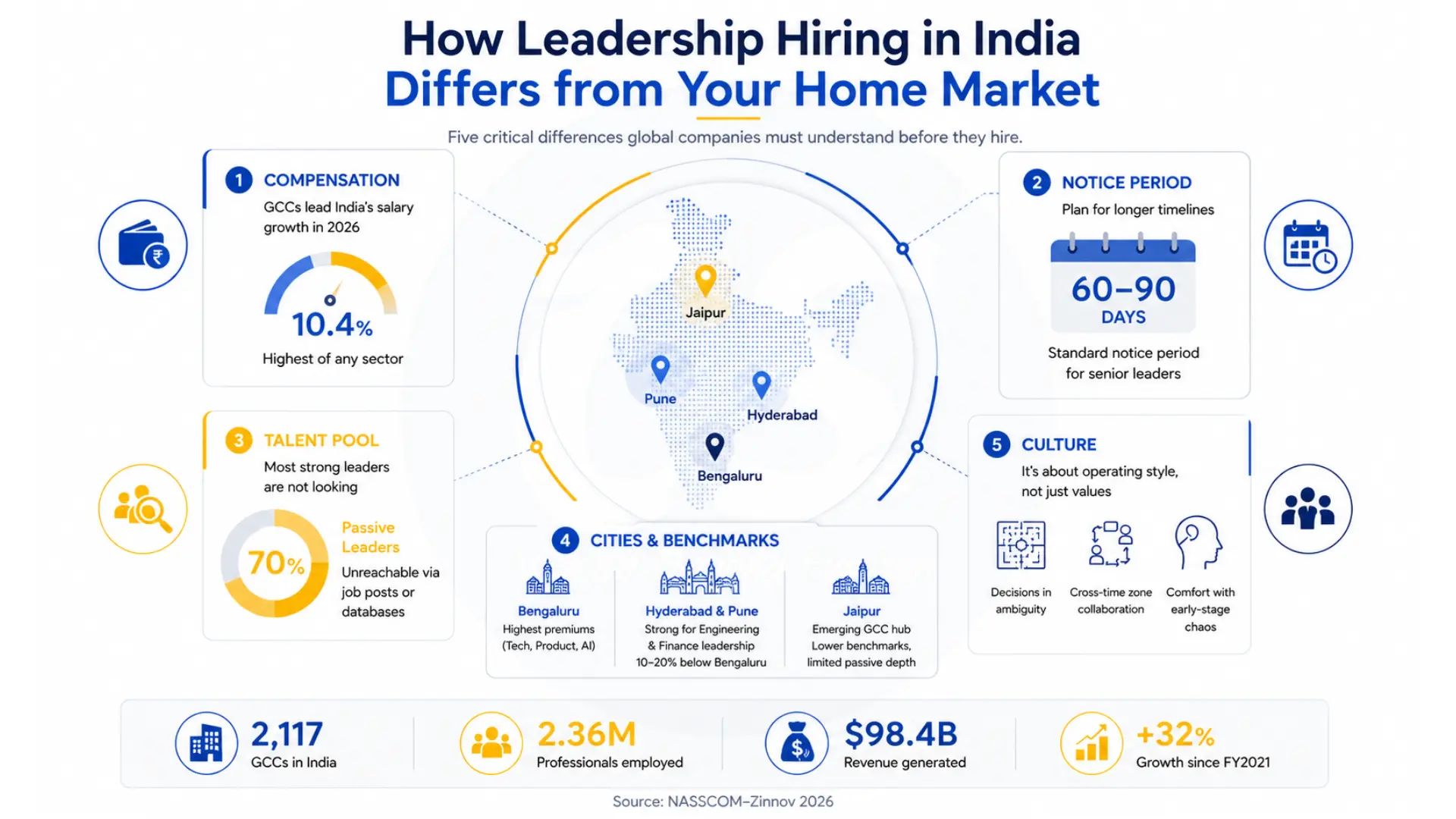
That brief has changed. India’s GCC ecosystem has crossed 2,100 centres and generates close to $98 billion in annual revenue. Nearly half of all centres built since 2021 made AI a core capability from day one, per the Nasscom-Zinnov GCC Landscape Report 2026. When a centre owns product decisions, intellectual property, or platform architecture, the person running it needs a different mandate entirely: the authority to set direction, not just hit targets.
Our guide to GCC talent strategy in India covers this same shift. But the talent conversation and the leadership conversation are not the same problem. Treating them as one is where most centres get stuck.
The distinction that matters: an execution leader protects what already exists. A capability leader decides what gets built next. Hiring the first for a role that needs the second is where most GCC leadership gaps start.
The mismatch: strong hires, weak leadership
GCC roles created in the first half of 2026 show 56% of hiring concentrated in the 4 to 10-year experience band. AI, data science, and automation skills drove nearly two-thirds of that demand.These are strong technical hires. They are not leadership hires.
That leaves a structural problem sitting quietly inside a lot of GCCs. A growing bench of senior individual contributors and mid-level specialists now reports into a leader hired years ago for a very different mandate. The technical depth is there. The person who can evaluate that work, set its direction, and own its outcomes with global stakeholders often is not.
This is not a hiring volume problem. It is a hiring calibration problem, and it rarely gets flagged until a centre tries to take on more ownership and hits a ceiling nobody planned for.
Set-up leader vs. scale leader
What GCC executive hiring in India gets wrong
Most GCCs make one of two hiring mistakes at the executive level.
- Hiring a scale leader too early. Someone with a strong track record running a large, established centre, dropped into a GCC that is still finding its operating model. They optimise a structure that does not exist yet.
- Hiring a set-up leader too late. A builder who thrives on ambiguity, kept in place long after the centre needs process discipline and predictable delivery at scale.
The fix is not a better resume filter. It starts with the right question: Is this centre still growing, or is it running at scale? The answer changes who you should hire. Our guide on building a future-ready GCC leadership team walks through this in more depth.
What to evaluate beyond the resume
A strong delivery record tells you almost nothing about whether someone can own capability decisions. Two areas are worth evaluating directly.
Culture Charter fit
Decision authority, operating pace, and communication norms are rarely spelled out in a job description, yet they are usually what determines whether a leader succeeds or quietly stalls. A leader who expects full autonomy will struggle inside a centre that still routes every call through headquarters, regardless of how strong their resume looks.
Screening beyond delivery record
Functional competence gets someone shortlisted. It does not tell you whether they can hold their ground with a global stakeholder, defend a technical decision under pressure, or push back on a deadline that does not make sense. A structured, multi-level evaluation — functional fit, leadership judgment, and cultural alignment, assessed separately — surfaces this before an offer goes out, not six months into the role.
Why generalist searches miss capability hires
Most search processes, internal or external, are built to answer one question: can this person do the job as written? For an execution role, that is usually enough.
For a capability-owning executive role, it is not. Generalist search firms and internal TA teams are typically optimised for speed and role fit, screening candidates against a fixed set of requirements rather than against judgment, authority, and fit for a centre still defining its own mandate. Job platforms give you access to a shelf of names you can see. They do not tell you which of those names can actually own a product decision under pressure. That gap is structural, not a matter of trying harder. It is also why the right GCC hiring agencies India works with tend to run capability-level searches differently from standard role-fit hiring.
How CS approaches GCC executive hiring in India
Why global companies choose Corporate Stalwarts for GCC leadership hiring:
- 95% candidate retention rate across 10,000+ senior placements
- 20+ years of placing founding and scaling leadership for GCCs, offshore centres, and international mandates in India
- Every engagement run by senior partners with direct India GCC placement experience
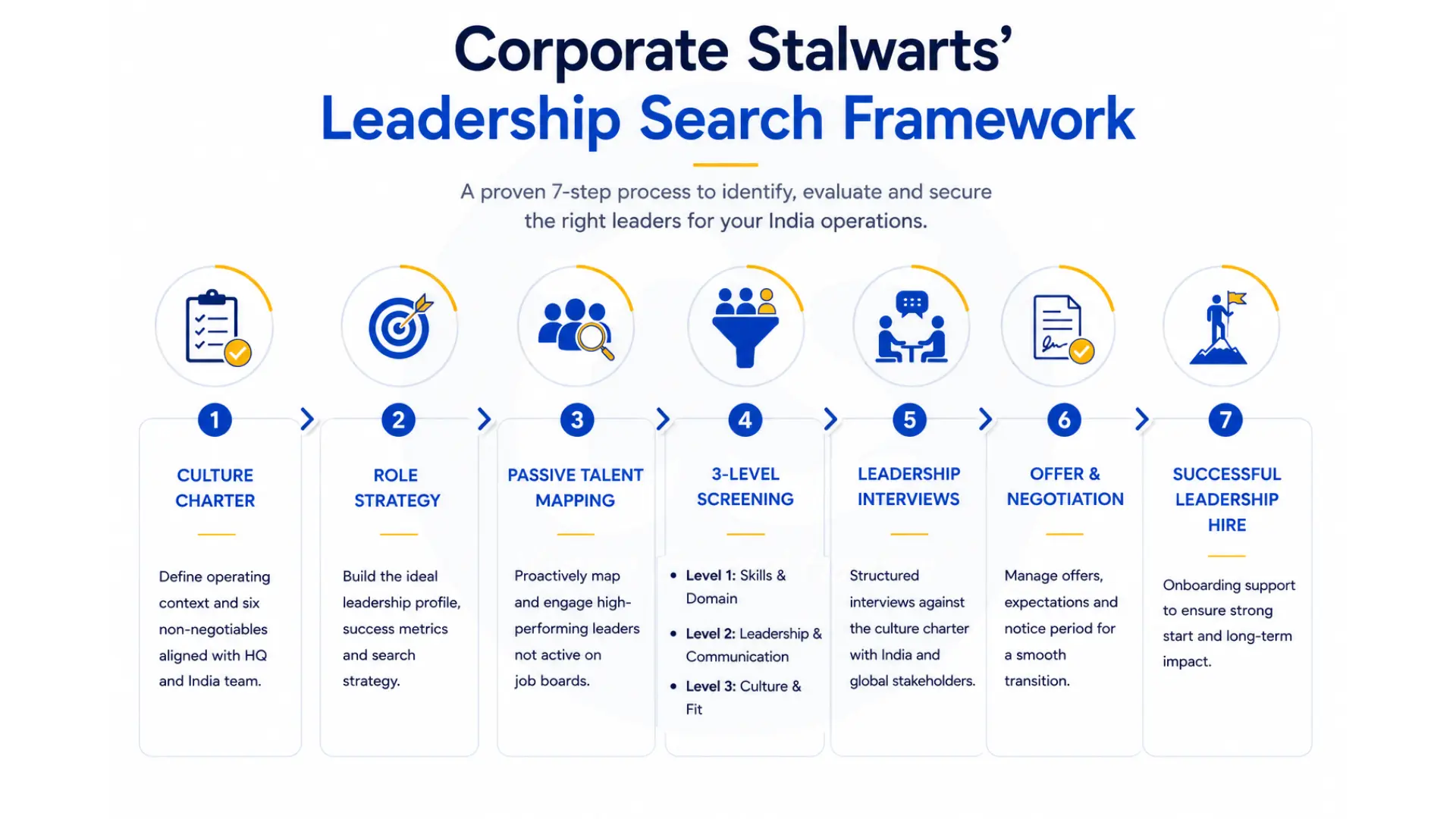
- Culture charter developed before any search begins — six dimensions, agreed by HQ and India team
- Three-level screening architecture built specifically for India leadership mandates
- Long-term clients, including Cargill, Yokohama, TVS Credit, Everest Masala, and HDFC — retained for 6 to 10+ years
- Shortlists delivered in 48 hours once the brief is locked
For location-specific GCC leadership searches, Executive Search Hyderabad and the broader GCC hiring agencies India pages cover CS’s active delivery across India’s major GCC hubs.
Real Case
We recently worked with a US-headquartered IT company. It scaled its India offshore development centre from under 10 professionals to over 100 in twelve months, across Gurgaon and Chandigarh, while shifting from a services model to a product model.
The leadership hire could not just manage headcount growth. It had to hold a Culture Charter conversation on decision authority and operating pace before the search began. Then we applied Three-Level Screening — functional, leadership, and cultural fit assessed separately — to find someone who could lead that transition, not just staff it.
If your GCC needs to own more than it was built for, the leadership question is worth asking before the next req goes out. Talk to our team about what your centre needs at the top.
Frequently Asked Questions
Cultural fit is assessed through structured conversations on decision-making authority, communication style, and operating pace, not just personality alignment. A Culture Charter approach makes these expectations explicit before hiring begins.

Corporate Stalwarts is a trusted recruitment firm with 20+ years of expertise in executive search and leadership hiring.
We’ve placed 10,000+ candidates across 600+ companies in FMCG, Manufacturing, IT, Pharma, and more. Our 1M+ candidate pool and 48-hour turnaround enable fast, high-quality hiring solutions.
We help businesses build high-performance teams with precision, speed, and industry expertise.


