


A leadership seat filled in three weeks feels like a win until the person leaves in month four. Most companies file that under “wasn’t the right fit” and restart the same process that produced the mismatch.
According to SHRM’s 2025 benchmarking data, executive cost-per-hire now runs nearly seven times higher than a standard hire, and that figure only covers the visible cost of the search itself.
QUICK ANSWER
Precision hiring filters candidates against a role’s decision authority, operating pace, and culture fit before they are presented, instead of presenting a wide slate and hoping one candidate works out. It slows the front end of a search deliberately, so the leadership team does not need rebuilding a year later.
Table of Contents
ToggleWhy do senior hires fail even after a strong interview process
A candidate can clear every interview round, handle the case study well, and still fail inside the role within a year. That is rarely an interviewing problem. It usually means the candidate was assessed against a job description rather than against how the business actually runs.
SHRM’s 2026 benchmarking brief found that only one in five organizations measure quality of hire in any structured way. Most companies find out a senior hire was wrong only once it shows up in missed targets or a resignation.
The interview cannot test what nobody defined
Panels score composure, articulation, and case-study logic well. What they rarely test is whether a candidate can operate at this company’s actual decision pace, or whether they will clash with how authority really moves here versus how the org chart says it should. If nobody has mapped that before the search opens, the interview is measuring the wrong thing accurately.
What is precision hiring and how is it different from volume recruitment
Volume hiring optimizes for pipeline size: more resumes, more interviews, more names to choose from. That works for high-turnover, lower-complexity roles where several candidates could plausibly do the job equally well.
Leadership roles do not work that way. Precision hiring starts before a resume is pulled, with three questions a job description rarely answers:
• Decision authority — what this person can approve without escalating
• Operating pace — how fast the business moves, and whether the candidate has worked at that speed
• Culture non-negotiables — the specific things that would sink an otherwise strong candidate here
Every candidate sourced afterward is filtered against those three answers, not a generic leadership checklist.
How much does a bad leadership hire cost a company
Founders usually price a mis-hire at the salary line, since that is the number finance can see. It is also the smallest part of the bill. The fuller cost includes the search itself, the underperformance before anyone intervenes, the team compensating for a leader who cannot deliver, and the second search that eventually follows.
SHRM data shows executive cost-per-hire climbing 21% since 2022, and that figure sits entirely before the hidden costs land. A wrong CTO hire, for instance, is not just a salary loss. It is every technical call made while still in the seat, and every senior engineer who left because of those calls.
The cost that never makes the board deck
Search fees and salary are easy to put on a slide. A strategy that stalled for two quarters because the wrong VP was running it rarely makes that slide, because nobody can cleanly attribute the loss. Precision hiring is priced against that second, harder-to-see cost.
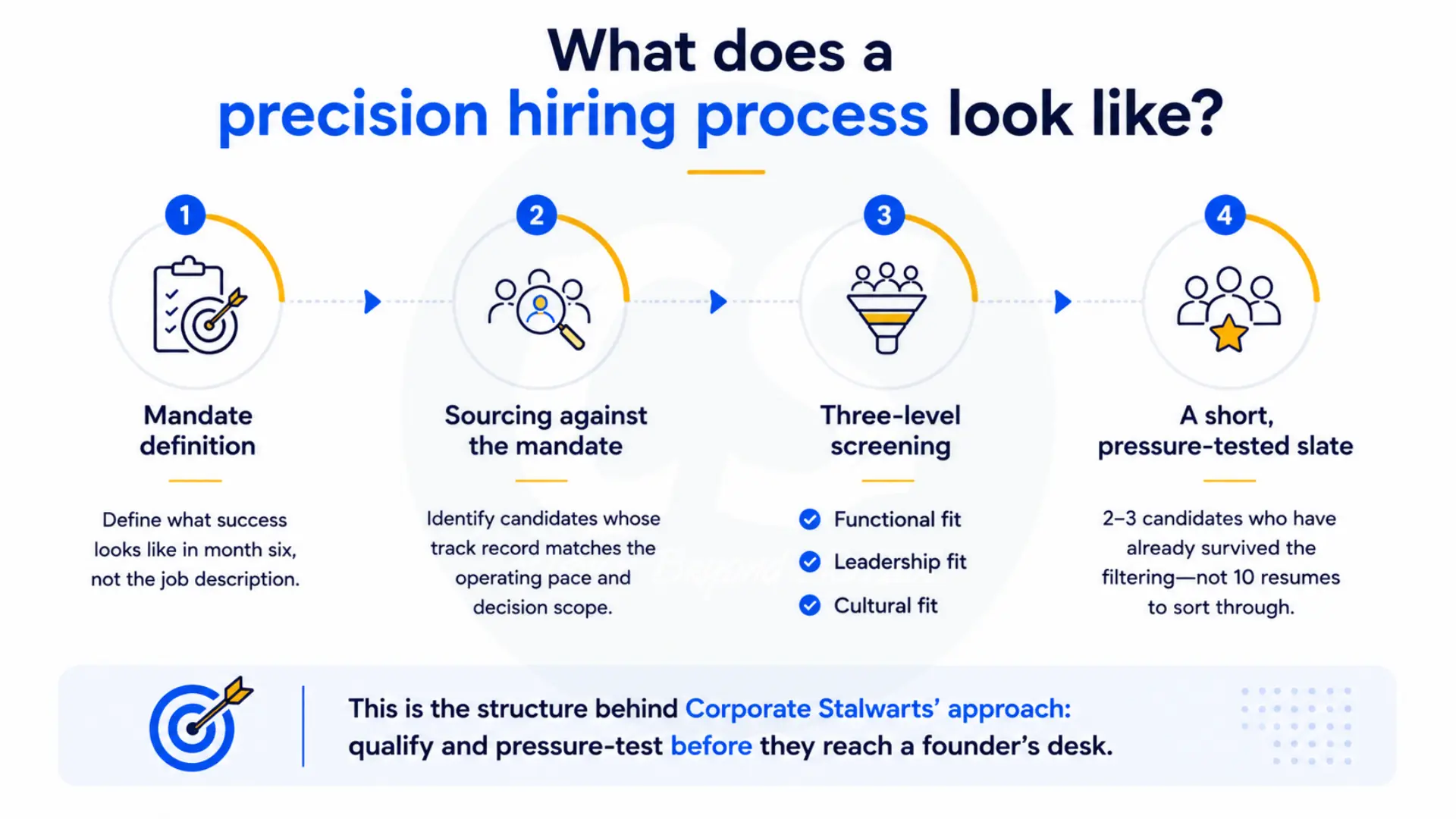
What does a precision hiring process look like
1) Mandatedefinition.Founder and search partner agree on what success looks like in month six, not the job description. Volume hiring typically skips this step.
2) Sourcing against the mandate.Candidates areidentified by whether their track record matches the operating pace and decision scope defined above, not by their last job title.
3) Three-level screening.Functional fit, leadership fit, and cultural fit. Most hiring processes stop after the first level.
4) A short, pressure-tested slate.Two or three candidates who have already survived that filtering, rather than tenresumes to sort through.
This is the structure behind Corporate Stalwarts’ approach: a search built to qualify and pressure-test candidates before they ever reach a founder’s desk, not a slate assembled to look complete.
Why does precision hiring matter more for fast-scaling companies
Growth pressure pushes leadership toward volume, because volume looks faster on a hiring dashboard. But a leadership team built through volume hiring tends to rebuild itself every twelve to eighteen months as mismatches surface, which costs more than a precision search would have from the start.
This also connects to why candidates not applying India becomes a pattern. A company that has run two volume searches in a year develops a reputation problem before it develops a hiring problem, and strong senior candidates start filtering themselves out early.
Where Corporate Stalwarts fits into a precision search
Corporate Stalwarts runs precision searches for founders and CHROs who need a leadership hire to work the first time. Three-Level Screening exists specifically to catch what a volume-based slate misses, and the Culture Charter framework maps decision authority, pace, and non-negotiables before sourcing begins, not after a candidate is already three interviews deep.
This is also what separates a search partner worth retaining from a vendor filling a requisition, covered further in leadership firm effectiveness.
If your last senior hire took months to close and even longer to feel right, a precision-first search changes both numbers.
Frequently Asked Questions
No. Fast-scaling companies benefit the most, since a mis-hire at leadership level slows growth faster in a smaller, leaner team than in a large one.
It determines whether a technically strong candidate can actually operate inside the business day to day, assessed alongside functional and leadership screening as a core filter, not an afterthought.

Corporate Stalwarts is a trusted recruitment firm with 20+ years of expertise in executive search and leadership hiring.
We’ve placed 10,000+ candidates across 600+ companies in FMCG, Manufacturing, IT, Pharma, and more. Our 1M+ candidate pool and 48-hour turnaround enable fast, high-quality hiring solutions.
We help businesses build high-performance teams with precision, speed, and industry expertise.