



Every company wants senior leaders. Almost nobody is fighting hard enough for the layer just below them. Mid-senior talent is where India’s real hiring war is happening, and tier-2 cities are quietly winning more of it than metros are. NASSCOM’s community research on GCC expansion projects a 30-40% rise in demand for tier-2 city talent over the coming years, driven directly by this gap.
QUICK ANSWER
Mid-senior talent, the 8-15 year experience band that runs execution without needing daily oversight, is scarcer in metros than headlines suggest. Tier-2 cities are winning this layer because the talent pool is deeper, retention is stronger, and the competition for the same candidates is thinner.
Table of Contents
ToggleWhy is mid-senior talent the hardest layer to hire right now
Entry-level hiring is well solved. Campus pipelines are strong and predictable. Leadership hiring, while difficult, is a visible problem companies actively budget for. The layer in between gets neither the pipeline nor the budget attention.
This is the group that translates strategy into execution: architects, principal engineers, senior domain leads, technical managers. They mentor juniors and operate independently across time zones and functions. Metro hiring pools for this band are saturated. Everyone is fishing from the same few thousand candidates in Bengaluru and Mumbai, which drives up cost without solving the actual scarcity.
The metro competition problem
A mid-senior candidate in a metro fields multiple offers in a matter of weeks. Retention drops as a result, since a competitor is always one message away. This isn’t a supply problem alone. It is a concentration problem, too many companies competing for the same visible pool in the same few cities.
Why do tier-2 cities have a structural advantage in mid-senior hiring
Tier-2 cities solve the concentration problem directly. The talent exists, it’s just less contested. Professionals in this experience band often studied at strong regional institutions and built careers at established employers in the same city, without ever entering the metro hiring race.
Retention compounds this advantage. Tier-2 mid-senior professionals relocate less often, since the cost-of-living gap and quality-of-life factors make staying put more attractive. A company that hires well in a tier-2 city keeps that hire longer than the same hire would stay in a metro market.
This is also where a precision hiring approach matters. A generic search in a tier-2 city misses the informal networks and regional institution ties that surface this talent. A mandate-first search built for the local market performs differently than a metro playbook run in a new city.
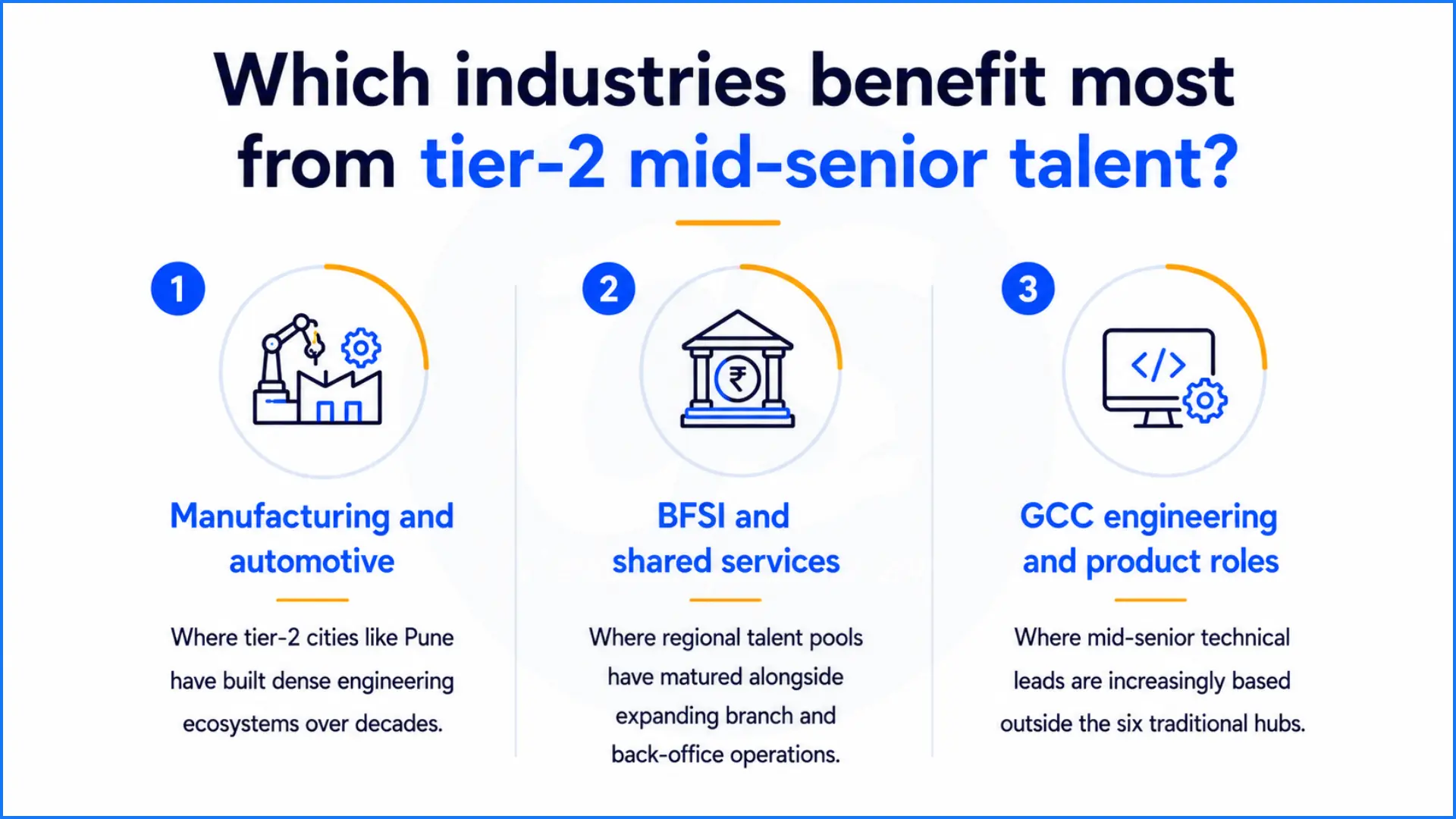
Which industries benefit most from tier-2 mid-senior talent
Not every function gains equally. The advantage is strongest where deep domain execution matters more than proximity to headquarters.
- Manufacturing and automotive, where tier-2 cities like Pune have built dense engineering ecosystems over decades
- BFSI and shared services, where regional talent pools have matured alongside expanding branch and back-office operations
- GCC engineering and product roles, where mid-senior technical leads are increasingly based outside the six traditional hubs
Companies expanding GCC operations into tier-2 India should read this alongside our breakdown of GCC talent strategy, which covers the sourcing side of this same shift in more depth.
How should companies approach mid-senior hiring in tier-2 cities
The biggest mistake is running a metro search process in a tier-2 city and expecting metro results. Boolean searches and LinkedIn-first sourcing under-return this talent, since mid-senior professionals in tier-2 markets are often less visible online than their metro peers.
What works instead is a search built around the specific city: regional institution networks, alumni ties, and referral chains inside the two or three anchor employers in that market. This also applies skills-based hiring principles at the mid-senior level, testing what a candidate has actually built rather than filtering by visible online presence alone.
Where Corporate Stalwarts fits into tier-2 mid-senior hiring
Corporate Stalwarts is a global executive search firm with 20+ years across CEO, CXO, and leadership hiring, and research-driven headhunting sits at the center of how mid-senior searches get run in tier-2 markets. The firm’s presence across Chandigarh, Jaipur, Pune, and other regional hubs, alongside Bangalore, Mumbai, Delhi, and Hyderabad, means sourcing is built around local networks rather than a single metro playbook applied everywhere.
For GCCs and expansion-stage companies weighing tier-2 city entry, mid-senior hiring is usually the layer that determines whether the site succeeds in year one or struggles to retain talent past it. Reviewing precision hiring as a starting framework helps before that search opens
Frequently Asked Questions
Often yes, but the bigger advantage is retention. A mid-senior hire in a tier-2 city typically stays longer than the same hire would in a saturated metro market.
Metro hiring relies heavily on LinkedIn-first sourcing. Tier-2 hiring depends more on regional institution networks, alumni ties, and referral chains inside local anchor employers.

Corporate Stalwarts is a trusted recruitment firm with 20+ years of expertise in executive search and leadership hiring.
We’ve placed 10,000+ candidates across 600+ companies in FMCG, Manufacturing, IT, Pharma, and more. Our 1M+ candidate pool and 48-hour turnaround enable fast, high-quality hiring solutions.
We help businesses build high-performance teams with precision, speed, and industry expertise.