


Every board is worried about AI talent. Most are worried about the wrong layer of it. The AI talent shortage is usually framed as an engineering problem. It is becoming a leadership problem faster. According to ManpowerGroup’s 2026 Global Talent Shortage Survey, AI skills have overtaken engineering and IT as the hardest capability to find globally, with 72% of employers reporting hiring difficulty.
QUICK ANSWER
The AI talent shortage will hit leadership hiring hardest by 2027, not through a lack of AI engineers, but through a lack of leaders who can govern AI decisions across a business. Companies will compete for a small pool of CXOs who understand both the technology and the operating context it needs to run inside.
Table of Contents
ToggleWhy is the AI talent shortage becoming a leadership hiring problem
Companies have spent two years hiring AI engineers. Fewer have hired anyone accountable for what those engineers build. That gap is starting to show at the top.
A technical AI hire reports to someone. That someone needs to decide where AI belongs in the business, where it doesn’t, and who is responsible when a model gets something wrong. Very few current CXOs were hired with that decision in mind. Most leadership teams are discovering this gap after AI adoption, not before it.
The shortage is shifting one level up
Engineering-level AI hiring is competitive but visible. Companies can see the gap and post against it. Leadership-level AI hiring is a quieter problem, because most job descriptions for CXO roles still don’t name AI governance as a core responsibility. The shortage shows up later, when a board asks who owns an AI decision and the honest answer is nobody clearly does.
What happens to leadership hiring if the shortage continues into 2027
If the current trajectory holds, 2027 leadership searches will compete for a narrower pool than 2026 searches do today. Two forces are converging.
First, the pool of leaders with real AI fluency is small and shrinking relative to demand, since most senior executives built their track record before AI was a board-level topic. Second, companies are starting to name this explicitly in leadership job descriptions, which means the search for a “regular” CXO and the search for an “AI-literate” CXO are becoming the same search. That collapses the available pool further.
Companies that wait until 2027 to define what AI fluency means for their leadership roles will be searching inside an even smaller pool than the one available today.
Which leadership roles are most exposed to the AI talent shortage
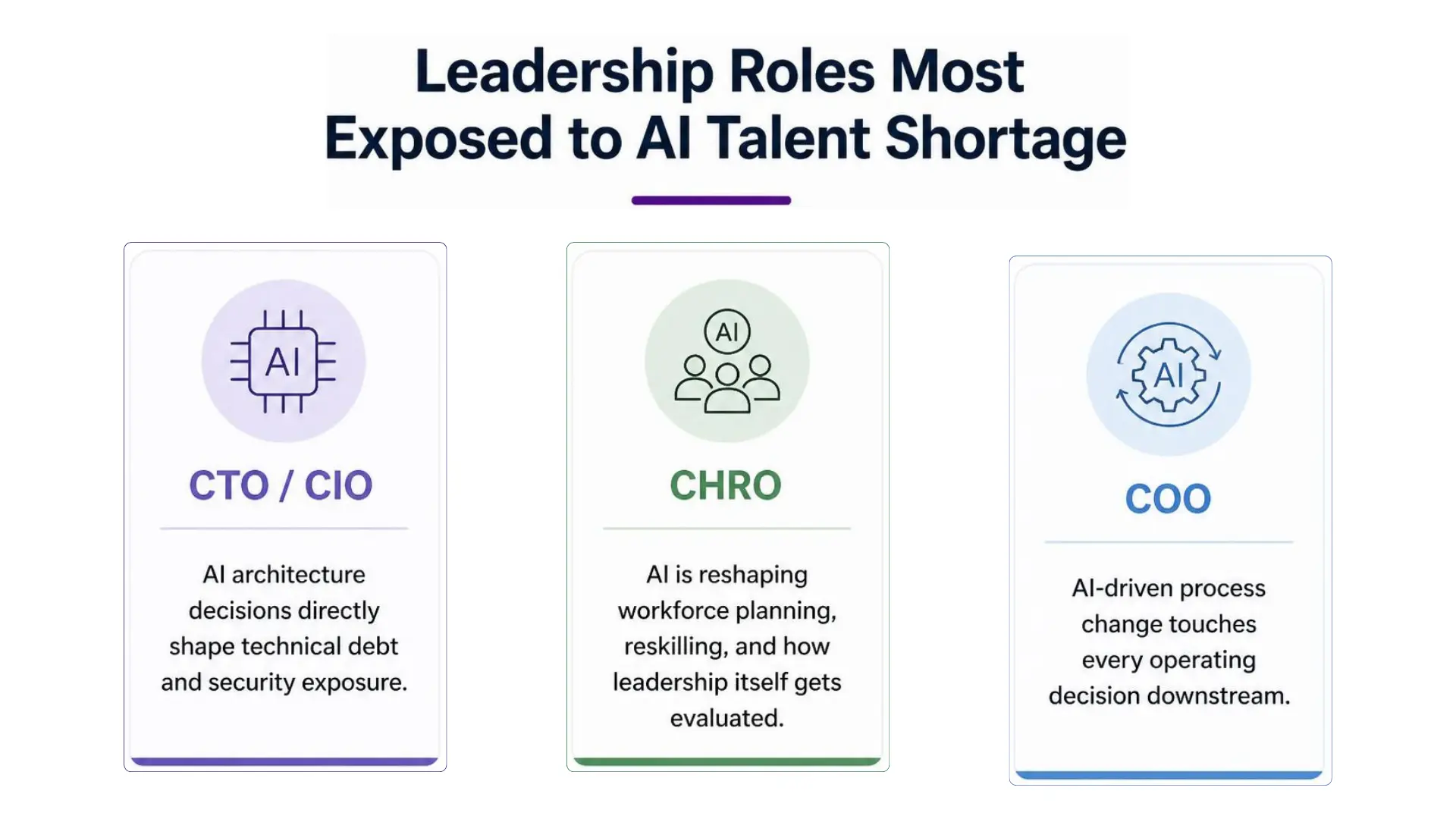
Not every CXO seat carries equal exposure. The roles most affected are the ones where AI decisions sit closest to the function:
- CTO and CIO roles, where AI architecture decisions directly shape technical debt and security exposure
- CHRO roles, where AI is reshaping workforce planning, reskilling, and how leadership itself gets evaluated
- COO roles, where AI-driven process change touches every operating decision downstream
A wrong CTO hire is expensive under normal conditions. Under AI-driven technical decisions, the cost compounds faster, because a wrong call doesn’t just affect one team, it affects every system built on top of that decision.
How should companies hire leadership talent during an AI skills shortage
The instinct is to widen the search and hope a strong AI-fluent candidate surfaces. That rarely works, because the pool this instinct is fishing from is exactly the one that’s shrinking. A precision hiring approach works better here, since it starts by defining what AI-related decisions this specific role will own, rather than searching broadly for “AI experience” as a generic label.
This also means applying skills-based hiring principles directly to AI fluency. Testing whether a candidate has made real AI-related decisions under pressure matters more than testing whether their resume mentions AI at all.
Where Corporate Stalwarts fits into AI-era leadership hiring
Corporate Stalwarts is a global executive search firm with 20+ years in CEO, CXO, and leadership hiring across technology, manufacturing, FMCG, pharma, healthcare, and automotive. Searches for AI-exposed leadership roles get built the same way as any other precision search: mandate first, then Three-Level Screening to test functional depth, leadership judgment, and cultural fit against that mandate.
For GCCs and international companies building out India leadership teams, this matters early. A leadership hire made without AI fluency in mind today becomes a costly gap to fix in 2027, once the pool has narrowed further. Companies already thinking this through can review precision hiring as the starting framework for their next search.
Frequently Asked Questions
Not for every role, but it is becoming standard for CTO, CIO, COO, and CHRO positions where AI decisions directly affect business outcomes.

Corporate Stalwarts is a trusted recruitment firm with 20+ years of expertise in executive search and leadership hiring.
We’ve placed 10,000+ candidates across 600+ companies in FMCG, Manufacturing, IT, Pharma, and more. Our 1M+ candidate pool and 48-hour turnaround enable fast, high-quality hiring solutions.
We help businesses build high-performance teams with precision, speed, and industry expertise.
