

A fabricated resume at the junior level costs a bad hire. A fabricated resume at the CXO level costs a strategy, a team, and a year. Executive hiring fraud risk has quietly become a board-level concern. It is no longer just a screening problem HR absorbs quietly.
Checkr’s 2026 Recruitment Realities report found that 49% of business leaders have already extended a job offer to a candidate who misrepresented qualifications using AI tools. Detecting AI-driven candidate fraud debuted as an entirely new top hiring challenge this year, one that didn’t exist three years ago.
QUICK ANSWER
AI hiring fraud changes at the leadership level because the stakes and the detection window are both different. A junior mis-hire is caught and corrected in weeks. A senior mis-hire, built on fabricated or AI-inflated credentials, can run undetected for months. In that time, it quietly shapes strategy, budget, and team decisions.
Table of Contents
ToggleWhy is AI hiring fraud a leadership problem
Most coverage of AI hiring fraud focuses on volume. The flood of AI-generated resumes clogging entry-level pipelines gets the headlines. That framing misses where the real damage sits. Robert Half’s 2026 hiring research found that 65% of hiring managers report AI-generated applications have made hiring harder. 58% say finding genuinely skilled professionals is tougher than a year ago.
At the leadership level, this isn’t a volume problem. Executive candidates rarely apply in bulk. The risk here is depth, not breadth. It takes just one polished, AI-assisted narrative to survive an interview process built to catch inconsistency, not fabrication at this level.
Why senior fraud is harder to catch than junior fraud
A junior candidate who fabricates a skill gets caught in the first week of actual work. A senior candidate who fabricates strategic experience can talk convincingly about decisions they never made. That performance can hold for months, until the gap shows up in results. By then, the cost isn’t a bad hire. It’s a bad quarter, and a leadership team unwinding decisions built on a false track record.
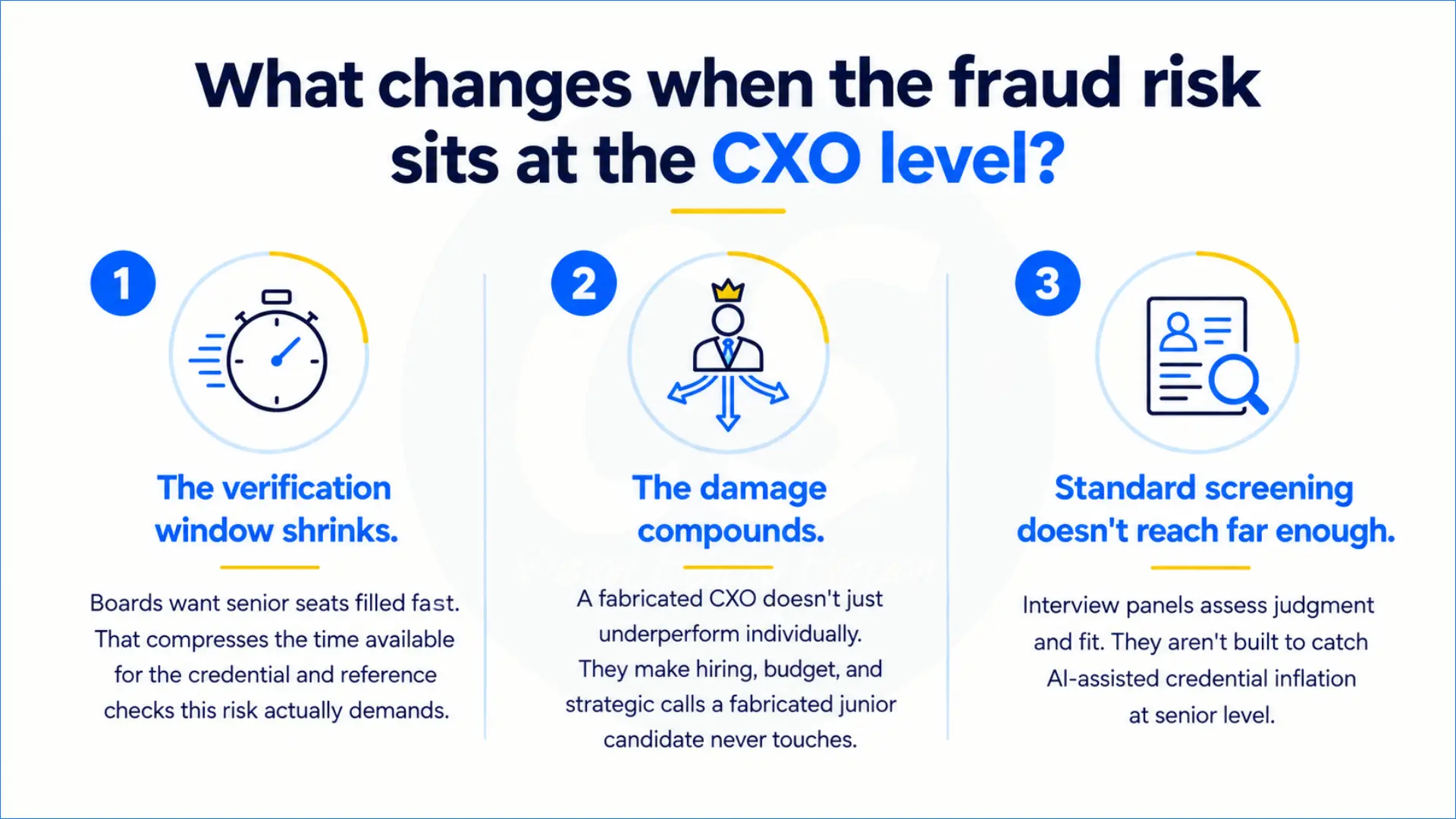
What changes when the fraud risk sits at the CXO level
Three things shift once the candidate is a leadership hire, not an individual contributor.
- The verification window shrinks. Boards want senior seats filled fast. That compresses the time available for the credential and reference checks this risk actually demands.
- The damage compounds. A fabricated CXO doesn’t just underperform individually. They make hiring, budget, and strategic calls a fabricated junior candidate never touches.
- Standard screening doesn’t reach far enough. Interview panels assess judgment and fit. They aren’t built to catch AI-assisted credential inflation at senior level.
This is exactly where the cost of a wrong CTO hire compounds fastest. It isn’t just a salary loss. It’s every technical decision built on a foundation that was never real.
How do you verify a senior candidate when resumes can’t be trusted
Resume screening was already a weak signal for leadership hiring before AI. It is close to unusable now. What holds up instead is structured, decision-based candidate verification. A candidate walks through specific calls they made in a specific role. Those answers get cross-checked against references who were in the room.
This is the same logic behind skills-based hiring, applied to a newer problem. Test what a candidate can demonstrate under pressure, not what their materials claim. That filters out fabrication in a way a polished resume never will. Job platforms give you raw ingredients, a shelf of names you can see. A structured search sources, qualifies, pressure-tests, and brings you the final dish, not a slate assembled on trust.
Why are companies turning to executive search partners over internal screening
Robert Half’s data shows 67% of employers are now more likely to seek support from a staffing or search firm to navigate AI-related hiring risk. 89% report those partners have been effective at it. Internal teams are already stretched thin managing volume. Depth-level candidate verification at the leadership tier needs a process built for it, not an add-on to an overloaded hiring cycle.
This is where a precision hiring approach earns its cost back. A search built around a defined mandate closes the exact gap AI-assisted fraud is built to exploit, with structured reference and decision verification at every stage.
Where Corporate Stalwarts fits into leadership hiring risk
Corporate Stalwarts is a global executive search firm with 20+ years running CEO, CXO, and leadership searches across technology, manufacturing, FMCG, pharma, healthcare, and automotive.
Our approach uses AI-powered screening where it earns its place, surfacing patterns and flagging inconsistencies faster than a manual review could. Every senior candidate is still verified by a human who has run this search before. AI narrows the field. Judgment decides who’s real.
Three-Level Screening exists to catch exactly this kind of risk. It tests functional depth, leadership judgment under real scenarios, and cultural fit. When we rebuilt a hiring process for a US IT company scaling from under 10 to 100+ professionals across Gurgaon and Chandigarh, this same structure separated candidates who could operate at that pace from those who only sounded like they could.
For founders and CHROs weighing whether to run a senior search internally or bring in a partner, this is the deciding factor. If your last leadership hire was verified only against a resume and a reference call, the risk is already live in your current team. Talk to Corporate Stalwarts before your next CXO search opens.
Frequently Asked Questions
Search partners bring dedicated candidate verification processes and market knowledge. Stretched internal HR teams often lack the time to build this, especially for senior hires.
Through structured reference checks tied to specific decisions a candidate made, cross-verified with people who were present. AI assists the screening, but judgment always makes the final call.

Corporate Stalwarts is a trusted recruitment firm with 20+ years of expertise in executive search and leadership hiring.
We’ve placed 10,000+ candidates across 600+ companies in FMCG, Manufacturing, IT, Pharma, and more. Our 1M+ candidate pool and 48-hour turnaround enable fast, high-quality hiring solutions.
We help businesses build high-performance teams with precision, speed, and industry expertise.