

Loading...

Why Companies Struggle to Find the Right Talent in India: 7 Recruitment Challenges Explained

Recruitment challenges in India tend to look the same from the inside. A role stays open for three months, the shortlist is thin, and the best candidate takes another offer....
Why Companies Struggle to Find the Right Talent in India: 7 Recruitment Challenges Explained

Recruitment challenges in India tend to look the same from the inside. A role stays open for three months, the shortlist is thin, and the best candidate takes another offer. The search then restarts at full cost.

ManpowerGroup’s 2026 survey found that 82% of employers in India struggle to find the skilled talent they need, against a global average of 72%. The cause is rarely one thing. Several problems stack up, and only some sit within your control.

QUICK ANSWER 

Hiring in India stalls for seven main reasons. Four are structural, meaning the market creates them: talent supply, skill gaps, location, and pay movement. Three are process failures your team can fix: slow decisions, candidate dropouts, and unrealistic job specifications. Knowing which is which decides where to spend your effort.

Why is it so hard to hire the right talent in India right now

The pressure is not even across industries. Automotive employers report the most difficulty at 94%. Finance and insurance sits at 85%, and tech and IT services at 84%.

A shortage figure alone does not help you plan, because it hides two different problems. Structural problems come from the market, and no process change removes them. Process failures come from how a company hires, and those are fixable. The seven challenges below fall into one group or the other.

Which recruitment challenges in India are structural

Demand and supply mismatch

Demand for experienced professionals grows faster than the pool of people who have done the job at the required scale. Many companies chase the same small group of candidates, especially for senior and specialist roles. No sourcing method creates people who do not exist yet. It can only reach the ones who do.

Skill shortages in new areas 

AI skills now rank as the hardest to find, according to the same ManpowerGroup survey. Skills move faster than careers do. A candidate with five years in a new field is rare, and a leader with ten is rarer. Companies either hire for adjacent experience and build the rest, or pay a premium for the few who have it.

Location and talent concentration

Senior talent clusters in a handful of cities, and those markets are crowded. Smaller cities offer less competition but fewer people, and relocation is a hard ask. NASSCOM’s community research on GCCs in tier-2 cities shows how global capability centres now spread beyond the big hubs. Each new centre adds another employer to the same regional pool. For more on this, see our guide to GCC talent strategy India.

Compensation gaps

Pay bands drift behind the market faster than approval cycles move. A band set twelve months ago can miss the market by the time a search opens. The market sets the price. Still, how often you check the band is your decision.

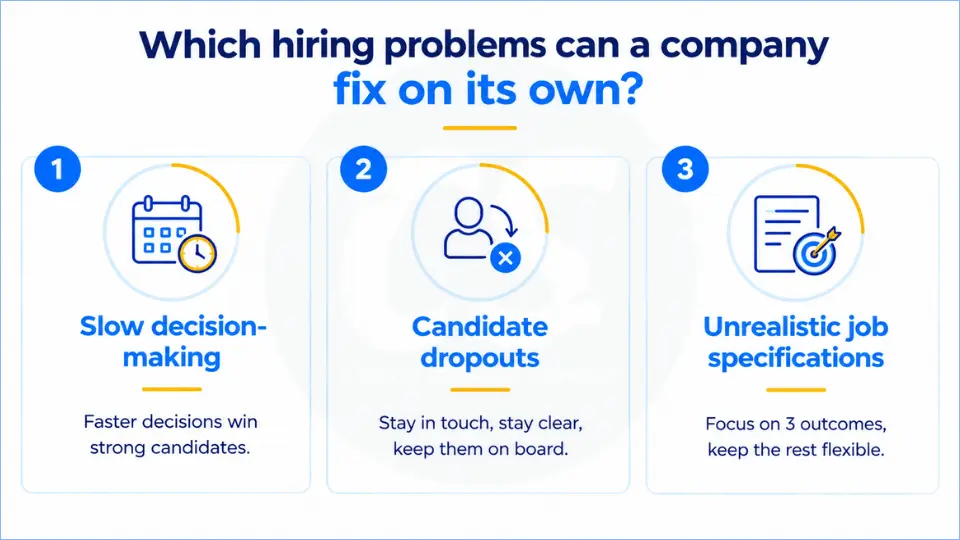
Which hiring problems can a company fix on its own

Slow decision-making 

Strong candidates run several processes at once. A panel that takes two weeks to schedule a final round loses to a company that decides in three days. Slow decisions rarely look like a problem inside the company, because each step feels reasonable. Together, they cost you candidates. Agree on who decides, and by when, before the search starts.

Candidate dropouts

Notice periods in India often run from one to three months for experienced hires. In that gap, counteroffers and competing offers arrive. Regular contact between acceptance and joining lowers the risk. So does clarity about the role during interviews, so the offer holds no surprises.

Unrealistic job specifications 

Some specifications ask for a profile that does not exist: ten years in a field that is five years old, plus domain depth, scale, and leadership. The search then looks like a talent shortage when it is a brief problem. Our piece on senior hiring challenges India covers how this plays out. Inflated briefs also explain candidates not applying India at all. Write the brief around the three outcomes the role must deliver, and treat the rest as flexible.
Which hiring problems can a company fix on its own - Corporate Stalwarts - Global Executive Search Firm (2)

How can you tell a structural problem from a process failure

Run one test on your last stalled search. Ask whether a better process would have changed the outcome. If yes, the problem is yours to fix. If no, it sits in the market, and the answer is wider reach, not faster steps.

Use this hiring bottleneck checklist as a rule of thumb:

  • Did the job brief list more than five must-have requirements?
  • Was pay checked against the market in the last six months?
  • Did the final decision take more than a week after the last interview?
  • Did anyone stay in touch with the candidate between offer and joining?
  • Did fewer than five qualified candidates reach the first interview?
  • Did the same few sources supply every candidate?

A yes to any of the first four points to a process failure. A yes to the last two points to a reach problem, which is where outside support helps.

When does external recruitment support make sense

Not every stalled search needs outside help. If the problem is a slow panel or a vague brief, a partner will not fix it faster than you can. External recruitment support helps when the issue is reach. Your network may be exhausted, your team may be stretched, or the role may need candidates who are not looking.

In those cases, a partner extends sourcing into talent your team cannot see on its own. The internal team keeps the decision.

Where Corporate Stalwarts fits into hiring in India

Corporate Stalwarts is a global executive search firm with 20+ years in CEO, CXO, and leadership hiring across technology, manufacturing, FMCG, pharma, healthcare, and automotive. Companies use us as an external recruitment partner. Some also use us as an HR outsourcing partner, where they want more of the workload taken on.

We work as a helping hand to your internal HR team. We use AI to speed up mapping and screening, and experienced people make every final call. Your team receives pre-screened candidates through our Three-Level Screening process: functional, leadership, and cultural. That leaves your leadership free to focus on the business.

Here is one example. A US IT company needed its offshore development centre in India to grow from under 10 to 100+ professionals in 12 months, across Gurgaon and Chandigarh, while moving from services to product. We rebuilt the hiring process around a Culture Charter and Three-Level Screening.

If your last stalled search answered yes to the reach questions in the checklist above, we are glad to talk through where support would help most.

Frequently Asked Questions
Demand for experienced and AI-skilled professionals is outpacing supply. ManpowerGroup's 2026 survey puts the share of Indian employers reporting difficulty at 82%. Slow processes and unrealistic briefs make the gap feel larger than it is.
Four come from the market: talent supply, skill shortages, location concentration, and pay movement. Three come from process: slow decisions, candidate dropouts, and unrealistic job specifications.
Stay in regular contact between acceptance and joining, since notice periods give competing offers time to arrive. Keep the role description consistent from interview to offer. Plan for counteroffers before they happen.
Some of the delay is structural, because senior talent is scarce and notice periods run long. The rest comes from slow panels, unclear decision rights, and briefs that keep changing. The second group is the one you can fix.

Both. Supply, skills, location, and pay trends are market conditions you work around. Decision speed, offer follow-up, and job briefs are internal habits you can change.

When the problem is reach rather than process. That means your network is exhausted, your team is stretched across too many roles, or the role needs candidates who are not actively looking.

Share this article

Related Articles

Browse the latest hiring insights

Why More Companies Are Turning to Executive Search Partners in 2027
Hiring plans are growing faster than the teams running them. Robert Half’s 2026 hiring research found that 66% of leaders planned to add full-time headcount in the second half of...
Why AI Hiring Fraud is a Different Risk at the Leadership Level
A fabricated resume at the junior level costs a bad hire. A fabricated resume at the CXO level costs a strategy, a team, and a year. Executive hiring fraud risk...
Why Mid-Senior Talent Wins in Tier-2 Cities
Every company wants senior leaders. Almost nobody is fighting hard enough for the layer just below them. Mid-senior talent is where India’s real hiring war is happening, and tier-2 cities...
How AI Talent Shortage Will Hit Leadership Hiring by 2027
Every board is worried about AI talent. Most are worried about the wrong layer of it. The AI talent shortage is usually framed as an engineering problem. It is becoming...