


Loading...

Why More Companies Are Turning to Executive Search Partners in 2027

Leadership hiring used to be something companies handled internally, with a search partner brought in only for the hardest seats. That line is moving. Robert Half’s research points to continued...
15/09/2026
Why More Companies Are Turning to Executive Search Partners in 2027

Leadership hiring used to be something companies handled internally, with a search partner brought in only for the hardest seats. That line is moving. Robert Half’s research points to continued headcount growth heading into 2027, with more companies planning to add both permanent and contract leadership talent.

At the same time, internal teams are running out of capacity to hire well at that pace. That combination is why executive search partner demand keeps climbing, not shrinking.

QUICK ANSWER 

Companies are turning to executive search partners in 2027 because internal teams can’t scale leadership hiring at the same pace headcount plans are growing. A search partner adds capacity and specialized screening exactly where internal recruiting is stretched thinnest, at the senior and leadership level.

Why are internal teams struggling to keep up with leadership hiring

Growth plans and hiring capacity are moving in opposite directions. Headcount targets are rising. Internal recruiting bandwidth is not rising with them. Most in-house teams are built for steady-state hiring, not a sudden jump in senior roles that all need to close well, not just fast.

Leadership roles also take more internal time per hire than any other level. Reference checks run deeper. Interview panels involve more senior stakeholders. Screening requires judging fit, not just skill. When headcount plans grow faster than internal capacity, leadership hiring is the first place quality starts to slip.

The gap shows up first at the senior level

Junior roles can absorb some strain. A slower junior hire delays a project. A slower or weaker leadership hire delays a strategy. That’s why the pressure on internal teams tends to surface here first, even when the headcount growth is spread across every level.

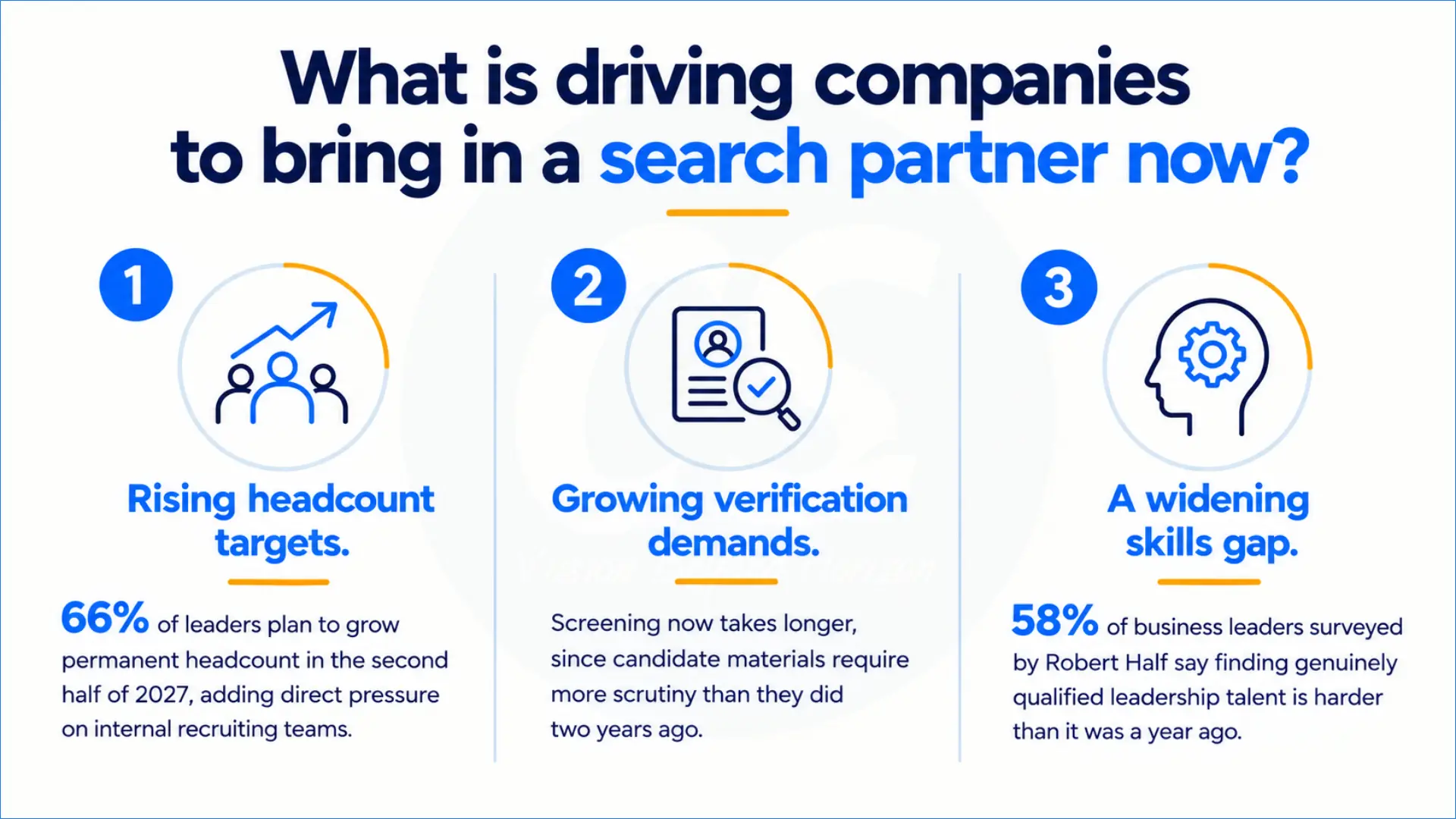
What is driving companies to bring in a search partner now

Three forces are converging in 2027, and none of them are new on their own. Together, they’re pushing more companies toward outside help.

  • Rising headcount targets. 66% of leaders plan to grow permanent headcount in the second half of 2027, adding direct pressure on internal recruiting teams.
  • Growing verification demands. Screening now takes longer, since candidate materials require more scrutiny than they did two years ago.
  • A widening skills gap. Finding genuinely qualified leadership talent is harder than it was a year ago, according to 58% of business leaders surveyed by Robert Half.

Internal teams can usually absorb one of these pressures. Absorbing all three at once is where most in-house leadership searches start to slow down or settle for a weaker candidate.
What is driving companies to bring in a search partner now - Corporate Stalwarts - Global Executive Search Firm

How does an executive search partner change hiring outcomes

A search partner doesn’t just add headcount to the hiring process. It adds a structure built specifically for leadership roles, which internal recruiting rarely has time to run properly under pressure. Robert Half’s data backs this up directly: 67% of employers say they’re now more likely to seek support from a search or staffing firm to navigate hiring challenges, and 89% report those partners have been effective at it.

This is closer to how precision hiring works than general staffing support. A defined mandate, structured screening, and a pressure-tested shortlist take the pressure off an internal team that’s already stretched. It also closes gaps a stretched internal process tends to miss, the kind covered in our breakdown of AI hiring fraud risk at the leadership level

When should a company bring in an executive search partner

Not every leadership hire needs outside support. The signal is usually one of three things: the role has been open longer than expected, the last search produced candidates who looked right but weren’t, or internal recruiting is already stretched across too many open roles to give a senior search the attention it needs.

Waiting until a search has failed once is the most expensive way to reach this decision. A wrong CTO hire costs far more than the search that would have prevented it.

Where Corporate Stalwarts fits into 2027 leadership hiring

Corporate Stalwarts is a global executive search firm with 20+ years running CEO, CXO, and leadership searches across technology, manufacturing, FMCG, pharma, healthcare, and automotive. We work as an extension of internal teams, not a replacement for them, taking on the leadership seats that need deeper screening and a mandate-first process, while internal recruiting keeps running everything else.

Three-Level Screening exists for exactly this moment, when headcount is growing faster than internal capacity can safely absorb. If your team is stretched across too many open leadership roles this year, that’s the point to bring in a search partner, not after the wrong hire has already cost you a quarter.

Frequently Asked Questions

Rising headcount targets are outpacing internal recruiting capacity, especially for leadership roles that require deeper screening than junior positions.
A search partner brings a structured, mandate-first process built specifically for leadership hiring, which internal teams often lack the time to run under pressure.
When a role has stayed open longer than expected, a past search produced weak fits, or internal recruiting is stretched across too many open senior roles at once.
Most focus on senior and leadership roles specifically, where the cost of a mismatch is highest and internal screening capacity is thinnest.

Robert Half's 2027 research found 67% of employers are more likely to seek support from a search or staffing firm, with 89% reporting the partnership was effective.

No. It typically speeds up time to a right fit, since a structured search process avoids the delays caused by a failed internal search and a second attempt.

Share this article

Related Articles

Browse the latest hiring insights

Why Mid-Senior Talent Wins in Tier-2 Cities
Every company wants senior leaders. Almost nobody is fighting hard enough for the layer just below them. Mid-senior talent is where India’s real hiring war is happening, and tier-2 cities...
How AI Talent Shortage Will Hit Leadership Hiring by 2027
Every board is worried about AI talent. Most are worried about the wrong layer of it. The AI talent shortage is usually framed as an engineering problem. It is becoming...
Why Skills-Based Hiring Will Shape Future CXO Decisions
A CXO with the right pedigree can still fail at the one thing the role actually demands. Skills-based hiring exists because boards kept discovering this the expensive way, after the...
Why Precision Hiring Beats Volume in Senior Roles
A leadership seat filled in three weeks feels like a win until the person leaves in month four. Most companies file that under “wasn’t the right fit” and restart the same...